Eunpyeong-gu, Eco-friendly Pest Control Drastically Reduces Bongsan Walkingstick Insect Population by Half
Walkingstick Insect Population Decreased by 52% Compared to Previous Year After Eco-friendly Pest Control
Selected as a Model Case for Forest Pest Control by Korea Forest Service Last Year
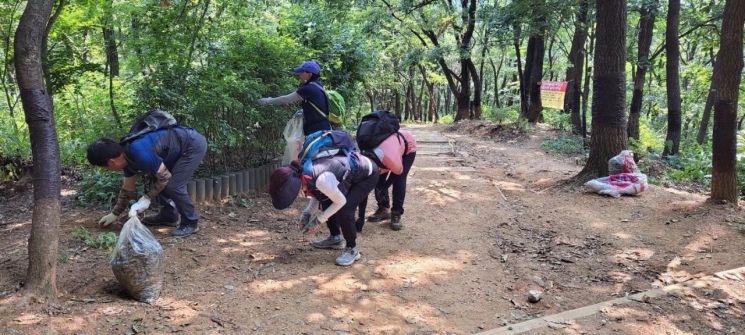
Eunpyeong-gu (Mayor Kim Mi-kyung) announced that the population of walkingstick insects in the Bongsan area, where intensive eco-friendly pest control activities were conducted, decreased by 52% compared to the same month last year.
Classified as pests, walkingstick insects appeared in swarms around Bongsan in 2020, causing inconvenience to residents. These insects emerge once a year, hatching between March and April, and adults can survive until November.
After the outbreak, the district has focused on eco-friendly pest control activities in the Bongsan area that do not destroy the forest ecosystem while controlling the walkingstick insects.
As a result, it was selected as a model case for forest pest control by the Korea Forest Service last year.
‘Eco-friendly pest control’ refers to methods that do not rely on chemical pesticides but involve capturing insects directly or managing fallen leaves that serve as egg hatching and overwintering sites.
This year, before the walkingstick insect eggs began hatching in earnest, the district formed a forest pest monitoring and control team of about 20 members to prepare for pest control. In March and April, when the insects were in the early nymph stage, eco-friendly pest control was carried out using sticky roll traps. From last month to this month, during the mid-nymph stage, the district collaborated with a tree hospital to enhance the professionalism of pest control activities. Even after July, when the insects reach adulthood, the plan is to capture walkingstick insects directly with local residents instead of spraying pesticides.
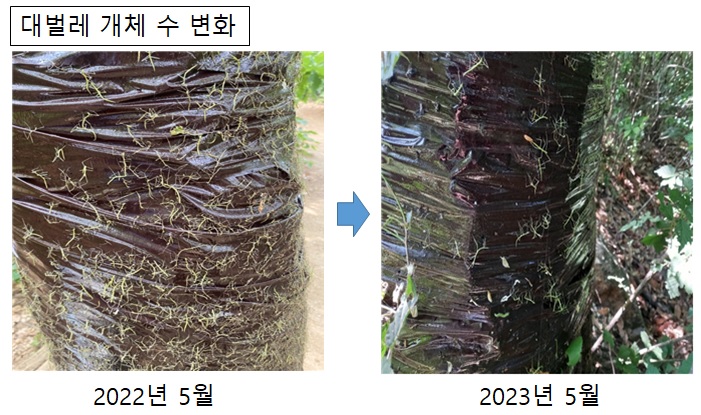
In the third week of April, when walkingstick insects typically emerge, the district conducted on-site monitoring with the Korea Forestry Promotion Institute around Bongsan Sunrise Park. Observing the hatching period and population density, they achieved a result of approximately 52% reduction in walkingstick insect population compared to the same month last year.
Although the low temperatures last winter had some effect, the sharp decline in walkingstick insect population is believed to be due to Eunpyeong-gu’s proactive eco-friendly pest control activities that consider the forest ecosystem since the 2020 outbreak.
Going forward, the district plans to create small-scale ‘biotopes’ (shared habitats for diverse species) along the Bongsan walking trails to support the habitat of natural predators of walkingstick insects, such as damselflies. This ecological pest control is expected to provide a nature-friendly learning environment for children using Bongsan as well. Additionally, the district will produce its own guideline manual to systematize eco-friendly pest control methods and use it as a model for future sudden pest outbreaks.
Moreover, the district has completely banned the use of neonicotinoid pesticides to protect healthy ecosystems and honeybees.
Kim Mi-kyung, Mayor of Eunpyeong-gu, stated, “We are striving to maintain ecosystem health through eco-friendly pest control, moving away from pesticide-centered methods. To prevent sudden pest outbreaks that increase due to climate change, we will continue to actively practice carbon neutrality alongside eco-friendly pest control.”
© The Asia Business Daily(www.asiae.co.kr). All rights reserved.
![Clutching a Stolen Dior Bag, Saying "I Hate Being Poor but Real"... The Grotesque Con of a "Human Knockoff" [Slate]](https://cwcontent.asiae.co.kr/asiaresize/183/2026021902243444107_1771435474.jpg)

















