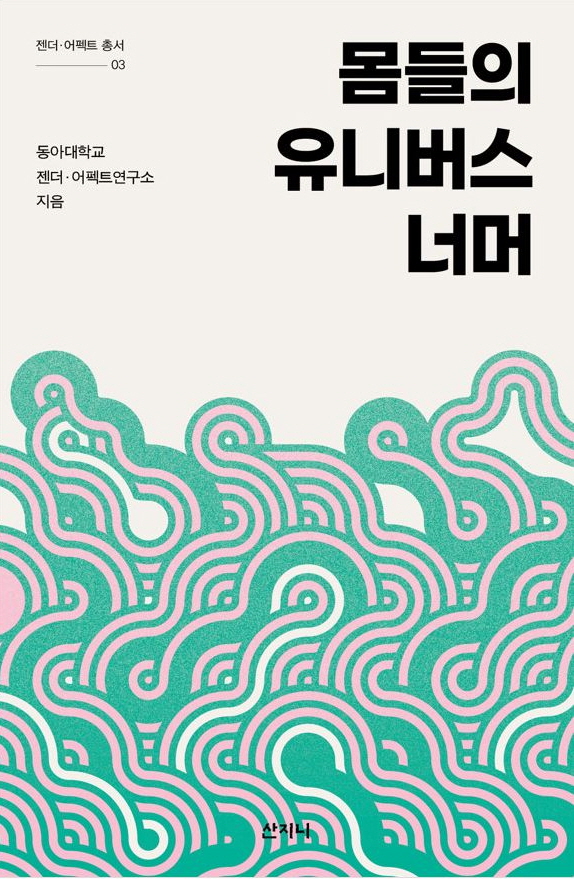
The Gender·Affect Research Institute at Dong-A University recently published the third volume of the Connected Body Theory and Gender·Affect Research Series, titled Beyond the Universe of Bodies (published by Sanjini Publishing).
Established under the leadership of Professor Kwon Myung-ah from the Department of Korean Language and Literature, the Dong-A University Gender·Affect Research Institute explores social and cultural agendas related to individuals and communities in modern society through the themes of "connection" and "dependency."
Additionally, by combining research methods of affect (情動, affact) and gender, the institute attempts a paradigm shift in the humanities concerning subjects such as the self and the body, life and death, illness, disability, minorities, and posthumanism, with researchers and activists from various fields participating as researchers and advisors.
Following the series volumes Promise and Prediction (Volume 1) and The History of (Im)Possible Connected Bodies (Volume 2), this book contains 12 research papers focusing on encounters and interactions such as "continuum," "assemblage," and "congregate" occurring beyond the universe of bodies.
The book explores bodies that continuously encounter, interact, and transform according to historical and geographical contexts under the theme that "the issues of bodies, which inevitably exist in the plural, are not individual problems but social and historical ones, thus requiring an investigation into the power dynamics of that society and history."
The first part, subtitled The History of Narratives and Assemblage: The Affect of Encounters, includes Director Kwon Myung-ah’s The Squid Game Affect, the Ethics of Encounter, and the Ethology of Connectivity, Researcher Kwon Doo-hyun’s The SF Ethology of the Indoor Universe, and Professor Kang Sung-sook of Inje University’s The Newborn Seo Bal Seen through the Ethology of Connectivity.
In her writing, Director Kwon cites Squid Game as a case study to examine the formation of transnational anti-feminist backlash flows, cultural capital, and the multidimensional relationships of transnational platforms.
The second part, Ears, Eyes, and Blood: Bodily Connectivity and Affect Beyond the Whole and the Part, features Research Professor Lee Hwa-jin of Yonsei University’s In Search of Deaf Cinema, Professor So Hyun-sook of Dong-A University’s War Imprinted on the Body, and Lecturer Kim Yi-jin of Dong-A University’s Representations of Family Searching by Overseas Adoptees, among others.
Professor So presents the civilian casualties and healing processes during the Korean War by examining oral histories of the No Gun Ri incident victims, revealing postwar lives where war, disability, and gender intersect.
Professor Naito Chizuko of Otsuma University in Japan’s Idols and the Affect of War, Lecturer Kim Eun-jin of Pusan National University’s Narratives and Representations of Women’s Sports in Media, and Professor Chen Pei-jen of National Chengchi University in Taiwan’s Emotional Mobilization during the Cold War are grouped in the third part, The Affect of Fighting: Women Interacting in War, the Cold War, and Sports.
The fourth part, Active as Passive, Passive as Active: Embodiment and Affect, consists of Professor Choi Yi-sook of Dong-A University’s Why Did They Wake Up at Dawn in the Pandemic Era?, Professor Park Eon-ju of Dong-A University’s An Essay on Debt and Obligation in the Context of Domestic Violence, and Lecturer Lee So-young of KAIST’s Feminism Even When It Is Not Called Feminism.
© The Asia Business Daily(www.asiae.co.kr). All rights reserved.
![Clutching a Stolen Dior Bag, Saying "I Hate Being Poor but Real"... The Grotesque Con of a "Human Knockoff" [Slate]](https://cwcontent.asiae.co.kr/asiaresize/183/2026021902243444107_1771435474.jpg)
















