Formed Along Roads in the 1950s for 'Urban Aesthetics'
"Didn't Know" "Interesting" Curiosity Among 20s and 30s Generations
Known as 'Hipjiro,' Euljiro in Jung-gu, Seoul, which is popular among the MZ generation, is lined with retro-style restaurants and cafes. Many coffee shops can only be reached by climbing narrow stairs barely wide enough for one person, and there are also many restaurants without any signboards at all. Finding hidden eateries and charming spaces tucked between the closely packed buildings has become a kind of pastime among people in their 20s and 30s.
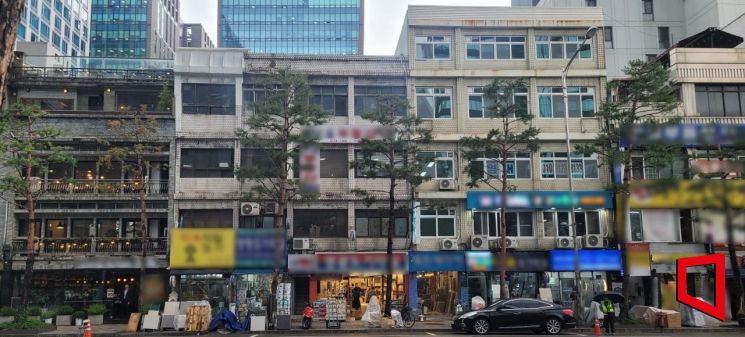 Buildings facing each other in the Euljiro area. They are packed closely together, leaving no gaps between the buildings. Photo by Han Seung-gon
However, there is an interesting fact here. Some buildings in Euljiro have no gaps between them. Although the heights and widths of the buildings differ, they are attached tightly like twins. These are so-called 'party wall buildings.' Party wall construction refers to buildings constructed under a system that allows two buildings to share a common wall when agreed upon by the building and landowners, in commercial zones or residential areas designated by urban design or building ordinances.
Such buildings do not apply sunlight rights restrictions or the minimum 50cm setback distance from the property boundary line as stipulated by civil law. By building this way, the setback distance between adjacent lots is reduced, allowing the building area to be maximized. For example, when developing multi-family housing with party wall construction, the 1m setback distance between two buildings can be excluded on both sides, securing up to 2m of additional space.
Near the entrance of Euljiro 3-ga Station, there are many party wall buildings so tightly connected that it is hard to tell where one boundary ends and another begins. Choi Young-ah (25), an office worker met near the station, said, "I usually just pass by, but after hearing about party wall construction, I noticed how all the buildings are attached, which is fascinating." Another office worker, Park Jae-young (28), added, "I didn’t realize there were no gaps because the buildings aren’t tall, but now I know. I think it’s a unique feature of Euljiro."
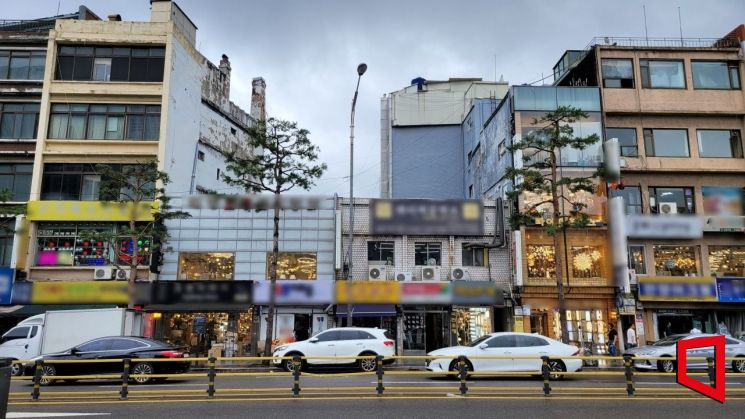
So why are there so many party wall buildings in the Euljiro area? Modern buildings began to appear in downtown Seoul, including Euljiro, in the 1950s and 1960s, right after the Korean War. At that time, there were many thatched and shanty houses, but the government took steps to beautify the city by setting minimum floor limits for buildings along main roads in downtown Seoul.
By today’s standards, these buildings have low floors, but compared to the past when wooden buildings were predominant, the buildings in Euljiro are like high-rise buildings. Due to party wall construction, buildings of similar height were built tightly packed along main roads, which was a practical urban beautification measure. Buildings densely lined up without gaps along the roads could cover the war-damaged, unsightly city center and allowed for urban regeneration in between.
The Seoul Metropolitan Government continued to adopt minimum floor limits as a means of vertical development and, through the urban design district system enacted in 1970, applied these limits not only to main roads but to the entire administrative area of Seoul. Safety was also considered. Since fires in party wall buildings could lead to major accidents, party wall buildings were required to have fire-resistant main structures and non-combustible finishing materials.
Ultimately, party wall buildings constructed in the 1950s and 1960s can be seen as concrete results of the vertical development policy along main roads that continued from before and after the war. Later, in the late 1990s, issues with the urban design district system surfaced, leading to reforms.
Meanwhile, these tightly packed buildings are also seen as fascinating sights by the MZ generation. Kim Se-hyun (27), who often visits Euljiro on weekends with friends, said, "Although shabby, the buildings and atmosphere are charming, so I come here with friends." Regarding party wall buildings, she said, "It’s amazing that there are no gaps between the buildings."
© The Asia Business Daily(www.asiae.co.kr). All rights reserved.
![Clutching a Stolen Dior Bag, Saying "I Hate Being Poor but Real"... The Grotesque Con of a "Human Knockoff" [Slate]](https://cwcontent.asiae.co.kr/asiaresize/183/2026021902243444107_1771435474.jpg)

















