Gyeongju's tourist attraction 'Sipwon Bread' received a request from the Bank of Korea to stop using the 10-won coin design without permission, causing confusion in the toy industry and early childhood education institutions about whether children's toy currency should also be prohibited. The Bank of Korea stated that it is cautious about imposing sanctions on children's toy currency because it serves an educational purpose.
Sipwon Bread is a bread modeled after the 10-won coin issued in 1996, featuring the design of the Dabotap pagoda of Bulguksa Temple in Gyeongju, which is engraved on the 10-won coin. Since it began selling around Gyeongju in 2019, it has gained great popularity among tourists. Currently, 17 companies in Gyeongju sell Sipwon Bread.
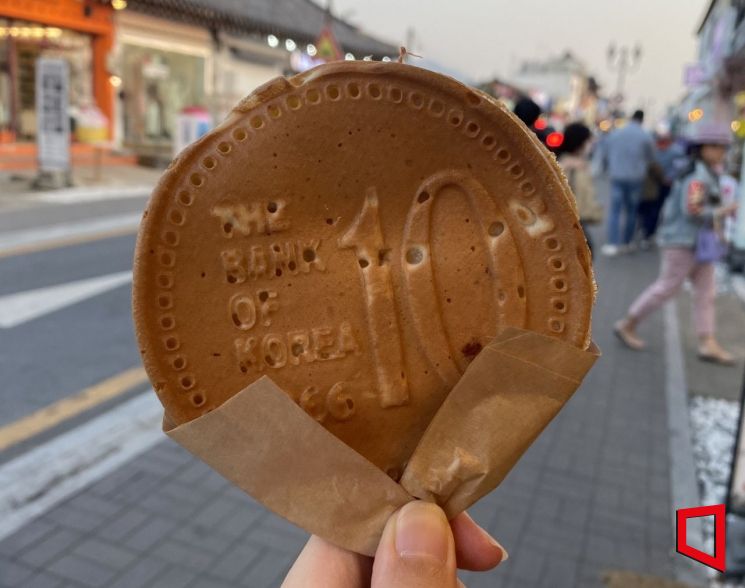 The famous Sipyeonppang of Gyeongju, Gyeongbuk, which has been embroiled in controversy for unauthorized use of the 10-won coin design.
 Photo by Yoo Byung-don tamond@
When the issue of Sipwon Bread arose, the Bank of Korea issued a press release stating, "We have established standards for the proper use of currency designs to ensure their sound use," and added, "Commercial use of currency designs is not permitted."
The Bank of Korea judged that Sipwon Bread violated these usage standards and requested a design change. According to the Bank, currency designs may only be used for educational, research, reporting, judicial purposes, or in currency replicas, illustrations inserted in printed materials such as books, newspapers, magazines, and e-books. Replicas must be made at less than 50% or more than 200% of the actual currency size, and illustrations must be single-sided, among other detailed conditions.
However, commercial use is prohibited unless separately authorized by the Bank of Korea. The Bank explained, "We established these restrictions because indiscriminate commercialization of currency designs could lead to a decline in trust in the currency system."
The Bank of Korea has been aware of the sale of Sipwon Bread for a year and has continuously requested manufacturers to stop using the existing design. However, some companies refused citing equipment investment costs, but recently it is known that they are considering design changes by engraving other patterns such as Cheomseongdae or Bulguksa instead of Dabotap. Similar products like Baekwon Bread in Tongyeong, Gyeongnam, and Obaekwon Bread in Sinsa-dong, Seoul, are also subject to sanctions.
Given this situation, toy companies producing so-called 'toy currency' sold to children are also concerned about being affected. Searching for terms like 'bank play bills' on portal sites yields dozens of products.
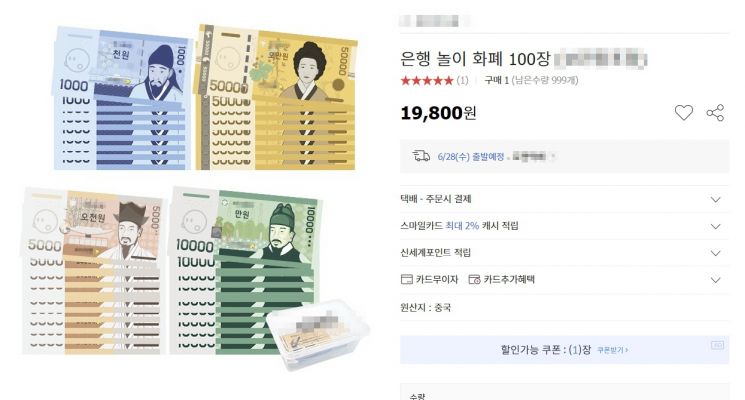
These companies sell products with designs similar to actual currency, ranging from 10-won coins to 50,000-won bills, priced from a few thousand won to tens of thousands of won. Many products resemble the colors and shapes of each currency, but their sizes are smaller than actual bills.
These products are also produced and sold for commercial purposes by toy companies, thus violating the Bank of Korea's currency design usage standards. However, the Bank is cautious about imposing full sanctions because these products are intended for children.
A Bank of Korea official said, "Although toy currency is indeed produced for commercial purposes and is clearly subject to regulation, there is also a public interest in children's financial education, so we currently have no plans to request an immediate cessation of use."
© The Asia Business Daily(www.asiae.co.kr). All rights reserved.
![Clutching a Stolen Dior Bag, Saying "I Hate Being Poor but Real"... The Grotesque Con of a "Human Knockoff" [Slate]](https://cwcontent.asiae.co.kr/asiaresize/183/2026021902243444107_1771435474.jpg)

















