Inspired by "Canned Beer, Quality Defect if Foam Forms"
Surpasses 400 Million Units Sold in 2 Years Since Launch
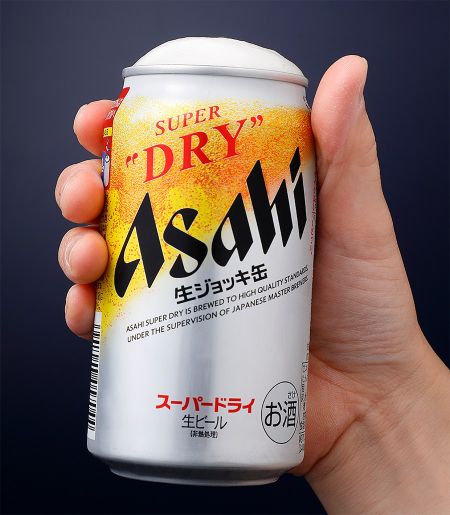
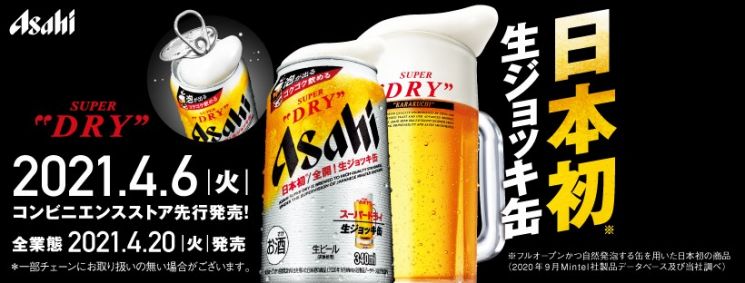
The 'Asahi Super Dry Draft Beer Can,' which is said to be so popular in Korea that it is hard to find, is actually known to have been created based on a defective product, sparking interest. This product, which took a full four years to develop, surpassed 400 million units in cumulative sales within just two years of its release.
On the 22nd, the Nikkei Industrial Newspaper, a subsidiary of the Nihon Keizai Shimbun (Nikkei), introduced the backstory of the birth of the Asahi Super Dry Draft Beer Can. When the can lid is opened, foam rises like draft beer, and the product gained sensational popularity both inside and outside Japan, surpassing 400 million units in cumulative sales within two years of its launch. Behind this popularity was a painstaking preparation period of four years. It took four years from the start of development to making prototypes. The new product launch project discarded as many as 100 prototypes.
The beginning of the draft beer can's creation was a technology exchange meeting held by Toyo Chemical (Toyokem), a subsidiary of Toyo Ink Holdings, and Asahi Breweries. Toyokem produces coatings applied to the inside of cans. These coatings prevent the metal components of the can from dissolving into the beer and altering its taste or causing the can to corrode from the beer. Since the can must not affect the beer's flavor, preventing foam is also a role of the coating. If foam occurs, the coating is treated as defective.
Asahi Breweries got an idea from this. The difference in taste between draft beer served at restaurants and canned beer is precisely the foam. What if canned beer could create delicate and creamy foam like draft beer? Inspired by defective products, the two companies began developing the draft beer can. Toyokem hesitated, saying, "Coatings that cause foam are treated as defective, so I don't know if there will be demand," and "We are actually developing a coating that could receive complaints," but they were persuaded and started the joint project.
Asahi Breweries and Toyokem began developing the draft beer can in 2017. The principle of creating foam lies in the microscopic unevenness inside the can. The reason foam forms when opening a canned beer is due to the pressure difference when opening a gas-charged can. This is amplified by the internal unevenness. The key is how delicately the unevenness inside the can is implemented.
The structure looks simple, but development was not easy. At first, they tried making grain-shaped unevenness, but it was only bumpy and did not produce foam. The final structure they reached was like a crater shape with sparse indentations. The unevenness was implemented so finely that it could not be seen or felt.
Although foam was generated, many challenges remained before product production. The coating manufacturing was reviewed multiple times, changing crater size and density, and more than 100 prototypes were made and tested.
Even before the April 2021 launch in Japan, development to maximize foam continued, according to officials. This was because foam often did not form during factory production even if it formed well in the laboratory. There were many variables such as the method of applying the coating, the way the beer was poured, and the temperature of the canned beer.
Eventually, after many attempts, the draft beer can created was able to gain sensational popularity immediately after its release. At that time, the product also experienced a shortage phenomenon in Japan.
It captured demand not only from consumers but also from businesses. Recently, some restaurants have been replacing draft beer with this canned beer. The gyudon franchise Matsuya has stopped serving draft beer since this spring and instead sells this beer. This is because draft beer for business use starts to deteriorate in quality if not consumed within three days after opening, and there is the hassle of cleaning machines.
The Nikkei Industrial Newspaper evaluated, "The team's attitude of not giving up and not letting failure be just failure made their name in the company's history."
© The Asia Business Daily(www.asiae.co.kr). All rights reserved.

![A Woman with 50 Million Won Debt Clutches a Stolen Dior Bag and Jumps... A Monster Is Born [Slate]](https://cwcontent.asiae.co.kr/asiaresize/183/2026021902243444107_1771435474.jpg)
















