"Ioniq 5 Made with 99% Domestic Parts"
Analysis of Automotive Parts by Major Domestic Companies
"Dedicated electric vehicles like the Ioniq 5 or EV6 contain over 99% domestically produced parts from Korean companies. Only some vehicle semiconductors or driver assistance modules are supplied by overseas companies. In the past, when manufacturing internal combustion engine vehicles, the localization rate of finished cars was considered, but now such analysis has lost much of its significance." (Hyundai Motor official)
As technologies surrounding mobility rapidly evolve, the formula for making cars is changing. In the past, core technologies were led by global automakers based in developed countries or a few large parts suppliers. However, in the era of future cars symbolized by electrification and autonomous driving, advanced IT technologies and software have become the benchmarks for the competitiveness of final products, leading to a clear trend of distributed vehicle manufacturing processes. In this process, global electric vehicle makers have shown increased interest in areas where Korean companies have competitiveness, such as electronic devices (electronics) and secondary batteries. We took a closer look at major Korean companies' vehicle parts including vehicle semiconductors, displays, and batteries.
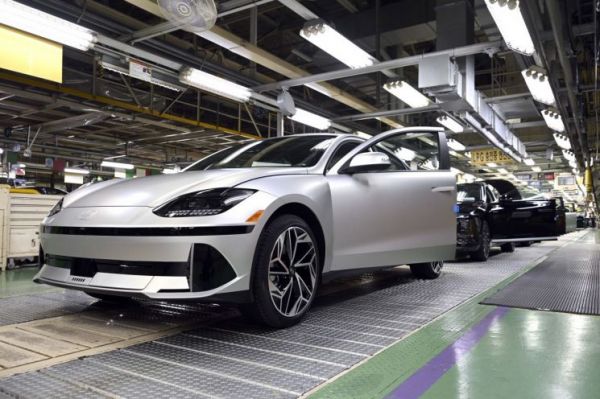 Hyundai Motor Company's Ioniq 6 on the final assembly line at the Asan plant.
 [Photo by Hyundai Motor Group]
From Semiconductors to Batteries... Electric Vehicles Made with Domestic Parts
First, semiconductors for vehicle infotainment systems (IVI), emerging as core technologies in future mobility, are increasingly supplied by Samsung Electronics. Recently, Samsung Electronics decided to install its IVI processor 'Exynos Auto V920' in Hyundai's high-end Genesis models starting in 2025. IVI is a system that simultaneously provides various driving-related information and entertainment features. Samsung Electronics has supplied these to German automakers Volkswagen and Audi.
In the display sector, Samsung Display was selected as the OLED display supplier for Genesis. LG Display is expanding its business by supplying most of Hyundai's instrument panel LCDs (liquid crystal displays). Since supplying digital cockpit OLEDs to Mercedes-Benz in 2021, LG Display has been expanding its customer base.
In batteries, SK On, LG Energy Solution, and Samsung SDI have strengthened their competitiveness in the global market. Batteries are considered key components determining electric vehicle performance. Especially as global automakers accelerate electrification, battery supply has become challenging, leading to active alliances between automakers and battery companies worldwide. LG, SK, and Samsung are expanding joint ventures with various companies including Hyundai Motor, General Motors (GM), Ford, and Stellantis.
Posco International is growing its business in driving motor cores, a key component for eco-friendly vehicles. To increase production of driving motor cores for electric vehicles, Posco International plans to start construction of a new plant in Poland within this year and increase output. The plant is scheduled to begin construction in the second half of this year and operate by 2025.
Posco and Hyundai Steel are expanding production of electrical steel sheets. Electrical steel sheets are similar to conventional automotive steel sheets but are made lighter and stronger to extend driving range. Posco launched the integrated brand for eco-friendly vehicle products and solutions, 'e Autopos,' and established an annual production system of 1 million tons of Giga Steel. Posco's Giga Steel is designed to minimize deformation against external shocks and is used in vehicle bodies and suspension systems that support chassis weight. Hyundai Steel developed and successfully mass-produced the world's first 1.8 GPa (gigapascal) premium hot-stamping steel, a steel material that reduces weight while increasing strength.
Hyosung Advanced Materials produces tire cords for electric vehicles. Tire cords are reinforcements inside tires that maintain tire shape and are essential for durability. Hyosung Advanced Materials holds about 51% market share in tire cords, ranking first in the industry.
In vehicle MLCCs (multilayer ceramic capacitors), Samsung Electro-Mechanics is making every effort to secure customers. Although Japanese companies Murata and TDK lead the vehicle MLCC market, Samsung Electro-Mechanics is focusing on growth potential by building a full lineup and noting the increasing number of potential customers as the future car market expands.
LG Innotek continues its growth in vehicle communication modules, electric vehicle power components, and vehicle sensors. Despite supply disruptions in vehicle semiconductors, LG Innotek's automotive components division recorded sales of 381.7 billion KRW in the first quarter of this year, a 22% increase compared to the same period last year.
Other notable domestic companies are active in areas such as ▲charging solutions (LG Electronics) ▲electronic components (LG Electronics) ▲powertrain (LG Magna) ▲infotainment systems (Harman) ▲headlamps (ZKW).
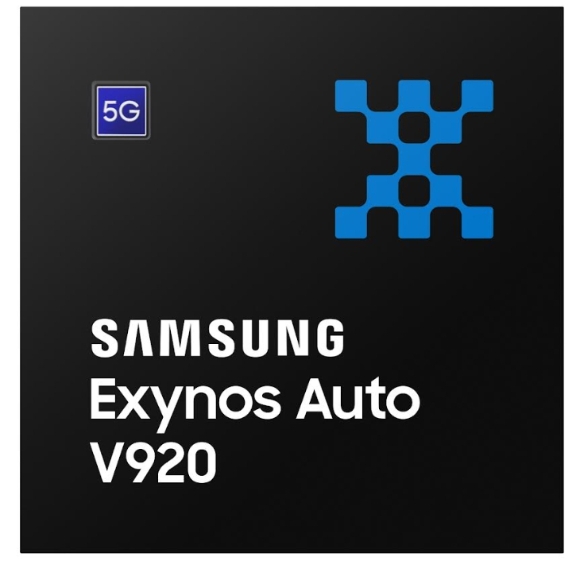 Samsung Electronics will supply Hyundai Motor Company with the 'Exynos Auto V920,' an IVI processor, in 2025.
 [Photo by Samsung Electronics]
What if Samsung and LG Made Electric Vehicles? The World's Best Products
There are even talks that Samsung and LG could directly manufacture electric vehicles if they wanted. An LG official said, "LG Energy Solution has the world's best batteries," adding, "The performance and durability of motors used in our home appliances are also world-class." The technology to compress cold-rolled steel sheets to make refrigerators is also top-tier globally. Cars are also made from cold-rolled steel sheets. This means cars could be mass-produced like refrigerators. Samsung is similar. Moreover, Samsung has past experience in making cars. Since both companies are ranked first and second globally in electronics, home appliances, and parts, they naturally excel in electric vehicles, which are advanced electronic and parts technology bundles.
However, neither company plans to produce electric vehicles directly. They have concluded that it is more rational to manufacture and supply the world's best electronic equipment and parts rather than compete with the world's top automakers. Thanks to the concerted efforts of Korean companies, future-oriented advanced products like electric vehicles can be fully equipped with purely domestic parts. In the past, core parts of domestic advanced products were foreign-made. For example, Samsung's mobile phones used Qualcomm communication chips, and LG's laptops used Intel central processing units. But electric vehicles are truly advanced domestic products using domestic parts from head to toe.
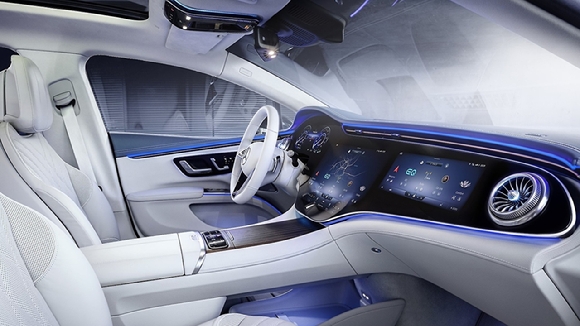 Interior view of the 2022 EQS premium electric sedan equipped with LG Electronics' infotainment system. [Photo by LG Electronics]
Economic Engine, Now 'Electric Vehicles' Instead of Semiconductors
Industry insiders express expectations that companies engaged in electric vehicle-related industries centered on Hyundai Motor Group are increasing investments across the board and focusing on new technology development, suggesting that Korea could lead the electric vehicle business.
Researcher Lim Eun-young of Samsung Securities said, "Korean auto parts companies have accumulated over 20 years of experience operating overseas factories in North America, India, and other regions alongside Hyundai Motor and Kia, and have established references by supplying electric vehicle parts to Hyundai Motor Group," adding, "As Hyundai Motor Group grows to become number one with global sales of 9.2 million units in 2026, Korean auto parts companies will also be re-evaluated."
Expectations are also high for revitalizing the domestic economy. The automotive industry is a national strategic industry that creates 1.5 million direct and indirect jobs and has vast upstream and downstream related industries such as batteries. While Korea's largest export item, semiconductors, continues to struggle, electric vehicle exports reached $8.2 billion last year, up about 45% from the previous year. The share of electric vehicles in total domestic automobile exports nearly tripled from 5.6% in 2019, just before COVID-19, to 15.2% last year. As the electric vehicle market grows, the global automobile trade market has also changed. China, traditionally regarded as a domestic market-focused country, exported 994,000 vehicles in the first quarter of this year, surpassing Japan (954,000 units) and Germany (839,000 units). This is the first time China has become the number one automobile exporter. Backed by a large domestic market, China has enhanced its competitiveness and overtaken traditional automotive powerhouses.
Senior Research Fellow Cho Cheol of the Korea Institute for Industrial Economics & Trade emphasized, "In the future, automobile exports are more likely to be led by the parts industry than by finished vehicles," adding, "Both internal combustion engine and future vehicle parts companies must enhance competitiveness through scaling up and automation."
Minister of Trade, Industry and Energy Lee Chang-yang pledged in May to support the transition of auto parts companies to future vehicles, stating, "The paradigm shift in the automotive industry, such as electrification and intelligence, is expected to bring significant changes to our automotive ecosystem," and "The government and industry will strengthen the future response capabilities of parts companies and seek support measures to expand exports."
© The Asia Business Daily(www.asiae.co.kr). All rights reserved.



















