7 Months After the Disaster, No Investigation Body Formed
'Sewol Special Investigation Committee' Also Restricted Amid R Party Obstruction
Opposition Security Committee Faces 'Solo Push' Dilemma
Seven months have passed since the '10.29 Itaewon Disaster' occurred just before Halloween last year. The 'Itaewon Special Act,' proposed mainly by opposition parties in the National Assembly, aims to establish an independent investigative body similar to the 2014 'Sewol Special Act,' while also reasserting the previously unmet goal of 'identifying structural causes.' With the Democratic Party of Korea pushing for the passage of the special act again, attention is focused on whether a complete outcome can be achieved.
According to political circles on the 22nd, the Democratic Party held a policy members' meeting the day before, adopted the Itaewon Special Act as the party's official stance, and decided to designate it as a fast-track bill at the plenary session on the 30th. Floor spokesperson Lee So-young explained, "Considering various conditions within the National Assembly that make it difficult for the special act to pass if it is not designated as a fast-track bill by the plenary session within June."
'Itaewon Special Act' Including the Formation of a Special Investigation Committee
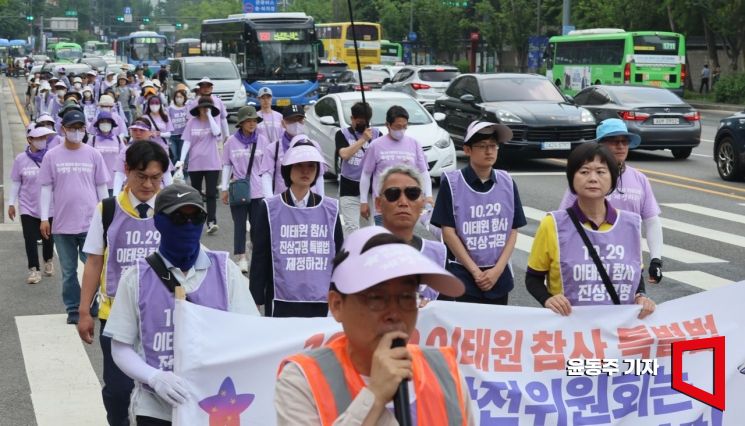 Families of the Itaewon disaster victims and citizens are marching to the National Assembly on the 14th in front of Seoul City Hall in Jung-gu, Seoul, urging the passage of the Itaewon Disaster Special Act. Photo by Dongju Yoon doso7@
After the disaster on October 29 last year, the National Assembly conducted a state audit. The Special Committee for the State Audit was active for 55 days and ended its activities last January. Due to the short period, the 700-page report focused more on the partisan disputes during public hearings rather than on the investigation of the facts and measures to prevent recurrence.
In response, the Itaewon Disaster Bereaved Families Association and the Citizens' Countermeasure Committee demanded the enactment of a special act, raising their voices through nationwide relay marches, signature campaigns, and memorial rallies. Consequently, on April 20, the four opposition parties (Democratic Party, Justice Party, Basic Income Party, and Progressive Party) jointly proposed the 'Special Act on Guaranteeing the Rights of Victims of the 10.29 Itaewon Disaster, Fact-Finding, and Prevention of Recurrence,' which includes the establishment of an independent investigative body and victim support.
The core of the special act, created based on the demands of survivors and bereaved families, is twofold: 'fact-finding' and 'victim support.' To investigate the facts, the special act mandates the formation of a Special Investigation Committee. This committee is authorized to conduct fact-finding investigations ex officio, issue orders for the submission of materials and objects, and request prosecution and investigation. If a special prosecutor's investigation is necessary, the committee can request it from the National Assembly, and the standing committee must complete its review within three months.
For victim support, the act establishes a Disaster Victim Relief Deliberation Committee under the Prime Minister's office, requiring the state to provide comprehensive support for victims' lives, including medical support payments and psychological assistance. It also includes provisions for developing community recovery programs and creating memorial parks to establish systems for preventing recurrence. The Special Investigation Committee is to operate for one year, with a possible six-month extension.
How It Differs from the 'Sewol Special Investigation Committee'
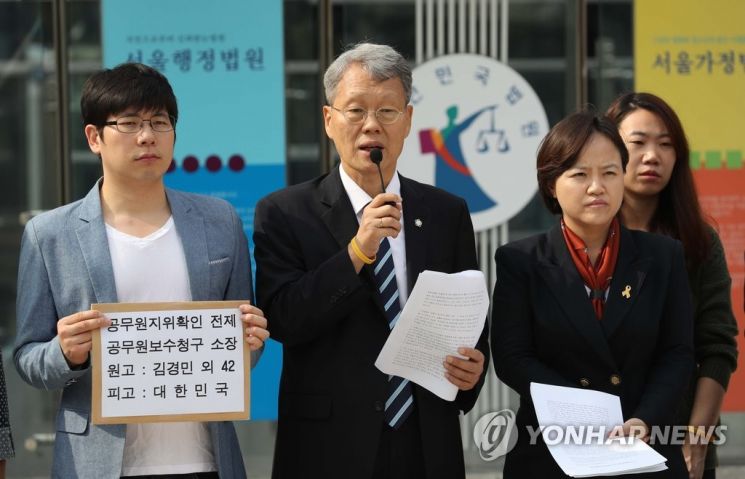 (Seoul=Yonhap News) On the morning of October 17, 2016, in front of the Seoul Administrative Court in Seocho-gu, Seoul, participants at the press conference for the 'Sewol Ferry Special Investigation Committee Investigator Civil Servant Salary Payment Lawsuit' stated, "The government notified that the Special Investigation Committee's investigation activities ended on June 30, but the investigators claim that the investigation period remains and have continued their investigation work."
A representative example of a special investigation committee formed after a major disaster is the 2014 '4.16 Sewol Ferry Disaster Special Investigation Committee.' After the 2014 disaster, the prosecution announced interim investigation results, but no results were released regarding government officials' responsibility. In response, the Families' Committee for Victims, Missing Persons, and Survivors of the Sewol Ferry Disaster demanded the establishment of an independent fact-finding body.
With the mobilization of large legal organizations and civil society groups, the Sewol Special Act was passed in the National Assembly on November 7, six months later. The Sewol Special Investigation Committee secured the right to request a special prosecutor and was able to establish regulations for hearings and the implementation of safety society measures. Notably, through three hearings, it partially uncovered government false announcements and causes of the accident.
However, its limitations were clear. From the formation stage, the committee faced constraints. In its first year, 2015, it was allocated a budget slightly more than half of the 15.9 billion won it requested. The investigation period was also shortened due to disagreements between parties on the start date, effectively not reaching a full year. Of the 17 members, 15 were legal experts, which hindered a multidimensional investigation of causes. During the investigation process, much manpower and time were wasted on administrative procedures from task selection to resolution, failing to reach the identification of social structural causes.
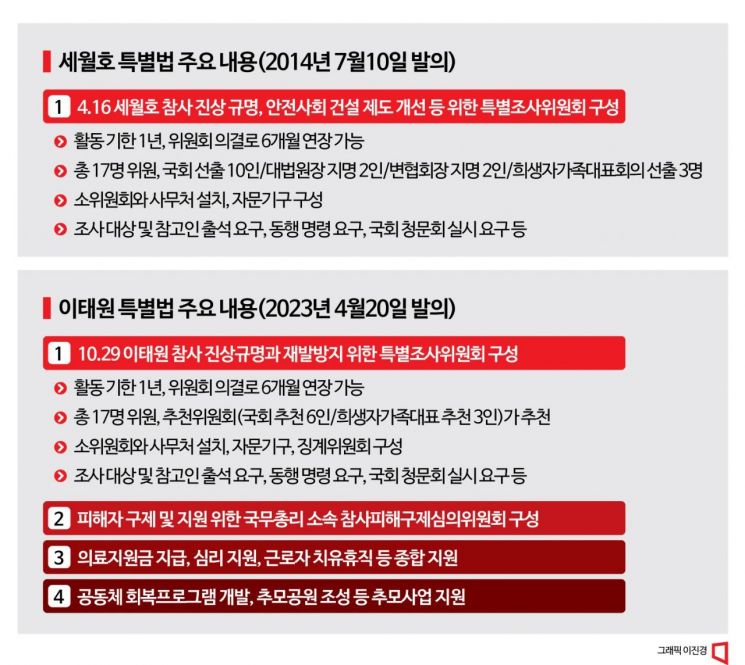
The Itaewon Special Act aligns with the Sewol Special Act in establishing an independent body guaranteeing the committee's independence and autonomy. However, the biggest difference lies in the 'recommendation rights.' The Sewol Special Investigation Committee had 10 members elected by the National Assembly, 2 appointed by the Chief Justice of the Supreme Court, 2 appointed by the President of the Korean Bar Association, and 3 elected by bereaved families, all appointed by the President.
In contrast, the Itaewon Special Act stipulates that the investigative body be composed of 17 members recommended by the National Assembly's Investigation Committee Recommendation Committee. The president, who is subject to investigation, cannot be involved in the committee's composition. The recommending members are three each from the ruling party, opposition parties, and bereaved families, and the Speaker of the National Assembly appoints them.
Additionally, unlike previous cases, the Itaewon Special Act emphasizes 'identifying structural causes.' The scope of investigation under the special act includes ▲ causes and responsibility for the disaster ▲ appropriateness of policy decisions and administrative measures by the state, etc. ▲ improvement of disaster and safety management laws and establishment of countermeasures ▲ actual damage and relief measures for victims after the disaster. When the Bereaved Families Association released the draft bill in February, they emphasized, "Thorough fact-finding is not about holding some public officials accountable and punishing them," but "It should be a process of examining all facts related to the Itaewon disaster without sanctuary and investigating structural causes."
Democratic Party Resumes Legislative Push Alone, Facing the Dilemma of Forcing Passage
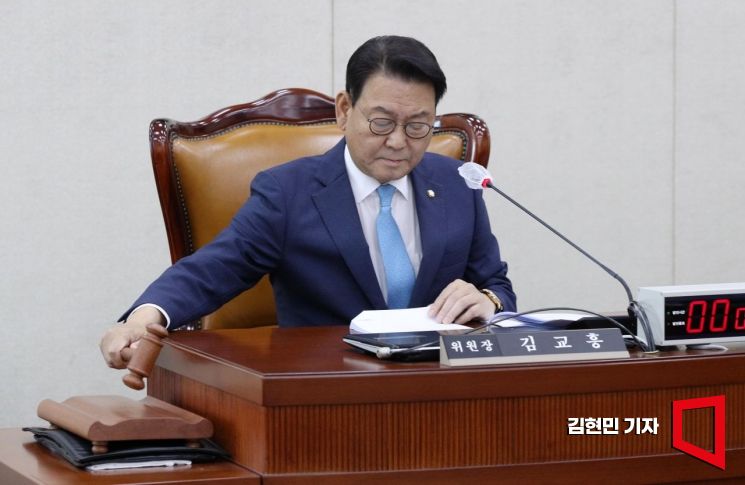 On the 19th, at the first subcommittee on bill examination of the Administrative Safety Committee held at the National Assembly, Chairman Kim Gyo-heung is striking the gavel. Photo by Hyunmin Kim kimhyun81@
Five months have passed since the conclusion of the special committee's activities, but the special act has not passed the standing committee subcommittee due to opposition from the ruling party. The ruling party has effectively opposed fact-finding from the time the state audit was underway until now. During the special committee, the ruling party opposed the adoption of the list of institutional witnesses and did not agree to the adoption of the final report. They have consistently opposed the enactment of the special act. Although the possibility of progress increased after the chairmanship of the Administrative Safety Committee, the relevant standing committee, was taken over by Democratic Party member Kim Kyo-heung, the ruling party opposing the bill must still be persuaded.
The Administrative Safety Committee plans to place the Itaewon Special Act on the agenda at the plenary meeting held that day. An opposition member of the committee explained, "We had requested to put it on the agenda up to the public hearing stage, but due to fierce opposition from the ruling party, we could not push it through." Also, since the chairmanship of the Administrative Safety Committee changed to the opposition, it is customary for the chairs of the 1st and 2nd subcommittees to be swapped between ruling and opposition parties, but the ruling party is holding onto the chairmanship of the 2nd subcommittee, which oversees the special act.
However, since the chair of the Administrative Safety Committee is from the opposition, legislating the special act is possible. The chair has the authority to place items on the agenda, and by using the fast-track (quick processing bill) system, the bill can be sent directly to the plenary session without going through the standing committee. However, since the president is likely to exercise a veto, the Democratic Party's position is to try to reach a consensus between ruling and opposition parties as much as possible.
Considering that about eight months are needed from designating the bill as a fast-track item to its submission to the plenary session, the Democratic Party is rushing to designate the bill. If the special act is designated as a fast-track bill at the plenary session on the 30th of this month, it is expected to be voted on around March next year, just before the 22nd general election. To designate the special act as a fast-track bill at the plenary session, at least three-fifths (180 members) of the total members must approve it, and since the bill's co-sponsors number 183, designation is expected to be relatively easy.
© The Asia Business Daily(www.asiae.co.kr). All rights reserved.
![User Who Sold Erroneously Deposited Bitcoins to Repay Debt and Fund Entertainment... What Did the Supreme Court Decide in 2021? [Legal Issue Check]](https://cwcontent.asiae.co.kr/asiaresize/183/2026020910431234020_1770601391.png)


















