Former Evaluation Institute Director Seong Gi-seon MBC Radio Interview
"Fundamental Cause of Private Education: Academic Credential Society and University Hierarchy"
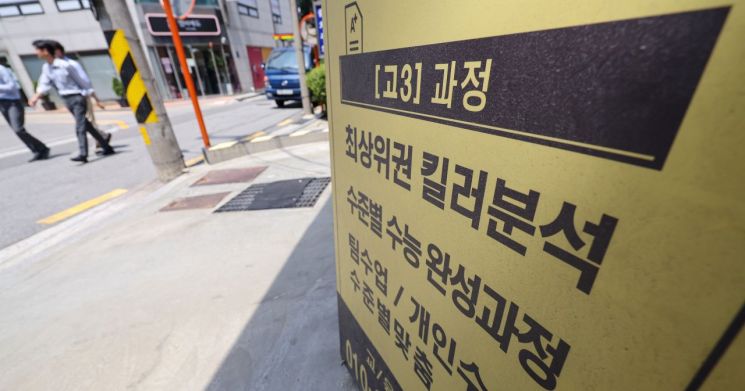
Amid the government identifying killer questions (ultra-high difficulty questions) as the main culprit of the 'private education interest cartel,' Sung Gi-seon, former president of the Korea Institute for Curriculum and Evaluation, pointed out that this is a "completely unacceptable awareness of the issue."
On the 20th, Sung appeared on MBC Radio's 'Shin Jang-sik's News High Kick' and said, "Under the current conditions, there must be a distribution of ultra-high difficulty questions, high difficulty questions, medium difficulty questions, and low difficulty questions, and there must be differences in achievement levels among students for the current regular admission system to function properly."
Regarding the current curriculum system, he said, "Centered on public education and under the Public Education Normalization Act, the CSAT is based on the curriculum we have and is mainly composed of learning content from schools," adding, "In fact, it has been well managed to the extent that no one can claim any relationship with private education."
He continued, "The cartel issue with private education is not something that can be harshly punished or threatened so easily," and pointed out, "It is not because of difficulty that private education is activated, but because of the fundamental academic credential society and university hierarchy in Korea. In fact, it is the anxiety about private education that drives students to academies. Of course, there are cases where students attend because the questions are difficult, but it cannot be said that it is directly connected."
Sung emphasized, "Statements related to education, especially the CSAT, should never be made recklessly in political or administrative domains," explaining, "If you consider the internal logic of education and the basic principles and preparation of CSAT question setting, the moment external pressure is applied, it leads to a very difficult situation."
He also expressed concern that reducing ultra-high difficulty questions would increase high difficulty questions, potentially leading to more private education. He said, "Students in the upper-middle or middle ranks find math much more difficult," adding, "Then private education inevitably increases."
Sung argued that reducing ultra-high difficulty questions also lowers discrimination power. He said, "So-called top-tier universities cannot discriminate," explaining, "The top grade is 4%, but if this 4% becomes 8% or 10%, grade jumps occur. A student who was in the top grade could drop to the third grade by missing one question. When their score drops due to a mistake, their anxiety increases significantly."
Regarding the criticism that ultra-high difficulty questions, which are set outside the textbook, push students toward private education, Sung said, "Most ultra-high difficulty questions are organized using passages from EBS textbooks," adding, "Since the general public cannot access EBS textbooks, they wonder why high school students have to talk about economics or science in Korean class. However, in Korean, students read texts and non-literary passages to check their reading ability."
© The Asia Business Daily(www.asiae.co.kr). All rights reserved.

















