People's Bank of China Lowers LPR Rate by 0.1%P
Fearing 'deflation (falling prices amid economic recession),' China has abruptly cut its benchmark interest rates. The move aims to revive the fading spark of the economy by expanding liquidity supply in the market, but experts predict the policy effect will be limited.
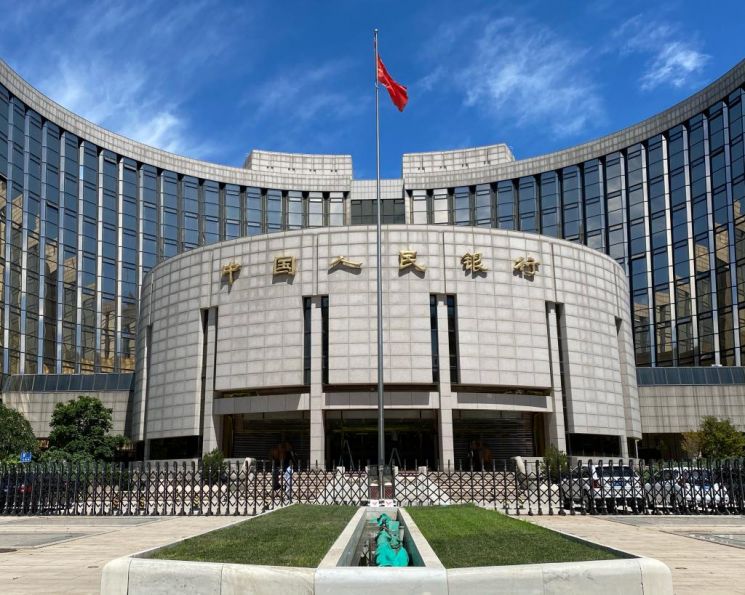
On the 20th (local time), the People's Bank of China, the country's central bank, lowered the 1-year Loan Prime Rate (LPR) to 3.55% and the 5-year LPR to 4.2%, each by 0.1 percentage points.
This is the first time in 10 months that the People's Bank of China has cut the LPR. The LPR serves as the de facto benchmark interest rate, representing the lending rates offered to the best customers of 18 major Chinese commercial banks.
China's recent benchmark rate cut was anticipated. As concerns grew that the Chinese economy would enter a recession phase due to a slowdown in the recovery trend despite the year-end reopening of economic activities, the market had expected a rate cut. China's Consumer Price Index (CPI) growth rate in May declined compared to the previous month, and retail sales and industrial production also slowed in the same month. Exports in May decreased by 7.5% compared to a year earlier. Amid this, the State Council of China announced on the 16th that it would soon release a policy package containing economic stimulus measures.
Earlier, a Reuters survey of 32 experts found that all respondents expected the People's Bank of China to cut both the 1-year and 5-year LPRs. However, the market assessed that the cut in the 5-year LPR was smaller than initially expected due to concerns that it might overheat the real estate market.
Previously, on the 15th, the People's Bank of China lowered the 1-year Medium-term Lending Facility (MLF) rate for the first time in 10 months, and on the 13th, it supplied liquidity worth 2 billion yuan to the market through a 7-day reverse repurchase agreement (reverse repo), lowering the applied rate by 0.1 percentage points compared to before.
However, experts predict that this benchmark rate cut will unlikely drive a rebound in China's economic recovery. Julian Evans-Pritchard, Chief China Economist at Capital Economics, said, "This rate cut will provide some support to economic activity by lowering interest on existing loans as well as the cost of new loans." However, he analyzed, "Given the current slowdown in loan demand, the likelihood of a rapid expansion in lending is low." Senior China Strategist Xing Jiaofeng at ANZ Bank forecasted, "Government policies will lead to a soft landing of the existing economy rather than re-stimulating growth."
In fact, global investment banks have been lowering their growth forecasts for China this year one after another. JPMorgan in the U.S. lowered its growth forecast from 5.9% to 5.5%. Swiss UBS revised it down from 5.7% to 5.2%, and Japan's Nomura Holdings cut it from 5.5% to 5.1%. The UK’s Standard Chartered projected China's growth rate at 5.4% this year, down 0.4 percentage points from the previous forecast of 5.8%.
Lu Ting, an economist at Nomura Holdings, predicted, "A decline in corporate confidence, negative sentiment, a fiscal cliff caused by a collapse in real estate sales, limited policy tools, delays and conflicts in decision-making may combine to prevent stimulus measures from reversing the situation."
© The Asia Business Daily(www.asiae.co.kr). All rights reserved.

















