Woori Bank Tops with 28.3 Billion Won
Concerns Grow Over Excessive Competition
Contribution Increase Continues Despite Government Guidelines
Competition among banks to secure contracts with 34 local governments (excluding autonomous districts) whose treasury bank contracts expire this year is heating up. As major commercial banks have contributed a total of 60 billion KRW to local governments in just half a year to secure treasury bank status, concerns over excessive competition are also growing.
On the 20th, Asia Economy analyzed disclosures from the Korea Federation of Banks and found that the four major commercial banks (KB Kookmin, Shinhan, Hana, and Woori) had paid a total of 56.288 billion KRW in contributions (cooperative project funds) to local governments as of June this year. Contributions are funds paid by treasury banks either by returning a portion of investment income earned from managing local government funds such as government grants, local taxes, and various funds, or as a form of contribution to secure the treasury bank contract. Local governments select their treasury banks every 3 to 4 years. Woori Bank paid the most with 28.339 billion KRW (13 cases), followed by Shinhan Bank with 12.547 billion KRW (10 cases), KB Kookmin Bank with 11.742 billion KRW (7 cases), and Hana Bank with 3.66 billion KRW (1 case).
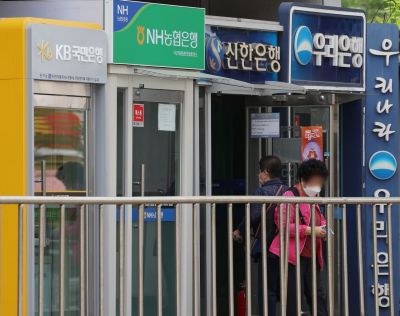
The contributions paid by these banks were 51 times higher than those paid by regional banks. During the same period, the only contribution from a regional bank was 1.1 billion KRW (1 case) from Gyeongnam Bank.
The reason banks are eager to secure treasury bank contracts is that it helps improve profitability. They can secure large-scale funds in a short period, and the treasury bank interest rate is around 0.1%, which lowers funding costs. Additionally, attracting customers such as local government officials is a bonus.
Because of these reasons, there have been criticisms of cutthroat competition as banks offer excessive benefits to local governments. The payments have a strong character of a kind of ‘rebate’ for securing the treasury bank contract, raising concerns that the burden could be passed on to consumers through higher loan interest rates. For example, Shinhan Bank promised a contribution of 301.5 billion KRW when it secured the first treasury bank contract for Seoul in 2019. This amount is double the 140 billion KRW paid by the previous Seoul treasury bank, Woori Bank, over four years.
Although the Ministry of the Interior and Safety and financial authorities have established and are implementing guidelines, they are insufficient to prevent excessive competition. According to the office of Yoon Chang-hyun, a member of the People Power Party, contributions from the five major commercial banks (KB Kookmin, Shinhan, Hana, Woori, and NH Nonghyup) to local government treasuries have increased from 258.6 billion KRW in 2019 to 262.2 billion KRW in 2020 and 278 billion KRW in 2021. According to the Ministry of the Interior and Safety’s ‘Treasury Bank Designation Evaluation Criteria,’ contributions are considered excessive if they exceed the bank’s net interest margin or increase by more than 20% compared to the previous year. Considering that the combined contributions from the four major commercial banks amounted to 10.684 billion KRW in the first half of last year, this standard has already been exceeded.
© The Asia Business Daily(www.asiae.co.kr). All rights reserved.
![Clutching a Stolen Dior Bag, Saying "I Hate Being Poor but Real"... The Grotesque Con of a "Human Knockoff" [Slate]](https://cwcontent.asiae.co.kr/asiaresize/183/2026021902243444107_1771435474.jpg)
















