As the weather has recently become warmer and ticks have become more active, on the 20th, the Korea Disease Control and Prevention Agency and the Rural Development Administration urged farmers to be cautious of tick bites and to follow prevention guidelines.
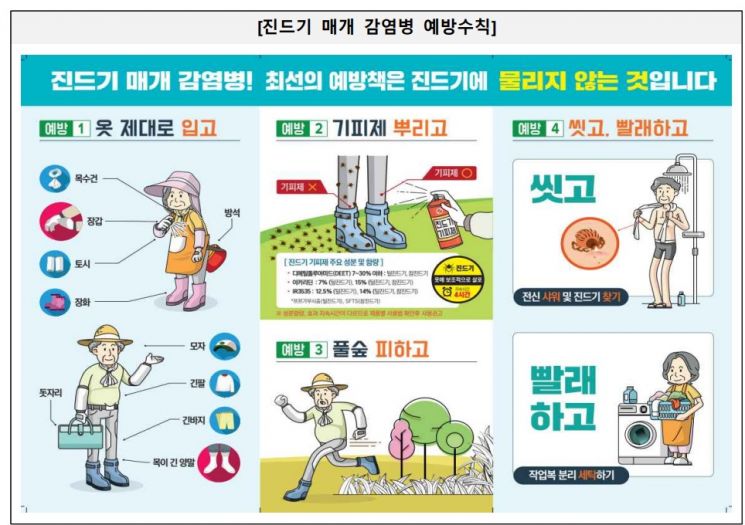
The tick-borne infectious diseases that mainly occur domestically are "Tsutsugamushi disease" and "Severe Fever with Thrombocytopenia Syndrome (SFTS)." Tsutsugamushi disease occurs when bitten by larvae of the hairy mite infected with Orientia tsutsugamushi bacteria, mainly in October to November, while SFTS, caused by the small striped mite, mainly occurs from June to October.
As of June 13 this year, there have been 193 cases of Tsutsugamushi disease and 19 cases of SFTS, with 4 deaths from SFTS, indicating a high fatality rate.
More than half of the patients are infected during agricultural work. According to an analysis by the Disease Control Agency of risk factors for tick-borne infectious diseases last year, 53.1% of Tsutsugamushi disease cases and 50.8% of SFTS cases occurred due to tick bites during agricultural work.
The Disease Control Agency emphasized that "the best way to prevent tick-borne infectious diseases is to avoid tick bites." Therefore, before agricultural work, farmers should wear agricultural work clothes with long sleeves and long pants, as well as gloves and boots. Wearing bright-colored clothing is also recommended so that ticks can be easily noticed when they cling to clothes.
When sitting on grass, use a work cushion or mat. Additionally, applying tick repellent to clothes and exposed skin approximately every 4 hours helps prevent tick bites.
After finishing agricultural work, work clothes should be thoroughly shaken off and washed immediately. While washing the body, carefully check for insect bite wounds or ticks attached to the skin. A Disease Control Agency official stated, "If a tick is attached to the body, do not crush it with fingernails or forcibly remove it, as this may cause additional infection through the tick's blood. Instead, visit a nearby public health center or medical institution for removal."
© The Asia Business Daily(www.asiae.co.kr). All rights reserved.

















