Complex Graph Interpretation Skills Required
Continued Criticism as the Main Cause of Private Education Overheating
Question 17 in the 2023 College Scholastic Ability Test (CSAT) Korean language section is considered a representative 'killer question.' Not only is the given passage itself difficult to understand, but the length of the question is also long, causing delays in solving time. Killer questions, which require high difficulty and long solving times, have been identified as the main cause of the so-called 'bul-sunung' (extremely difficult CSAT) and have triggered private education competition among top-tier examinees aiming for high scores.
Question 17 was a problem solved by utilizing the information on 'Kleiber's basal metabolic rate study' provided in the passage. The passage explains the 'L-graph' showing the relationship between weight gain rate and basal metabolic rate increase rate, and examinees must properly understand this information to solve the problem. The passage provided in the options is also extensive. It is a problem that can only be answered correctly by being able to interpret both the graph and the options comprehensively.
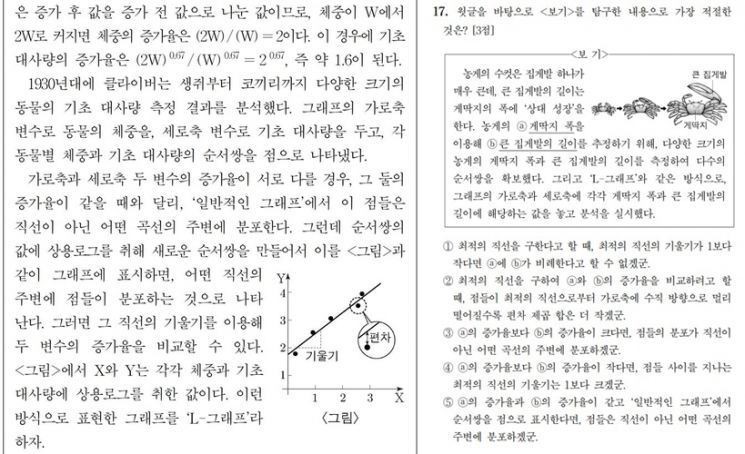 2023 College Scholastic Ability Test Korean Language Section Question 17 Passage and Question. [Image source=Online Community]
As such, killer questions not only have high difficulty but also take a long time to solve. It can be said that they test the examinee's passage interpretation ability and overall time management skills.
However, killer questions have been pointed out as a cause of fostering private education competition among top-tier examinees. In the top ranks, where rankings can change by one or two questions, examinees must stake their lives on a single killer question. In the private academy scene, specialized lectures targeting only killer questions are not uncommon.
A representative example is the method of teaching examinees tests much more difficult than the CSAT. It has been reported that some academies use textbooks for the 'Legal Education Eligibility Test' (LEET), which is used for law school admissions.
 On the 19th, educational content is displayed in front of an academy in Daechi-dong, Gangnam-gu, Seoul.
 [Image source=Yonhap News]
Some academies even develop killer questions themselves. These are called 'killer question workbooks,' and it is common to market these workbooks prominently. There are also cases where 'killer question contests' are held for entrance exam instructors or graduate students, offering prizes ranging from 1,000,000 to 2,500,000 KRW.
Meanwhile, the ruling party and government have decided to exclude killer questions from this year's CSAT. On the 19th, Lee Tae-gyu, a member of the National Assembly and the ruling party's education committee secretary, said to reporters after the National Assembly's 'Meeting on Enhancing School Education Competitiveness and Reducing Private Education' that "In the future, to ensure fair CSAT evaluation, questions on content not covered in the public education curriculum will be excluded, and question-setting techniques will be advanced to secure appropriate difficulty levels," adding, "Killer questions are an easy way to increase test discrimination but are a fundamental cause that drives students to private education."
Lee Ju-ho, Deputy Prime Minister for Social Affairs and Minister of Education, who attended the meeting, said, "One of the biggest problems in education is setting CSAT questions on content not covered in the public education curriculum," emphasizing, "We must solve a problem that has not been resolved for decades."
© The Asia Business Daily(www.asiae.co.kr). All rights reserved.


















