The Democratic Party of Korea raised doubts on the 19th about whether the World Trade Organization (WTO)'s ban on seafood imports could be maintained if they agree to the Fukushima contaminated water issue. The party announced its plan to raise one question daily regarding the government's briefing on the Fukushima contaminated water.
Song Ki-ho, Deputy Head of the Democratic Party's Fukushima Contaminated Water Task Force and lawyer, along with Lee So-young, the party's floor spokesperson, questioned at a briefing in the National Assembly whether the seafood import ban could be maintained if the discharge of contaminated water is agreed upon. Earlier, the government stated in a briefing on the 16th that the ban on seafood imports from Fukushima and the discharge of contaminated water into the ocean are separate issues, and that the ban on seafood imports from Fukushima would not be lifted. The Democratic Party raised doubts about this explanation.
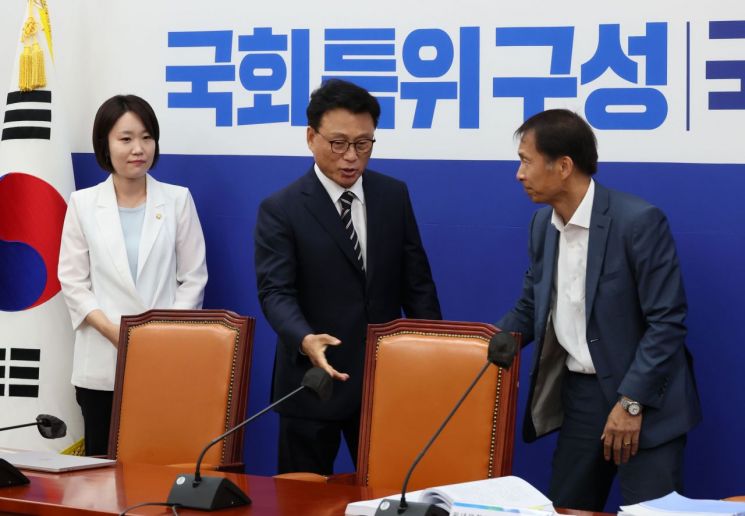
Song, an expert in international trade law, pointed out, "South Korea's position of banning seafood imports based on the radioactive risk of the Fukushima sea and Japan's assessment that the Fukushima sea is safe from radiation even if contaminated water is discharged are incompatible."
He argued that the seafood import ban is a 'provisional measure' and that it is South Korea that must present scientific evidence of the radiation threat, stating, "If we fail to properly establish the grounds and logic regarding the radiation risk of seafood from the Fukushima coast, we will not be able to defend against Japan's strong demands to lift the provisional import ban."
Song further noted, "Japan's radiation environmental impact assessment currently considers the waters near Fukushima to be safe from radiation and evaluates the safety of additional contaminated water discharge based on this. The International Atomic Energy Agency (IAEA), while requesting improvements in radiation impact monitoring methods, holds the position that Japan's assessment results are sufficiently conservative and reasonable," adding, "If South Korea agrees with these evaluations by Japan and the IAEA, it would be officially agreeing that the Fukushima sea is safe." Moreover, he criticized, "It is highly likely to be seen as contradictory that our government, which claims that the deliberate discharge of more than 1.3 million tons of radioactive contaminated water is safe and that the impact of discharged radioactive substances is minimal, insists on maintaining the import ban based on the risks from the 'accidental discharge' 12 years ago."
© The Asia Business Daily(www.asiae.co.kr). All rights reserved.
![Clutching a Stolen Dior Bag, Saying "I Hate Being Poor but Real"... The Grotesque Con of a "Human Knockoff" [Slate]](https://cwcontent.asiae.co.kr/asiaresize/183/2026021902243444107_1771435474.jpg)
















