Cumulative Deficit of 174.5 Billion Won... Final Decision by Board on 20th
Union: "Don't Just Emphasize Profit Logic, Provide Alternatives"
Seoul Baek Hospital of Inje University in Jung-gu, Seoul, is set to close after 82 years since its opening. Struggling with financial difficulties, Seoul Baek Hospital formed a TF (Task Force) team in 2016 to attempt business normalization, but it is reported that the hospital has not been able to escape deficits.
Professors and staff at Seoul Baek Hospital strongly oppose the closure solely for economic reasons.
The Inje Foundation is scheduled to hold a board meeting on the 20th to make a final decision on the closure of Seoul Baek Hospital. It is reported that the cumulative deficit of Seoul Baek Hospital has reached 174.5 billion KRW as of this year.
The hospital management normalization TF team recently concluded that due to difficulties in pursuing medical-related businesses, it is inevitable to either convert the hospital to other uses or sell it after closure.
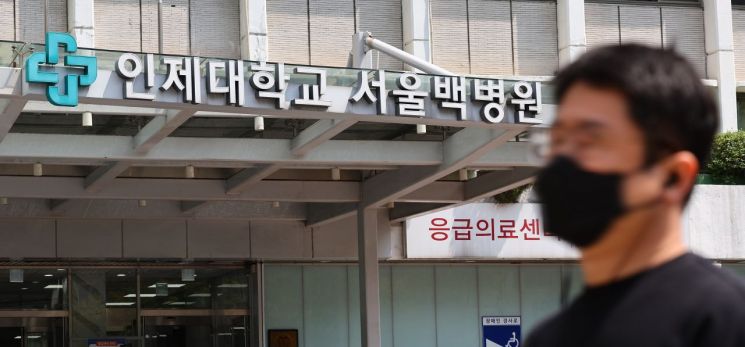 Inje University Seoul Paik Hospital is taking steps toward closure due to financial difficulties after 82 years since its opening.
 [Image source=Yonhap News]
Even if the hospital closes, the plan is to transfer employment for 393 employees to other hospitals within the foundation. Inje Foundation also operates hospitals in Sangye, Ilsan, Busan, and Haeundae besides Seoul Baek Hospital.
There is no information yet on plans for utilizing the hospital building and site, but the real estate industry predicts a high possibility of commercial use.
Following the revision of the "Private University Basic Property Management Guide" by the Ministry of Education in June last year, which relaxed the approval criteria for converting properties such as land or buildings owned by private university corporations into revenue-generating uses, the Seoul Baek Hospital site can now be used commercially. Seoul Baek Hospital is close to Myeongdong, a representative bustling area, and the site value is estimated to be between 200 to 300 billion KRW.
Employees of Seoul Baek Hospital and the medical community are protesting, claiming that the hospital unilaterally notified them of the closure. The National Health and Medical Industry Union, to which the Seoul Baek Hospital labor union belongs, held a press conference in front of the main building of Seoul Baek Hospital on the 19th, urging the withdrawal of the closure proposal.
The union stated, "The hasty closure of Seoul Baek Hospital is a betrayal of the 393 employees who have silently endured bed reductions, staff cuts, and restructuring in dedication and sacrifice for business normalization."
They added, "The sudden closure of Seoul Baek Hospital, which provides pediatric care, treatment for severe patients, and serves as a regional emergency medical institution, will create a medical vacuum in downtown Seoul. As the only infectious disease specialized hospital and operator of a large-scale emergency center in downtown Seoul, the closure of Seoul Baek Hospital could lead to a gap in essential medical services and a lack of public healthcare functions. Before prioritizing profit logic, reasonable alternatives must be sought."
The local government of Jung-gu, Seoul, which has jurisdiction, is also reported to have discouraged the closure due to concerns over medical service gaps. Seoul Baek Hospital is the only university hospital in Jung-gu and served as an infectious disease dedicated institution on the front lines during the COVID-19 pandemic. If Seoul Baek Hospital closes, the only comprehensive medical institution remaining in Jung-gu will be the National Medical Center.
Meanwhile, comprehensive hospitals in Seoul have been closing one by one over the past 20 years. Previously, Chung-Ang University Pildong Hospital (2004), Ewha Womans University Dongdaemun Hospital (2008), Chung-Ang University Yongsan Hospital (2011), St. Paul’s Hospital (2019), and Jeil Hospital (2021) have either closed or relocated.
The union acknowledged that "the closure of comprehensive hospitals in downtown Seoul is somewhat inevitable due to issues such as a decrease in resident population, deficits, and polarization of university hospitals," but emphasized, "closure should not be hastily pursued solely because of deficits."
© The Asia Business Daily(www.asiae.co.kr). All rights reserved.

















