Radioactive Nuclides Entering Our Sea in 4-5 Years
Cannot Contaminate Salt
Regarding some media reports that radioactive contaminated water from the Fukushima nuclear power plant in Japan could reach our nearby seas within 5 to 7 months, the government stated that this is "not true."
Concerning rumors that solar salt could be contaminated, the government also said, "There is no intersection because the radioactive nuclides and chemical symbols are different. Chemically, radioactive nuclides cannot enter salt."
On the 19th, Song Sang-geun, Vice Minister of the Ministry of Oceans and Fisheries, said at a daily briefing held at the Seoul Government Complex annex regarding the ocean discharge of contaminated water from the Fukushima nuclear power plant, "Among the discharged contaminated water, tritium is expected to flow into our seas starting 4 to 5 years later, reaching about 0.001 becquerels per cubic meter (Bq/m³), which is approximately one hundred thousandth of the normal tritium concentration in our seas after 10 years."
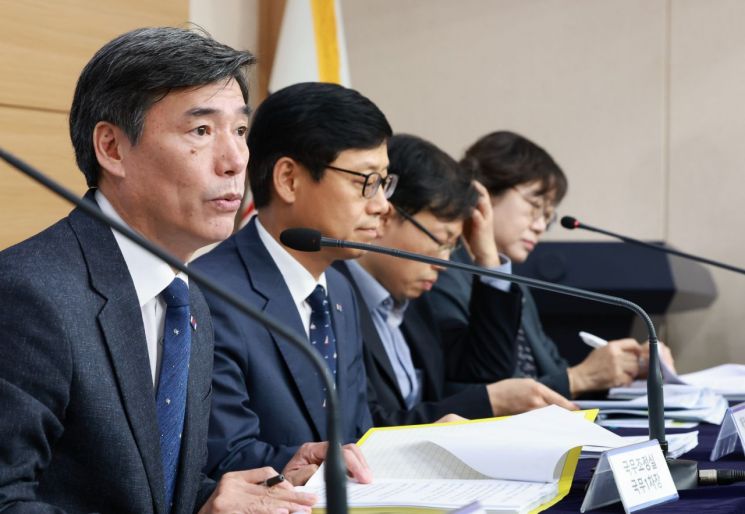
Regarding recent media reports that water at depths of 200 to 500 meters takes 5 to 7 months to flow through the Taiwan Strait, pass near Jeju, and enter the East Sea, he said, "The model used in domestic research simulations is capable of calculating from the surface to depths of 5,000 meters," adding, "The actual simulation results include the behavior of mid-depth water at 200 to 500 meters and calculations down to deep layers." Kim Kyung-ok, a senior researcher at KIOST, previously stated, "The discharged contaminated water mostly travels along the Kuroshio Current toward the United States. It is unusual for it to flow directly into the jurisdictional waters without passing through this current, but this scenario was also considered in the research results."
Vice Minister Song also urged the public not to be misled by unscientific rumors such as "salt will be contaminated if nuclear power plant wastewater is discharged," regarding the recent shortage of solar salt, saying, "Our solar salt is safe now and will remain safe in the future." Heo Kyun-young, Technical Review Committee Chair of the Pan-Ministerial Task Force, added, "The main components of salt are sodium and chlorine, represented by the chemical formula NaCl, but the list of radioactive nuclides from Tokyo Electric Power Company does not include Na or Cl. Therefore, radioactive nuclides cannot enter salt."
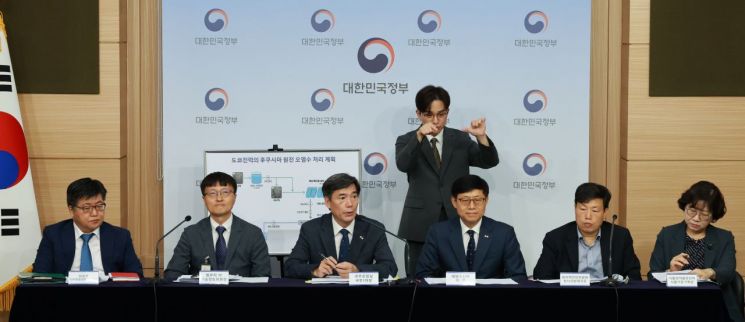
Regarding inspections of fish species from the Northwest Pacific imported into the country, Vice Minister Song said, "The main imported fish is Alaska pollock, which is jointly produced with Russia in the Sea of Okhotsk, and there is also Pacific saury. Radiation inspections are conducted through inspections of distant-water catches, and we plan to expand these inspections in the future." Park Gu-yeon, First Deputy Minister of the Office for Government Policy Coordination, who is in charge of the Fukushima contaminated water response, said, "We will thoroughly review the scientific safety of contaminated water treatment and ensure flawless safety management of seafood."
© The Asia Business Daily(www.asiae.co.kr). All rights reserved.
![Clutching a Stolen Dior Bag, Saying "I Hate Being Poor but Real"... The Grotesque Con of a "Human Knockoff" [Slate]](https://cwcontent.asiae.co.kr/asiaresize/183/2026021902243444107_1771435474.jpg)

















