Russia smuggles 1.5 billion yen worth of Japanese semiconductors
Evades sanctions via Hong Kong, Korea, and others
Calls for sanctions legislation on third-country companies arise
Japanese-made semiconductors have been found to have flowed in large quantities into Russia, bypassing the Japanese government's sanctions on Russia. It is estimated that the scale of Japanese semiconductors purchased by Russia through overseas countries over the past year is 1.5 billion yen, equivalent to about 14.1 billion won.
According to customs data from the Indian information research firm 'Export Genius,' obtained by the Nihon Keizai Shimbun on the 18th, Russia imported a total of 1.5 billion yen (approximately 14.1 billion won) worth of Japanese-made semiconductors from February 24 last year to March 31 this year.
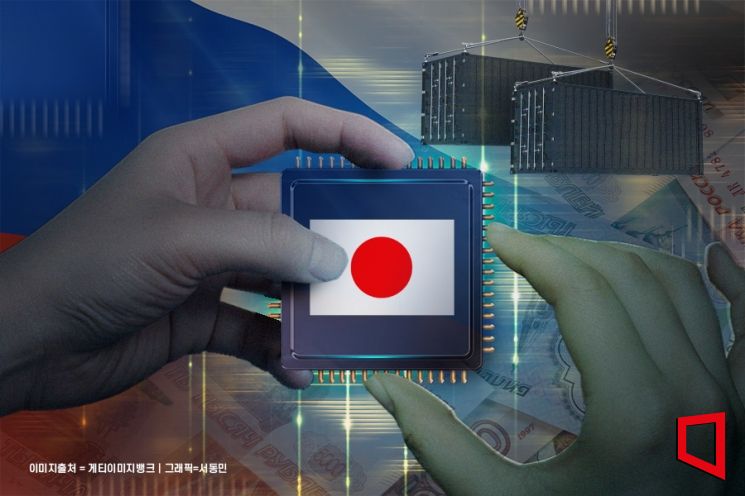
Among these, the volume brought in via Hong Kong and mainland China (8.19 million dollars) accounted for 70% of all Japanese semiconductors smuggled into Russia. Japanese semiconductors imported by bypassing South Korea and T?rkiye are estimated to be worth 990,000 dollars and 500,000 dollars respectively. The scale of Japanese semiconductors flowing in through Lithuania is estimated to be about 410,000 dollars.
According to the investigation, a trading company based in Hong Kong exported about 4,000 semiconductors produced by Japan's Kioxia to a Russian electronic components wholesaler in October last year. In March of the same year, a Chinese company smuggled Japanese semiconductors worth 150,000 dollars to a Russian trading company.
Earlier, Japan joined sanctions against Russia, including semiconductor export restrictions, in coordination with the United States and other Western countries in February last year. Currently, Japan prohibits exports of a total of 57 items to Russia, including semiconductors and telecommunications equipment.
In light of this news, there are criticisms that Japan's sanctions against Russia are effectively not working. Japan is unable to fully track the final destinations of its domestically produced semiconductors sold through the global supply chain. According to a report by Nihon Keizai in April, Russia exploited the lax management of U.S. sanctions on Russia to smuggle in U.S.-made semiconductors worth a total of 1 trillion won.
The Nihon Keizai Shimbun pointed out, "To verify whether Japan's sanctions against Russia are working well, one should look at how well the complex semiconductor supply chain is managed," adding, "The response to semiconductor distribution is essentially a measure of Japan's export control."
There were also calls to enhance the effectiveness of sanctions against Russia. Currently, the United States can impose sanctions on third-country companies if they violate its export controls, but under current Japanese law, only companies that export directly to Japan can be regulated.
Kazuto Suzuki, a professor at the Graduate School of Public Policy at the University of Tokyo, told the Nihon Keizai Shimbun, "There is practically no way to prevent indirect exports through third countries. However, secondary sanctions (sanctions on third-country companies) can stop indirect exports," and pointed out, "Despite ongoing transactions with Russia in any form, those companies are not receiving any sanctions from the Japanese government."
© The Asia Business Daily(www.asiae.co.kr). All rights reserved.
![Clutching a Stolen Dior Bag, Saying "I Hate Being Poor but Real"... The Grotesque Con of a "Human Knockoff" [Slate]](https://cwcontent.asiae.co.kr/asiaresize/183/2026021902243444107_1771435474.jpg)











