The Seoul Metropolitan Government will install a gondola connecting Namsan Yejang Park to the summit to improve accessibility to Namsan. It is expected that by 2025, visitors will be able to take the gondola from Myeongdong Station to the top of Namsan. The operating profits will be managed as a fund and used for ecological restoration and the creation of leisure spaces on Namsan.
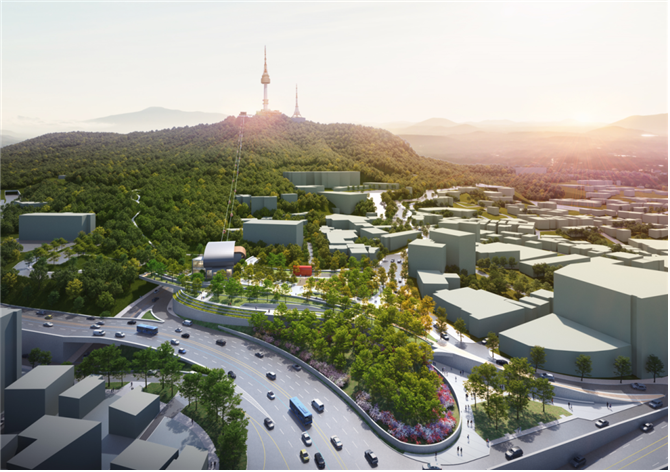
On the 19th, the Seoul Metropolitan Government announced that it will promote the "Sustainable Namsan Project," which includes these measures to preserve Namsan's ecological environment and create pleasant leisure spaces for citizens. The goal is to enhance citizens' accessibility to Namsan and create a sustainable future for Namsan through an eco-friendly approach that restores its ecological value.
During the industrialization era, Namsan's landscape was encroached upon by buildings resulting from disorderly development aimed at economic stimulation, development-centered growth, and rapid urbanization. To restore Namsan's ecological environment and natural scenery and return it to the citizens, Seoul has been making efforts over the past 30 years through various projects such as "Finding Namsan's True Form" and "Namsan Renaissance." To continuously preserve Namsan's ecological environment, the city designated 369,529㎡ of Quercus acutissima forest on the northern slope and 344,572㎡ of pine forest on the southern slope as ecological landscape conservation areas in 2006 and 2007, respectively.
However, recently, changes in vegetation within the ecological landscape conservation areas of Namsan and the emergence of harmful species such as the invasive pest Lycorma delicatula (spotted lanternfly) have posed threats to Namsan's ecological environment. Additionally, since the implementation of tourist bus entry restrictions in August 2021, the lack of suitable alternative transportation has increased inconvenience for mobility-impaired individuals and tourists, raising the need for new management measures for Namsan.
Accordingly, the "Sustainable Namsan Project" aims to restore the ecological environment, create leisure spaces, and strengthen Namsan's public nature. First, to restore Namsan's ecology and natural scenery, a public-based consultative body involving the city, citizen environmental groups, and environmental experts from academia will be operated. On the 12th, the city launched the "Development Council for Sustainable Namsan," chaired by Professor Han Bong-ho of the Department of Landscape Architecture at the University of Seoul. The council will explore various policies and projects for Namsan's future.
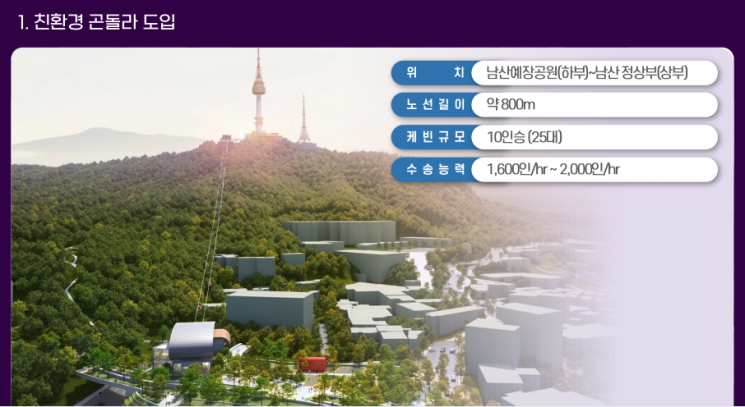
To improve accessibility and convenience for citizens, including those with mobility challenges, and to provide new "viewpoints" on Namsan, an eco-friendly gondola will be introduced as tourism infrastructure that can enhance Seoul's appeal. By next year, the city plans to prepare the Namsan ecological environment project plan, commence construction of the Namsan gondola, and establish ordinances related to the operation profit fund. The eco-friendly gondola is scheduled to be completed by 2025, ensuring the ecological restoration projects for Namsan proceed smoothly, harmoniously, and in balance. The operating profits generated by the eco-friendly gondola will be used as resources for projects identified by the council.
The city plans to utilize "Namsan Yejang Park" as the lower station for the gondola. This location is close to Myeongdong Station and features a large bus parking lot with 39 spaces, a transfer center, and passenger waiting areas. Since it connects directly to the Namsan summit, it is expected to significantly contribute to revitalizing the downtown areas around Myeongdong and Namsan. Additionally, to ensure comfortable use by children, the elderly, and people with disabilities, a barrier-free, slope-free pathway will be created from Myeongdong Station to the gondola lower station at Namsan Yejang Park.
The ecological environment project plan is expected to include expanding the ecological landscape conservation areas. The existing ecological conservation areas designated on the northern slope's Quercus acutissima forest and the southern slope's pine forest will be expanded, and a comprehensive management project considering ecological characteristics will be implemented to restore naturalness and enhance biodiversity.
Furthermore, through eco-friendly pest control and preventive management activities, comprehensive and proactive management will be conducted to restore natural water circulation by rehabilitating artificial structures. Asphalt roads and other unnecessary impervious soil pavements within Namsan will be restored to vegetative environments or improved with permeable eco-friendly pavements. Low-use, unnecessary forest trails will be closed, and management plans will be established to minimize vegetation damage caused by indiscriminate use.
Leisure spaces will also be expanded. A skywalk offering views of Namsan's natural scenery and places to rest will be constructed between Namsan Library and Namsan Outdoor Botanical Garden. An outdoor forest museum will be created to allow visitors to see and experience representative gardens from across the country in one place, linked with Namsan's forest resources. Natural scenery trails such as the Namsan Dulle-gil (7,294m), Hanyangdoseong Trail (3,892m), and Fortress Wall Trail (2,285m) will be maintained, and educational programs to experience and observe Namsan's ecosystem will be operated.
Yeo Jang-kwon, head of the Seoul Metropolitan Government's Balanced Development Headquarters, said, "Making Namsan a vibrant and high-quality ecological environment is the best way to provide citizens with the most attractive leisure space," adding, "We will do our best to create an attractive Namsan loved by Seoul citizens and people worldwide, where they can enjoy it conveniently and comfortably."
© The Asia Business Daily(www.asiae.co.kr). All rights reserved.


















