"If we follow the law, will justice be upheld?"
This is the first line of the protagonist, Yagami Raito, in the musical Death Note. The opening scene of Death Note takes place during a high school class. The teacher teaches that justice can only be upheld by following the law, but Raito raises an objection.
The title of the first number (a song performed in the musical) that follows is "Where is Justice?" Singing, Raito questions justice as a useless theory and a meaningless debate, asking what justice really is.
The beginning of Death Note is intense and weighty. First, the theme of law and justice is rare in musicals, which tend to be more showy, sparking curiosity. Law and justice are also among the most important issues in contemporary Korean society.
Any doubts about whether the theme of law and justice suits a musical are quite effectively resolved. This seems to be because Death Note incorporates elements that evoke Johann Wolfgang von Goethe (1749?1832), the great German literary figure, and his Faust. Goethe completed Faust over about 60 years, finishing it just months before his death. The play deals with heavy themes such as good and evil, life and salvation.
Faust is famous for its story about a human who makes a deal with the devil by selling his soul. In Death Note, a similar deal is made between a human and a shinigami (death god), where the human gives up half of their remaining lifespan to gain the "Shinigami Eyes."
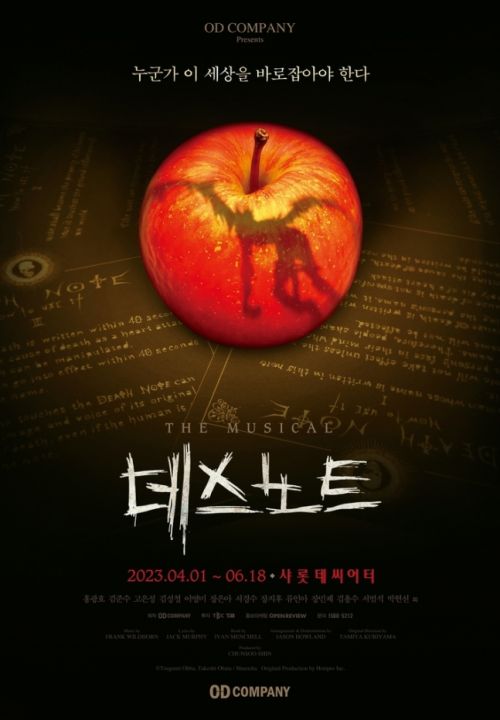
The original manga gained tremendous popularity, and a series of films were produced, so the plot is well known. The story unfolds when Raito accidentally picks up the shinigami's notebook, the "Death Note," which causes anyone whose name is written in it to die. After discovering the secret of the Death Note, Raito sets out to realize justice in the world by writing the names of criminals in the Death Note to eliminate them. Public opinion is divided. Some praise Raito as a savior called "Kira," meaning "killer," viewing him as an apostle of justice for eradicating criminals. Others criticize him, arguing that killing, even criminals, is murder, and that Raito is just another criminal. The police tighten their investigation, insisting that murder is murder.
The story places the protagonist Raito on the ambiguous boundary between good and evil, resembling the character of Dr. Faust in Faust.
The role of the shinigami Ryuk in Death Note is similar to that of the devil Mephistopheles in Faust. Ryuk, bored, drops his Death Note on the ground, which Raito picks up, triggering the events. In Faust, the devil Mephistopheles makes a bet with God as a kind of prank. When God says Faust is His servant, Mephistopheles proposes a wager to see if he can lead Faust astray.
Because of the heavy theme of law and justice, the flow of the play could become too serious, but it is balanced by the story of the female lead, Amane Misa. Misa is an idol singer who showcases the musical’s inherent glamorous showmanship. However, since the play focuses on the confrontation between Raito and the genius detective L, her role sometimes feels instrumental rather than fully developed.
The stage of Death Note is covered on the floor, background, and ceiling with a total of 1,380 light-emitting diode (LED) panels. The LED panels effectively create the imaginary world of the shinigami. However, in scenes depicting the real world, such as classrooms and streets, there are moments where the effect feels somewhat awkward.
© The Asia Business Daily(www.asiae.co.kr). All rights reserved.

















