"Sing Haiming's China Visit Planned Before Controversy"
Purpose to Convey Business Concerns and Discuss Relationship Restoration
Five members of the Democratic Party of Korea (DPK) visiting China stated that the purpose of their trip was to discuss the restoration of bilateral relations, including the resumption of group tourism. They emphasized that contrary to some reports, they did not receive any pressure or demands from the Chinese side regarding the "One China" policy during their visit.
On the 15th, DPK lawmakers Kim Tae-nyeon, Hong Ik-pyo, Hong Ki-won, and Hong Sung-guk, members of the Minsheng Economic Crisis Countermeasures Committee, held a press briefing for Beijing correspondents at a Korean traditional restaurant in Chaoyang District, Beijing, where they made these remarks.
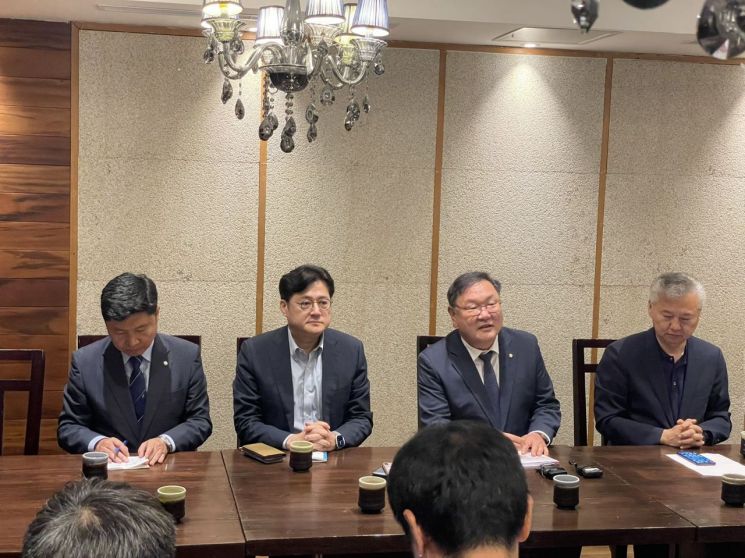 Hong Gi-won, Hong Ik-pyo, Kim Tae-nyeon, and Hong Seong-guk of the Democratic Party of Korea (from left) are holding a meeting with correspondents at a Korean restaurant in Beijing on the 15th during their visit to China. (Photo by Beijing Correspondents)
"Ministry of Foreign Affairs to actively consider group tourism resumption"
"China interprets Blinken's visit as a shift to de-risking"
Regarding the purpose of the visit, Rep. Kim explained, "During the activities of the Minsheng Economic Crisis Countermeasures Committee formed in June last year, we learned that businesspeople are concerned about economic retaliation similar to the THAAD (Terminal High Altitude Area Defense) incident due to the recent deterioration in Korea-China relations. There was a need to respond to demands for more communication with China to prevent such situations from occurring."
He added, "With the trade deficit continuing for 15 months, more than half of the causes are related to issues with China. Therefore, it was necessary to understand the judgments, diagnoses, and forecasts of Chinese government officials and institutions, especially think tanks influencing China's foreign and security policies, which is why we came."
Rep. Hong Ik-pyo said, "While the number of flights between Japan and Europe and China has recovered to 70% of pre-COVID-19 levels, Korea's is still less than half. Ultimately, the lack of demand is because group tourism is not allowed, so I proposed a proactive review of the resumption of group tourism to Sun Weidong, Vice Minister of the Chinese Ministry of Foreign Affairs." He added, "Although we did not receive a definite answer, the day after the proposal to the Vice Minister, a director-level official from the Chinese Ministry of Foreign Affairs conveyed that they would actively consult with relevant departments. I even told Vice Minister Sun that if Chinese group tourists come, I would personally go to the airport to welcome them."
Additionally, Rep. Hong Sung-guk introduced that China evaluates U.S. Secretary of State Tony Blinken's visit as a shift from "decoupling" to "de-risking." He said, "When asked about Secretary Blinken's visit, they directly expressed, 'Isn't this the beginning of managing risks?' and it was interpreted as a willingness to accept the transition of U.S.-China relations from decoupling to de-risking."
Regarding the recent deterioration in Korea-China relations, it was reported that China hinted the cause lies with the United States. Rep. Hong Ik-pyo explained, "Regarding the cause of the deterioration in Korea-China relations, the Chinese side mainly pointed to third-party factors or the United States rather than taking responsibility themselves." He continued, "China said that Korea's policies are heavily influenced by the U.S. China policy, which they consider undesirable. Each country should make independent judgments, and this did not mean they wanted Korea to side with China."
Concerns about Xing Haiming controversy conveyed... No response from Chinese side
Denial of 'One China' coercion: "Not a subject of discussion"
Regarding Xing Haiming, the Chinese Ambassador to Korea, who has recently been controversial in Korea, concerns were conveyed to the Chinese government, but it was made clear that it was not a subject of discussion. Rep. Hong Ik-pyo said, "I mentioned that the public feels considerable inappropriateness and discomfort regarding Ambassador Xing's remarks and hoped that things would not progress in a way that harms the people of both countries." Rep. Kim added, "The issue of Ambassador Xing was not a major topic. If this becomes a controversy, we would not be able to discuss other matters that were the original purpose of the visit." He explained that the Chinese side did not provide any particular response or answer to their concerns.
The lawmakers strongly denied reports that they were pressured by the Chinese side to agree to the "One China" policy during their visit. Rep. Hong Ik-pyo stated, "There was no discussion on that, and the reports of pressure or coercion are not true." Rep. Kim emphasized, "Mentions of 'One China' are something I heard 20 years ago when I came to China, 10 years ago, and 5 years ago. It is like a mandatory statement that officials must make when meeting foreign politicians."
Rep. Hong Sung-guk assessed the outcomes of the visit, saying, "We had many serious discussions and clarified that the starting point of the deterioration in Korea-China relations was after the THAAD incident, during which the Chinese side took an excessively strong stance. I suggested that since China focuses on hard power in diplomacy, it is necessary to create a friendly atmosphere in the civil sectors of each country through soft power." He added, "We specifically mentioned allowing group tourism and lifting the ban on Korean content, and requested reciprocity so that when Korean companies withdraw from China, they are treated the same as Chinese companies."
The delegation also responded to some claims that they tried to visit China secretly due to the recent deterioration in Korea-China relations, explaining that "they simply did not publicize the visit." Rep. Kim said, "Because of the Ambassador Xing situation, if the schedule had been reported in advance, it might have been handled abnormally and deviated from the essence, so we planned to announce it after returning and organizing the details." He added, "We notified the Ministry of Foreign Affairs in advance and also communicated and coordinated with the Korean Embassy in China beforehand."
© The Asia Business Daily(www.asiae.co.kr). All rights reserved.

















