No Tae-ak, Chairman of the National Election Commission (NEC), and the election commissioners, who were reported for refusing the Board of Audit and Inspection's (BAI) audit regarding allegations of preferential hiring involving children and siblings of former and current executives, will be investigated by the Public Investigation Division 1 of the Seoul Central District Prosecutors' Office (Chief Prosecutor Lee Hee-dong).
Lee Jong-bae, a Seoul City Council member and the accuser in this case, announced on the 15th, "The case accusing Chairman No Tae-ak and all election commissioners of violating the Board of Audit and Inspection Act has been assigned to the Public Investigation Division 1 of the Seoul Central District Prosecutors' Office, and an investigation has commenced."
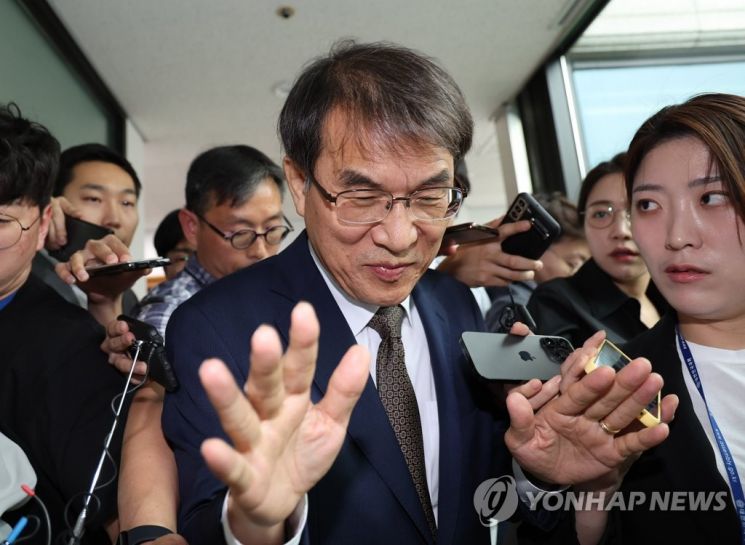 Noh Tae-ak, Chairman of the National Election Commission, is heading to the chairman's office after a meeting held at the Gwacheon National Election Commission on the 2nd, responding to questions from the press. [Image source=Yonhap News]
Earlier, on the 2nd, the NEC held a committee meeting and decided to accept a National Assembly investigation or an audit by the Anti-Corruption and Civil Rights Commission regarding the preferential hiring allegations but refused the BAI's on-duty inspection.
On the 4th, Councilman Lee filed a complaint with the prosecution against Chairman No and all election commissioners for violating the Board of Audit and Inspection Act and other charges.
At that time, Councilman Lee pointed out, "According to the NEC's special audit committee announcement, Secretary-General Park Chan-jin, Deputy Secretary-General Song Bong-seop, Jeju Standing Commissioner Shin Woo-yong, and Gyeongnam General Affairs Manager Kim Jeong-gyu possibly exerted undue influence in the hiring process of their children, prompting a request for investigation. According to materials submitted to the NEC by People Power Party lawmakers Lee Man-hee and Jeon Bong-min, children of four retired executives were preferentially hired at their 'father's workplace,' and it was also revealed that a sibling was hired through a career recruitment at the NEC."
He stated, "The matter is very serious and has caused public outrage. On the 31st of last month, the BAI decided to conduct a thorough inspection of the NEC's personnel management, including hiring and promotions, to verify legality and preferential treatment. However, the accused, including Chairman No Tae-ak and the NEC, refused the BAI's inspection, stating that 'due to the checks and balances among state institutions, the NEC has not been subject to on-duty inspections as a constitutional custom. Therefore, it is difficult to comply with the on-duty inspection,' which was the unanimous opinion of the election commissioners."
Councilman Lee added, "The NEC's election management duties fall under administrative affairs, so it can be effectively regarded as an administrative agency, making it subject to the BAI's audit," and "The NEC was audited by the BAI in 2016 and 2019."
He also emphasized, "The NEC claims that the BAI's audit could infringe on its independence and neutrality, but an audit regarding hiring corruption does not affect the NEC's independence and neutrality in any way."
Article 51, Paragraph 1 of the Board of Audit and Inspection Act (Penalties) stipulates that those who refuse an audit or fail to comply with requests for document submission under the Act shall be punished by imprisonment of up to one year or a fine of up to 10 million won.
Meanwhile, the NEC maintains the position that it is not subject to the BAI's on-duty inspection under the Constitution.
Article 97 of the Constitution states, "The Board of Audit and Inspection shall be established under the President to audit the settlement of national revenues and expenditures, the accounts of the state and organizations prescribed by law, and to inspect the duties of administrative agencies and public officials."
The NEC argues that since it is a constitutional agency separately stipulated in Chapter 7 of the Constitution rather than a statutory agency, it is not subject to the BAI's audit. They claim that the NEC cannot be included among administrative agencies subject to the BAI's audit.
However, there is a counterargument that this claim lacks persuasiveness because the current audit concerns corruption among affiliated staff, i.e., an inspection of duties rather than an audit of accounts.
The two institutions also have significant differences regarding Article 24 of the Board of Audit and Inspection Act, which regulates the BAI's inspection matters.
Article 24, Paragraph 1 of the Board of Audit and Inspection Act (Inspection Matters) lists the BAI's inspection targets as follows: ▲ affairs of administrative agencies established under the Government Organization Act and other laws and the duties of public officials belonging thereto (Item 1), ▲ affairs of local governments and duties of local public officials (Item 2), ▲ affairs of persons specified in Article 22, Paragraph 1, Item 3 and Article 23, Item 7, and duties of executives and employees related directly or indirectly to accounting affairs subject to the BAI's audit (Item 3), ▲ affairs entrusted or delegated by the state or local governments under laws and duties of public officials or persons equivalent to public officials under other laws (Item 4).
Paragraph 3 of the same article specifies exceptions to inspection targets, stating that "public officials under Paragraph 1 do not include public officials belonging to the National Assembly, the courts, and the Constitutional Court."
The BAI holds the position that since the only institutions excluded from on-duty inspection under the Act are the National Assembly, the courts, and the Constitutional Court, the NEC is naturally included as a subject of inspection. The fact that the 1994 amendment to the Board of Audit and Inspection Act decided not to exclude the NEC during discussions in the National Assembly supports this claim. The NEC, however, regards this as a legislative deficiency.
The two institutions also clashed over whether to accept on-duty inspection during the controversy over the so-called "Sokuri voting" during the early voting process of last year's presidential election.
Meanwhile, facing mounting public criticism over refusing the audit, the NEC held another committee meeting on the 9th and announced its position to accept the BAI's audit only regarding the preferential hiring allegations involving children of former and current executives.
Nevertheless, the NEC stated, "The BAI's inspection of the NEC's inherent duties, as a constitutionally independent agency, is not consistent with the spirit of the Constitution," and "To clarify this, we will file a constitutional dispute adjudication with the Constitutional Court, which holds the final authority on constitutional interpretation."
The NEC is also in conflict with the Anti-Corruption and Civil Rights Commission (ACRC) regarding the investigation it initially agreed to accept.
On the 14th, Jeong Seung-yoon, Vice Chairman of the ACRC and head of the special investigation team on NEC hiring corruption, held a press conference at the Government Complex Seoul, stating, "The NEC is not cooperating and is responding uncooperatively to the field investigation."
Vice Chairman Jeong said, "This morning, we conducted field investigations at the NEC headquarters and 17 regional NEC offices, but the NEC is refusing to cooperate with the ACRC investigation, citing acceptance of the BAI audit."
In response, the NEC reportedly maintains its willingness to cooperate with the ACRC investigation but has only suggested coordinating the investigation schedule because the BAI's on-site audit period overlaps with the ACRC's investigation period.
© The Asia Business Daily(www.asiae.co.kr). All rights reserved.

















