MoEF and MOLIT Agree to Raise Intercity and Express Bus Fares
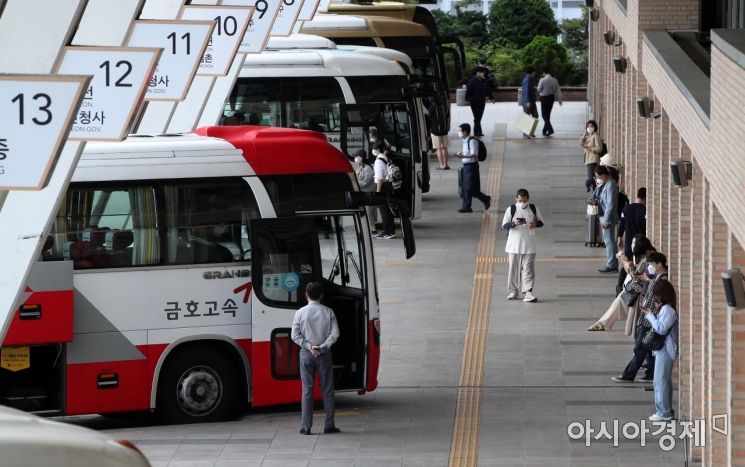
Intercity and express bus fares will rise slightly in the second half of this year. This comes just six months after the fare increase at the end of last year. The government believes that a gradual fare increase is inevitable, considering the easing inflation trend and the burden on the bus industry due to last year's rise in fuel costs.
According to related ministries on the 15th, the Ministry of Economy and Finance and the Ministry of Land, Infrastructure and Transport are preparing and discussing a fare increase plan for intercity and express buses. It has been six months since the government raised fares by an average of 5% in November last year. For intercity and metropolitan buses under the jurisdiction of the Ministry of Land, Infrastructure and Transport, cost factors reflecting fuel prices, labor costs, and inflation rates are reviewed, and if an increase is necessary, the ministries consult to determine the specific scale of the increase. A government official explained, "Energy prices rose sharply last year, but considering the public burden, we decided to spread out the timing of the increase as much as possible," adding, "There were parts that could not be reflected at that time, but as inflation has eased, we decided to defer them."
Considering the heavy burden the bus industry had to bear due to last year's rise in fuel costs, a gradual fare increase is deemed unavoidable. Following Russia's invasion of Ukraine last year, the price of diesel, the main fuel used by express and intercity buses, soared, causing fuel costs to rise significantly. Although the government implemented a fare increase for the first time in three years and nine months at the end of last year, it was judged insufficient. Earlier in May, Won Hee-ryong, Minister of Land, Infrastructure and Transport, mentioned the possibility of a fare increase at a press conference commemorating his first anniversary in office, stating, "During the rapid inflation, express bus fares were artificially frozen, and we decided to raise them in two phases, so we cannot keep suppressing express bus fares indefinitely."
By the second half of this year, local governments also plan to raise public transportation fares such as subway and city bus fares, as well as taxi fares. Although fare increases have been restrained due to the central government's freeze policy, it is now considered necessary to raise prices reflecting inflation. Seoul City plans to raise subway and bus fares by up to 300 won as early as August, while Incheon City is reviewing a 300 won increase for city bus fares, and Ulsan City is considering a 250 won increase. With major transportation fares rising one after another in the second half of the year, there is also a possibility that public service fees could push inflation, which was stabilizing, upward. The Bank of Korea analyzed in its economic outlook last November that "the high likelihood of taxi base fare increases centered on Seoul and the metropolitan area from next year is also expected to increase inflationary pressure."
© The Asia Business Daily(www.asiae.co.kr). All rights reserved.
![Clutching a Stolen Dior Bag, Saying "I Hate Being Poor but Real"... The Grotesque Con of a "Human Knockoff" [Slate]](https://cwcontent.asiae.co.kr/asiaresize/183/2026021902243444107_1771435474.jpg)
















