7 Years of Continued Negative Interest Rates in Japan
"Favorable Conditions for Yen Carry Trade"
As the Bank of Japan (BOJ) is expected by experts to maintain its existing ultra-low interest rate policy without any changes, interest in the "yen carry trade" strategy is also growing.
On the 13th (local time), Bloomberg reported, "Due to the dovish stance of BOJ Governor Kazuo Ueda, the yen is solidifying its position as the most attractive currency for carry traders," adding, "This is acting as a factor that intensifies the yen's depreciation."
The "yen carry trade," a technique of borrowing the low-interest yen and using the funds to operate high-interest currencies, mainly appears when the yen continues to weaken or when interest rate differentials between major countries widen.
Recently, with the BOJ's monetary easing policy coinciding with aggressive monetary tightening by major central banks, the yen has been identified as the only currency among 31 major currencies to have a negative interest rate. This has led to increased attention on the yen carry trade.
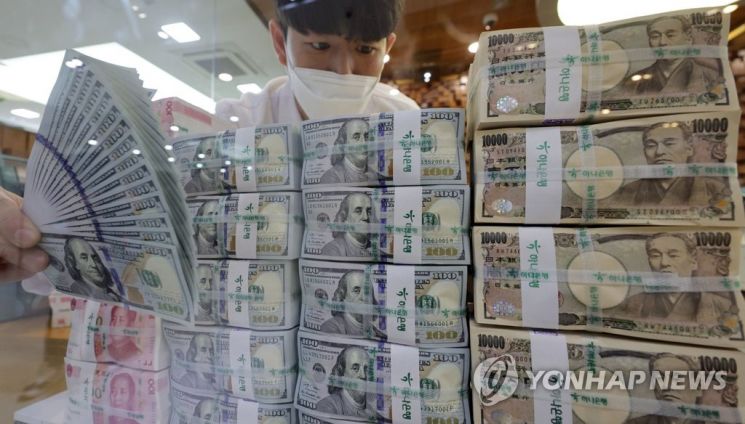 As experts predict that the Bank of Japan (BOJ) will maintain its ultra-low interest rate policy for several months without any policy changes, attention is focusing on the 'yen carry trade' strategy.
 [Photo by Yonhap News]
Accordingly, the "amount of yen loans by foreign bank branches in Japan," which is considered an indicator of the yen carry trade, has increased by 48% since the end of 2021, reaching 12.9 trillion yen (approximately 117 trillion won) at the end of April. Carry traders have achieved a 19% return since the end of 2019. This involves buying yen and then purchasing US, Canadian, New Zealand, Australian dollars, and pounds.
Japan's negative interest rate, maintained for seven years, is regarded as a favorable condition for the yen carry trade.
Bloomberg's analysis of 3-month government bond yields for 30 currencies showed that the yen recorded a negative yield of -0.4%, the only one among them. This is 1.8 percentage points lower than the popular funding currency, the Swiss franc. This means the cost of borrowing yen is cheaper compared to other foreign currencies.
Experts believe the risk is not high as the Japanese central bank is expected to maintain its monetary easing policy for the time being. More than half of the economic experts surveyed by Bloomberg assessed that Japan will not change its negative interest rate policy within this year.
Shusuke Yamada, head of Japan currency and interest rate strategy at Bank of America, explained, "Carry trades are more likely to occur especially when volatility decreases," adding, "Market participants are confident that low yields in Japan will persist for a long time."
Meanwhile, as the won/yen exchange rate recently dropped to the 920 won level per 100 yen, continuing the "record-level" yen depreciation, the number of tourists visiting Japan is increasing. This is due to the full endemic recovery of overseas travel demand and the approaching holiday season.
According to the Bank of Korea's economic statistics system, on the 8th, the won/yen exchange rate fell to 928.63 won per 100 yen. This is the lowest level in 7 years and 7 months since November 9, 2015, when it was 923.33 won.
© The Asia Business Daily(www.asiae.co.kr). All rights reserved.