Sangui’s Presentation on ‘Comparison of Major Countries’ Legislative Systems and Implications’
Legislative proposals initiated by the National Assembly are increasing, driven by rising legislative demand and the atmosphere of a 'working National Assembly.' There are calls to introduce a legislative impact analysis system for bills proposed by members of the National Assembly to improve legislative quality. Currently, this system is only applied to government-initiated bills.
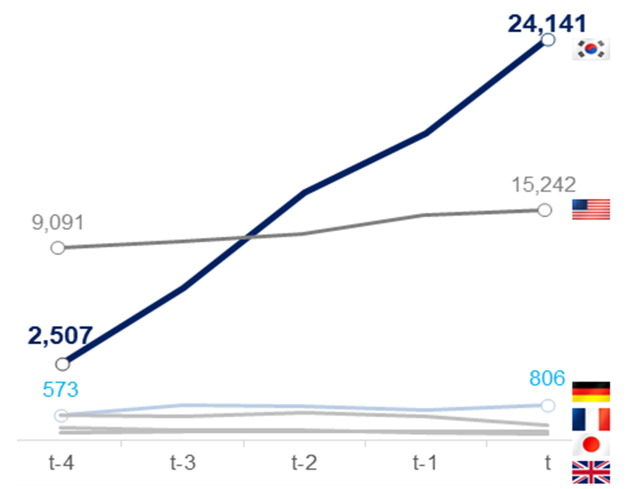
The Korea Chamber of Commerce and Industry (KCCI) stated in its report titled “Comparison of Legislative Systems in Major Countries and Implications,” released on the 15th, that the number of bills submitted to the Korean National Assembly increased more than tenfold over five sessions, from 2,507 bills during the 16th National Assembly (2000?2004) to 24,141 bills in the 20th National Assembly (2016?2020). This is a steep increase rarely seen in major countries such as the United States, Japan, and Germany.
Looking at the trend of bills proposed over the last five sessions in major countries, the United States (9,091 → 15,242), Germany (573 → 806), and the United Kingdom (167 → 191) saw slight increases, while Japan (273 → 155) and France (563 → 330) experienced decreases. Considering this, KCCI explained that the increase in bills proposed in Korea is at an exceptional level. The 21st National Assembly has also continued this upward trend, surpassing 90% (21,763 bills) of the 20th National Assembly’s proposals within just three years of its inception.
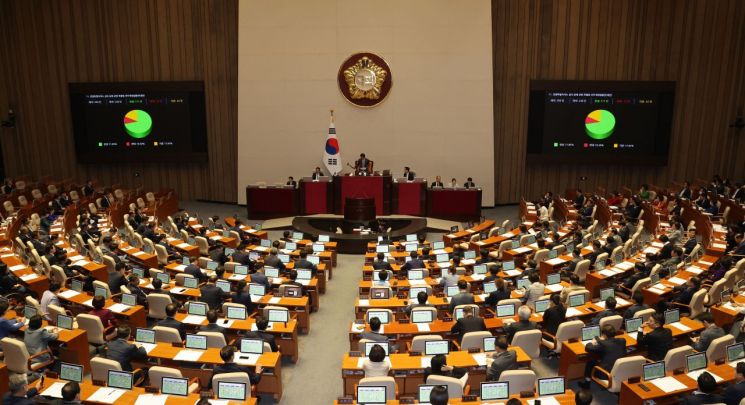
The report pointed out that legislative efficiency is declining. The increase in proposed bills has led to a drop in the bill approval rate and a rise in bills discarded due to expiration of terms. The bill approval rate, which was 37.7% during the 16th National Assembly, steadily declined to 13.2% in the 20th National Assembly. In the 21st National Assembly, it fell further to 9.4%, falling short of the approval rates in major countries such as Germany (67%), Japan (43.8%), the United Kingdom (16.5%), and France (12.7%).
Professor Hong Wansik of Konkuk University School of Law said, “While active bill proposals positively reflect public opinion, they can increase the burden of bill review or act as a factor lowering legislative quality. In fact, an analysis based on the 20th National Assembly shows that the review time per bill is only 13 minutes.”
The report recommended introducing legislative impact analysis for bills proposed by members of the National Assembly, which currently do not undergo such analysis unlike government-initiated bills. It argued that this could minimize inefficiencies arising from the increase in proposed bills, the rise in similar or duplicate regulatory bills, and the decline in legislative quality due to insufficient bill review time.
It emphasized that now is the right time to introduce legislative impact analysis. Currently, six related amendment bills are pending in the 21st National Assembly. Since efforts to institutionalize legislative impact analysis for member-proposed bills began in the 18th National Assembly, this is the largest number of bills pending, indicating a growing consensus within the National Assembly. The six pending bills in the 21st National Assembly include proposals by Assemblyman Kim Taenyeon and Assemblyman Shin Jeonghun (both from the Democratic Party), and Assemblymen Yoon Jaeok, Lee Jongbae, Jeong Gyeonghee, and Hong Seokjun (all from the People Power Party).
The report highlighted that most major countries implement legislative impact analysis and pursue improved legislative quality and efficiency through complex proposal and review processes. In the United Kingdom, both government and member bills undergo legislative impact analysis, covering all laws regardless of type or scope, including both primary and subordinate legislation. Germany requires submission of opinion documents equivalent to legislative impact analysis upon request by the Bundestag. France, which restricts areas where members can propose legislation, has the highest administrative court submit opinions upon request by the presidents of the National Assembly and the Senate. Japan does not have legislative impact analysis but mandates internal party review before member bill proposals. In the United States, it is common to attach cost-benefit analyses when submitting bills, and analysis reports on legislative impacts are attached before bicameral agreement.
Kang Seokgu, head of the KCCI Research Department, said, “Preparing bills that reflect diverse legislative demands is an important duty and authority of the National Assembly, but the more bills there are, the greater the review burden and concerns about legislative quality inevitably increase. Since a consensus has been formed within the National Assembly, we hope that discussions and legislation to introduce legislative impact analysis will proceed swiftly in the 21st National Assembly.”
© The Asia Business Daily(www.asiae.co.kr). All rights reserved.


















