On the 13th (local time), American semiconductor company Nvidia became the first semiconductor company to surpass a market capitalization of $1 trillion. Nvidia, considered the biggest beneficiary of the artificial intelligence (AI) boom, has seen its stock price soar more than 180% just this year. On the same day, Tesla continued its longest-ever rally, extending it to 13 consecutive trading days. As leading big tech companies keep breaking new records for 'firsts' and 'longest' streaks, some in the market are also expressing caution that these rallies may be nearing their end.
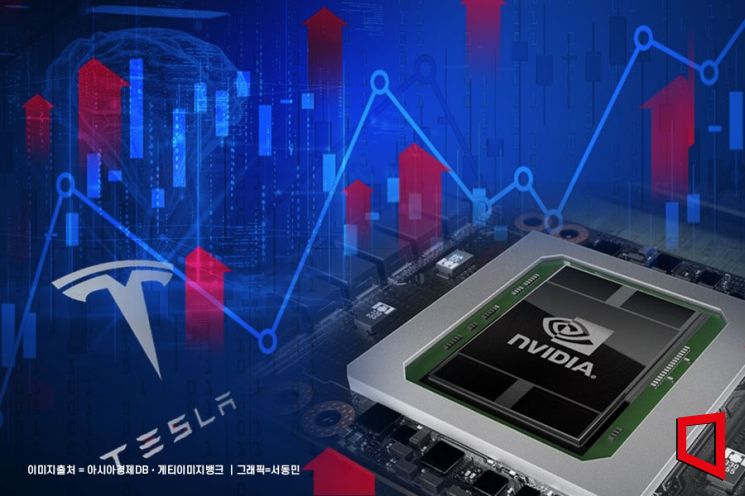
On that day in the New York Stock Exchange, Nvidia's stock closed at $410.22 per share, up 3.90% from the previous close. Accordingly, Nvidia's market capitalization surpassed $1 trillion based on the closing price. This milestone comes 30 years after Nvidia's founding in 1993. It is also a record achieved about two weeks after the company briefly touched a $1 trillion market cap intraday on the 30th of last month. However, the closing price was lower than the previous intraday high of $419.39.
Nvidia is the first semiconductor company to cross the $1 trillion market cap mark. Even across the entire New York Stock Exchange, the $1 trillion club includes only a few companies such as Apple, Microsoft, Google Alphabet, and Amazon.
Nvidia's stock price has surged more than 180% this year, fueled by the AI boom including ChatGPT. Supplying over 90% of the world's market for high-value-added semiconductors such as graphics processing units (GPUs) used in AI development, Nvidia has continued its rally amid surprising earnings and rosy expectations. Earlier, it projected second-quarter revenue of $11 billion, exceeding Wall Street estimates by more than 50%, further fueling the rally. Wall Street investment banks such as JP Morgan and Evercore ISI have already raised Nvidia's target stock price to as high as $500.
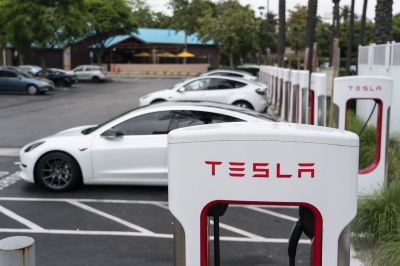
On the same day, electric vehicle company Tesla also broke its record for the longest rally. Tesla's stock closed at $258.71 per share, up 3.55% from the previous close, marking 13 consecutive trading days of gains. The previous longest rally was 12 consecutive trading days recorded in June 2010. The recent Tesla rally is supported by news of partnerships with Ford, General Motors (GM), and others for high-speed charging stations. There is growing buying interest on expectations that Tesla's Supercharger network could become the standard for electric vehicles in the U.S. The so-called "300Sla" (stock price $300) expectation is also rising. Investment firm Wedbush recently set Tesla's target price at $300. This contrasts with the earlier part of the year when Tesla's stock wavered due to intensified competition in electric vehicles and price cuts.
Other big tech stocks such as Microsoft (MS), Google, and Amazon have also continued their upward momentum recently. The Nasdaq index, which is tech-heavy, closed up 0.83% at 13,573.32, breaking the 13-month high recorded the previous day. The rally in tech stocks was reaffirmed as the U.S. consumer price index showed a slower increase and expectations for interest rate freezes grew.
However, caution is gradually spreading due to the soaring stock prices. In particular, Wall Street has expressed concern that the rally is concentrated in a few big tech stocks, including Nvidia.
Apple, which reached an all-time high closing price and approached a $3 trillion market cap the previous day, is facing mostly downgraded investment opinions from analysts. UBS downgraded Apple to "neutral" late the previous day. UBS stated, "The stock trading at 29 times earnings per share is expensive," and added, "This is especially true considering iPhone sales are expected to slow by about 1-2% in the second half of this year." Shortly after, Bloomberg reported based on its own data analysis that buy ratings for Apple were at 67%, the lowest level since the end of 2020. Reflecting the impact of UBS's downgrade and others, Apple's stock closed slightly lower that day.
Christopher Ailman, Chief Investment Officer (CIO) of the California State Teachers' Retirement System, appeared on CNBC that day and warned, "Wall Street is exaggerating AI." He pointed out that this year's rally is concentrated in a few mega-cap tech stocks including Nvidia, calling it "a signal that it may not continue." He added, "I am very concerned about how narrow the market is," and noted, "I am worried that technology, especially big tech, has risen excessively."
Aswath Damodaran, a professor of business administration at New York University, also stated on CNBC's Closing Bell, "For Nvidia to justify its current stock price, it would have to either annihilate or dominate the entire AI market. I cannot willingly accept such a bet," and pointed out, "There is too little room left for further gains." Jonathan Krinsky, a technology strategist at BTIG, suggested in a report that the rally in tech and growth stocks may be nearing its end. He noted that Nasdaq futures are 22% above the 200-day moving average and diagnosed, "This year's pattern is almost the opposite of last year's."
© The Asia Business Daily(www.asiae.co.kr). All rights reserved.
![Clutching a Stolen Dior Bag, Saying "I Hate Being Poor but Real"... The Grotesque Con of a "Human Knockoff" [Slate]](https://cwcontent.asiae.co.kr/asiaresize/183/2026021902243444107_1771435474.jpg)

















