Taking Photos and Decorating... Play Culture Unmatched by Smartphones
Korean Four-Cut Instant Photos Also Popular for Being "Natural"
"Puricura (instant photos) have been around for 25 years, yet they still remain popular."
Recently in Japan, an instant photo craze called 'Puricura' is resurging, especially among the MZ generation (Millennials + Generation Z). The instant photo machines, once known in Korea as 'sticker photos,' are attracting the footsteps of the MZ generation again. Riding this wave, the four-cut instant photos recently trending in Korea are also gaining popularity in Japan.
In an era where smartphones capable of high-resolution photography are widely available, why are the MZ generation once again enthusiastic about Puricura? Japanese media have begun to focus on the beloved retro culture, independent of technological advancements.
On the 12th, Nihon Keizai Shimbun (Nikkei) reported on the 'Puricura love' among young people, including Generation Z. According to the report, in bustling areas like Harajuku in Tokyo, it is not uncommon to find dozens of these machines placed together, bustling with students and tourists even on weekdays.
Nikkei quoted a representative from the Japanese Puricura company Furyu, saying, "Smartphones are not enemies but have become partners coexisting with Puricura." The more frequently people take photos with their smartphones, the more they tend to visit Puricura machines.
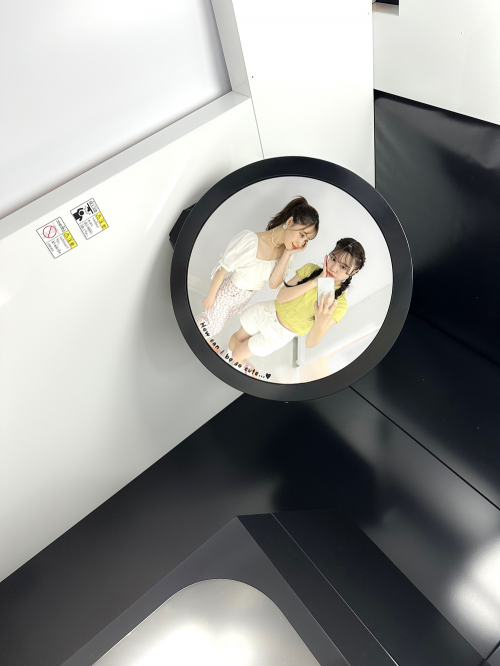 Smartphone plan offered by Japan's Furyu's 'My Palette.' It provides time to take personal photos with a smartphone. (Photo by Furyu website)
In fact, Puricura machines have begun evolving in ways that allow coexistence with smartphones. The Japanese Puricura machine 'My Palette' offers a 'Smartphone Plan.' This service allows users to place their smartphones in the photo booth and freely take videos and photos for 60 seconds. This feature was added due to high demand for sharing instant photo-taking moments on social networking services (SNS) like TikTok and Instagram.
Similar to photo editing applications on smartphones, detailed retouching functions have also been introduced. Moving away from the old methods of simply enlarging eyes and reducing face size, users can now select desired facial image types such as 'cute,' 'mature,' or 'natural' to transform their faces all at once. Even the eyes can be individually adjusted in size and contour.
The emotional appeal that smartphones cannot capture has also played a role in attracting young people. Nikkei cited a group interview survey conducted more than 200 times annually by Furyu targeting women in their teens and twenties, analyzing that the underlying reasons for taking Puricura photos are 'commemoration,' 'play,' and 'decoration.'
According to Furyu, a survey of 150 people in their teens and twenties who took Puricura photos in August last year showed that 70% answered "to preserve memories of the day," which was the most common reason. The second most common reason was "because I can take photos with friends and doodle on them." Nikkei reported, "The doodling feature that allows drawing pictures or writing, and the composite function that lets users decorate their faces with stickers have become a form of play for Generation Z," adding, "These elements cannot be experienced simultaneously on smartphones, making Puricura distinct."
Thanks to the Puricura craze, Korean instant photos are also gaining popularity in Japan. Unlike Japanese Puricura, which emphasizes retouching such as large eyes and pale skin, Korean instant photos pursue naturalness, targeting a niche demand. The four-cut Korean instant photo machine 'Photoism' opened its first store in Japan this year and plans to expand to 30 stores within the year due to high visitor numbers. A Photoism representative said, "There is surprisingly high demand for avoiding excessive decoration," and added, "The fact that people can take photos as they are has been well received."
© The Asia Business Daily(www.asiae.co.kr). All rights reserved.

















