Direct Announcement of Low Birthrate Measures on the 13th
Japanese Prime Minister Fumio Kishida directly announced measures to address the low birthrate on the 13th.
At a press conference that day, Prime Minister Kishida stated, "The main factors behind the rising unmarried rate and declining birthrate are income issues among the younger generation." He emphasized that unless a society is created where young people can have hope, marry, and have children, it will be difficult to reverse the low birthrate trend.
He added that "the period until 2030, when the young population is expected to start declining rapidly, is the last chance to reverse the trend," and said, "With determination not to back down, we will implement economic growth and low birthrate measures like the two wheels of a car."
Since the beginning of his tenure, Prime Minister Kishida has frequently emphasized "unprecedented low birthrate" measures. On this day, he chaired the "Children's Future Strategy Meeting" and explained the decided low birthrate measures. The measures, announced under the name "Children's Future Strategy Policy," include government support for costs related to child-rearing and childbirth.
The existing child allowance, which was paid up to middle school students, will be extended to high school students, and income restrictions for parents will be abolished, with implementation starting in October next year. The Japanese government has prepared a plan to provide 15,000 yen (about 150,000 won) per month for infants aged 0 to 3, 10,000 yen (about 100,000 won) per month up to high school students, and 30,000 yen (about 300,000 won) per month for the third child and beyond.
From 2026, childbirth costs will be covered by insurance. A plan was also proposed to increase the childcare leave benefit rate so that the actual income of both parents does not decrease when using childcare leave.
Regarding securing funding, he said, "The principle is to secure it through thorough expenditure reform so as not to hinder economic growth or reduce the income of the younger generation." He denied the criticism that the government is trying to delay presenting funding measures by stating that necessary reform bills will be submitted to the Diet.
He stated that over the next three years, Japan's budget for child and child-rearing expenses will be among the highest internationally when viewed on a per capita family relationship expenditure basis. The Japanese government will issue special child bonds temporarily to cover funding shortages and, along with expenditure reforms in social security costs, will also establish a new "support fund system."
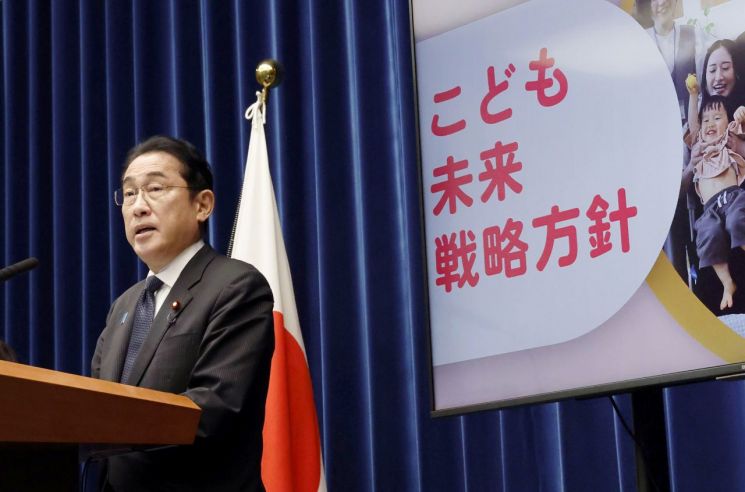 Japanese Prime Minister Fumio Kishida held a press conference on the 13th and directly announced measures to address the low birthrate.
 [Image source=Yonhap News]
Meanwhile, at the press conference, Prime Minister Kishida said regarding the dissolution of the House of Representatives and the possibility of an early general election, "I will carefully observe the political situation and make a judgment."
He also expressed his intention to continue efforts to encourage North Korea to engage in dialogue concerning the resolution of the past abduction issue of Japanese citizens by North Korea. In particular, he said, "I will continue to convey my determination from the perspective of resolving current issues and opening a new era together with both sides."
However, regarding the possibility of a Japan-North Korea summit meeting within this year, he said, "At this point, I would like to refrain from giving a definitive answer."
© The Asia Business Daily(www.asiae.co.kr). All rights reserved.
![Clutching a Stolen Dior Bag, Saying "I Hate Being Poor but Real"... The Grotesque Con of a "Human Knockoff" [Slate]](https://cwcontent.asiae.co.kr/asiaresize/183/2026021902243444107_1771435474.jpg)











