Bathhouses Shrink Due to COVID-19 and Electricity Price Hikes
Tourists Fill the Void Left by Disappearing Domestic Customers
Following the impact of COVID-19, the bathhouse industry has been further hit by rising electricity and gas prices, leading to a contraction in the sector. Amid this, foreign tourists have emerged as a new consumer base for jjimjilbangs (Korean sauna and bathhouses).
Tourists from China, Japan, Vietnam, and India have been drawn to jjimjilbangs’ signature offerings such as sikhye (sweet rice drink) and maekbanseok eggs (eggs boiled on a heated stone). Some foreigners even sweat it out in the over 80-degree bulgama (hot kiln) rooms.
 A scene from Netflix's program 'Conan Without Borders.' Conan O'Brien and actor Steven Yeun once visited a Korean jjimjilbang.
 [Image source=Netflix/Online community capture]
According to the Chosun Ilbo on the 13th, at a jjimjilbang in Jung-gu, Seoul, more than half of the approximately 30 guests were foreigners.
Chinese visitor Zhang Ling (42) said, “I often come to Korea to buy clothes in Dongdaemun, and when I have a late evening flight and some time to spare, I use the jjimjilbang. It’s convenient because I can shower, and I think the charm of jjimjilbangs lies in experiencing Korea’s traditional atmosphere.”

A representative of a jjimjilbang in Seodaemun-gu, Seoul, stated, “There has been a significant increase in group tourists from Hong Kong and Singapore.”
The bathhouse industry, already severely contracted due to the spread of COVID-19 in 2020, has been dealt a direct blow by the rise in electricity and gas prices. In May, the consumer price inflation rate for bathhouse fees reached its highest level in over 14 years since the global financial crisis.
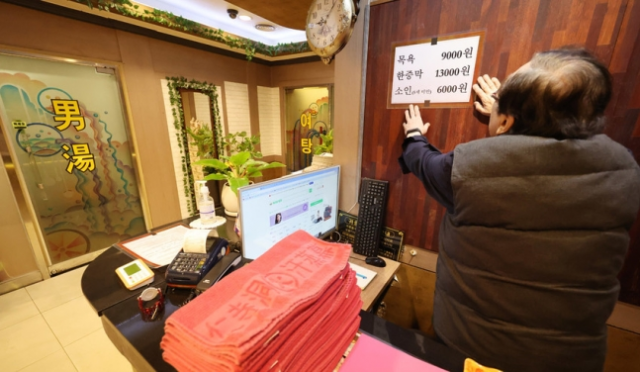 The owner is touching the increased price list at a public bathhouse in Jongno-gu, Seoul.
 [Photo by Yonhap News]
According to consumer price trends compiled by Statistics Korea, bathhouse fees in May rose 14.1% compared to the same month last year. This was the largest increase in 14 years and 5 months since December 2008, when prices rose 14.2% during the global financial crisis.
As a result, the number of bathhouses has been declining. The number of bathhouses peaked at 1,442 in 2003, but from 2020 to last year, 730 bathhouses nationwide have closed.
As of the end of last year, there were 6,012 operating bathhouses nationwide. Ultimately, only 34.8% of all bathhouses established since 1954 remain. Among the 17 metropolitan municipalities, Seoul has the highest proportion of closed bathhouses, with only 704 remaining out of 3,885 licensed or registered bathhouses as of last year. The closure rate stands at 81.9%.
In this situation, foreign tourists are filling the gap left by the declining number of Korean customers. The rapid recovery of foreign tourists visiting Korea after the lifting of COVID-19 social distancing measures is also influencing this trend. According to the Korea Tourism Organization, about 1.71 million foreign tourists visited in the first quarter of this year, a 16.2% increase compared to the fourth quarter of 2022.
The increase in foreign tourists has also boosted the popularity of other tourist attractions in Seoul. N Seoul Tower announced on the 13th that the number of foreign visitors to its observatory from January to May increased by 305% compared to the same period last year.
© The Asia Business Daily(www.asiae.co.kr). All rights reserved.



















