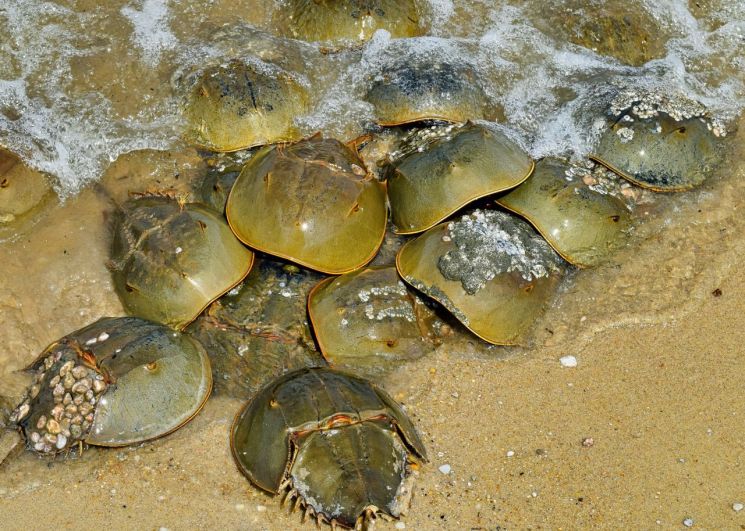
A testing method that can replace horseshoe crab blood, which is essential for developing vaccines and other pharmaceuticals, has been registered in the Korean Pharmacopoeia. An official from the Ministry of Food and Drug Safety (MFDS) stated on the 13th, “This is a measure to expand the social value of animal welfare to the pharmaceutical and bio industries.” According to the medical field, when developing new drugs in the form of injections or stents administered into the bloodstream, an ‘endotoxin (a toxin that causes strong fever in the bloodstream) test method’ must be conducted. Exposure to endotoxins in humans can cause high fever, septic shock, and potentially death.
The key substance in this test method is found in the blue blood of the horseshoe crab. When a substance called lysate (LAL; Limulus Amebocytic Lysate), made from extracted blood cells, reacts with endotoxins, it coagulates. Since the U.S. Food and Drug Administration (FDA) approved the LAL test method in 1973, it has become the standard for endotoxin testing.
However, 30% of horseshoe crabs die during blood collection, and even those returned to the sea often fail to spawn properly. Because of this, the International Union for Conservation of Nature (IUCN) listed the horseshoe crab as an endangered species on its Red List in 2016. Moreover, with the unprecedented COVID-19 pandemic prompting pharmaceutical companies worldwide to develop vaccines, it is estimated that 450,000 horseshoe crabs have been used. As the pharmaceutical market is expected to continue growing steadily, the deterioration of horseshoe crab populations and the need for alternative substances have increased simultaneously.
The MFDS newly established an animal alternative test method (rFC; recombinant Factor C) to minimize the use of horseshoe crab blood. Recombinant Factor C is a reagent made by artificially recombining genes and can replace the LAL test method. Seung-ryeol Ryu, head of the Biopharmaceutical Research Division at the National Institute of Food and Drug Safety Evaluation, explained, “In a 2021 research project, endotoxin testing using the rFC test method showed performance equivalent to the LAL test method in five indicators: specificity, linearity, repeatability, precision, and robustness.”
On the same day, the MFDS will hold a workshop for the pharmaceutical and bio industries to promote the spread of the animal alternative endotoxin test method. Since the endotoxin test requires the operator’s proficiency, the workshop aims to inform about the newly registered test method and its correct usage. About 100 pharmaceutical industry representatives are expected to attend.
Overseas, standards for animal alternative test methods are being established one after another. The European Pharmacopoeia approved the use of recombinant Factor C in December 2021. Japan registered it in its pharmacopoeia in April 2021, and China did so in June 2020. However, progress in the United States has been slow. Although there was a proposal to register recombinant Factor C as a standard in the U.S. Pharmacopoeia in 2020, the expert committee to review it was disbanded in September 2021. This year, the U.S. Pharmacopoeia has reorganized the expert committee and is moving to establish standards for animal alternative test methods.
An MFDS official said, “Animal alternative test methods cannot completely replace tests using horseshoe crab blood, but since the number of horseshoe crabs is limited, we hope pharmaceutical companies will take an interest in the fact that new test methods exist.”
© The Asia Business Daily(www.asiae.co.kr). All rights reserved.

















