Individuals Buy 475.9 Billion KRW of Gobbus ETF... KOSPI Net Sold 5.5651 Trillion KRW
Brokerages Raise KOSPI Upper Range for Second Half Despite Advanced Economies' Growth Slowdown Concerns

As the KOSPI continues its bullish trend, breaking above the 2600 level for the first time in over a year, individual investors are drawing attention by betting on a market downturn. In particular, individual investors have been aggressively purchasing ‘double inverse’ exchange-traded funds (ETFs) that reflect twice the magnitude of index fluctuations. While these products yield double profits when the index falls, losses also double when the index rises, raising concerns about whether these bets will benefit or harm individual investors.
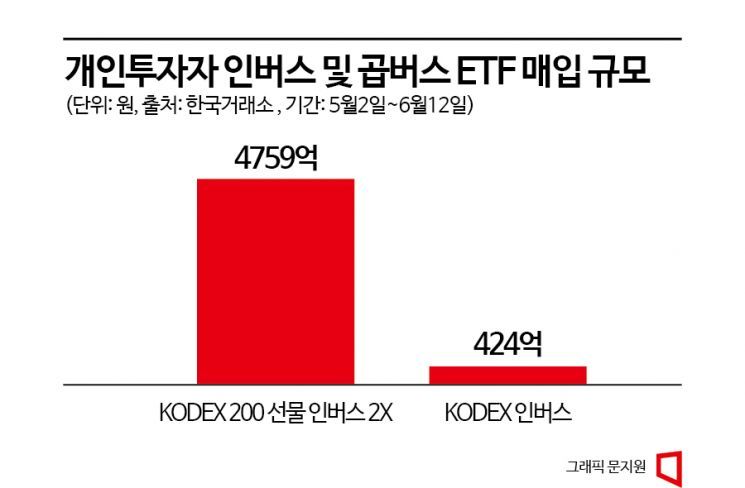
According to the Korea Exchange, individual investors bought 475.9 billion KRW worth of the ‘KODEX200 Futures Inverse 2X’ ETF between May 2 and June 12, the largest amount among ETFs. This product delivers twice the returns when the KOSPI 200 futures index declines, but losses also double when the index rises. During the same period, individual investors also net purchased 42.4 billion KRW worth of the ‘KODEX Inverse’ ETF. This indicates a growing perception among individual investors that the KOSPI has reached a peak and a strong expectation of a market downturn.
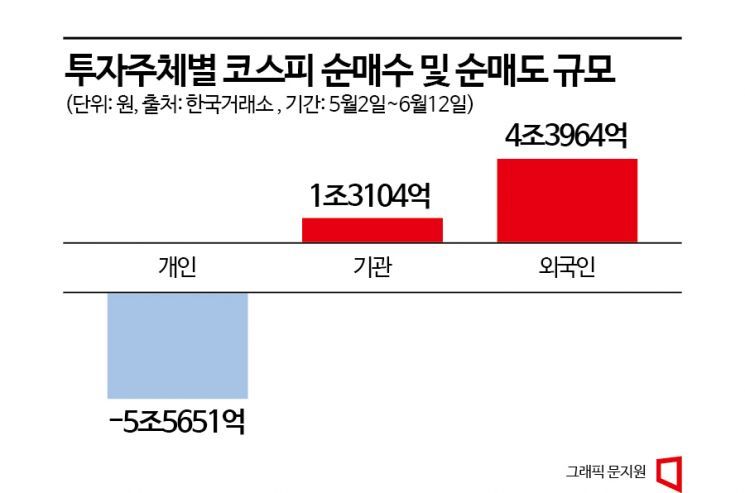
In fact, individual investors net sold a total of 5.5651 trillion KRW worth of KOSPI stocks during the same period. This amount is roughly equivalent to the combined net purchases of foreign investors (4.3964 trillion KRW) and institutional investors (1.3104 trillion KRW). Essentially, the volume sold by individuals was fully absorbed by foreign and institutional investors.
Contrary to individual investors betting on a market decline, securities firms have issued positive outlooks for the stock market in the second half of the year. The most optimistic forecast came from DB Financial Investment, which projected the KOSPI could reach as high as 3000 points, coining the term ‘Samcheonpi’ (three-thousand KOSPI). Hyunki Kang, a researcher at DB Financial Investment, stated, “With increased purchasing power in major countries, there is potential for an earnings-driven market, and the stock market is expected to experience an unexpectedly strong rally in the second half of this year.” Samsung Securities, which had the most conservative outlook among securities firms, also raised its KOSPI forecast for the second half. Previously suggesting a range of 2200 to 2600, Samsung Securities recently revised it upward to 2350 to 2750. KB Securities, which had set the upper bound at 2800, also raised it to 2920. Most other securities firms projected the KOSPI upper range between 2650 and 2900 for the second half. These forecasts represent a significant upward revision compared to the 2000 to 2600 range projected by the securities industry at the end of last year.
The reason securities firms are repeatedly raising their KOSPI forecasts for the second half is due to expectations that earnings improvements will continue, especially among large-cap stocks driving the KOSPI’s rise, leading to a rebound in corporate profit forecasts. The semiconductor sector is a prime example. Since domestic semiconductor inventory has already peaked, there are expectations that inventory levels will decline from the second quarter onward. Hyunwoo Do, a researcher at NH Investment & Securities, noted, “The semiconductor industry recovery will begin in earnest from the third quarter of this year,” adding, “Production cuts are underway across the industry, and demand is improving, centered on PCs and artificial intelligence (AI) servers.”
However, some caution that corporate earnings rebounds may fall short of expectations, and it remains to be seen whether the semiconductor-driven large-cap rally will spread throughout the broader market. Kyungmin Lee, a researcher at Daishin Securities, said, “Due to China’s economic recovery and semiconductor industry improvement, the rebound is expected to continue through the third quarter,” but also analyzed, “As the year progresses, concerns over economic slowdown in developed countries will likely limit the upside, resulting in a box-range market.”
© The Asia Business Daily(www.asiae.co.kr). All rights reserved.



















