Body Hair (體毛), a Defensive Line Against Mosquitoes
Also Important as a Clue to Human Evolution
Thin Body Hair Can Defend Against Parasites
Mosquitoes, the unwelcome guests that visit every summer night. However, not all humans are equally vulnerable to mosquitoes. People with more body hair tend to get bitten less by mosquitoes.
The way body hair blocks mosquitoes is simple. The hair growing on the human body is usually curly. When a mosquito trying to penetrate the skin gets caught in the hair, it becomes immobilized. Additionally, body hair acts as an 'alarm system' that detects and notifies the presence of mosquitoes early, increasing the chances of catching them before they bite.
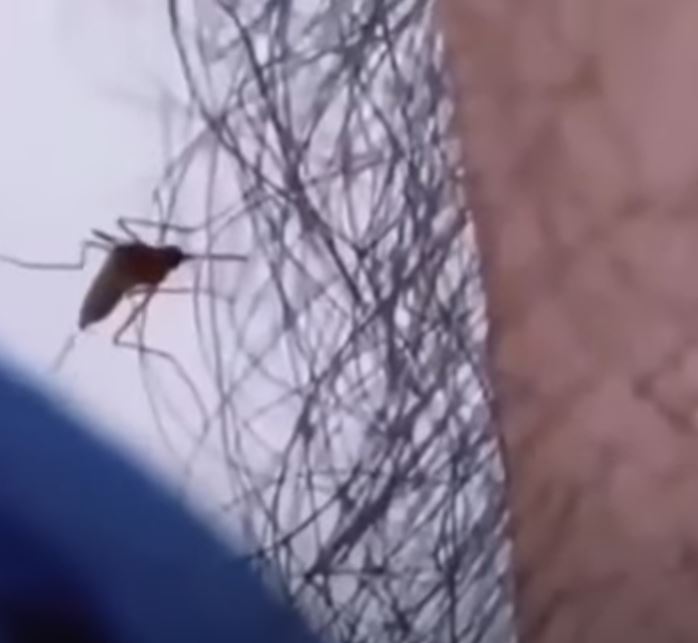
As a result, people with dense and thick body hair can be protected from biting insects like mosquitoes. Those with more body hair are naturally endowed with a body that is particularly resistant to mosquitoes.
Although it may seem like a simple intuition, 'body hair that blocks mosquitoes' can be an important clue to understanding the human body. Until now, academia has not clearly explained why humans still have body hair. However, if we assume that body hair plays a role in defending against insects, we can understand why humans have hair on their bodies.
There is even a serious paper on this topic. It is titled "Enhanced Detection of Ectoparasites through Human Vellus Hair" published in the world-renowned biology journal Biology Letters.
In this paper, the researchers point out that "human hair neither regulates temperature nor plays an important role in sexual selection." In other words, human hair is almost useless for survival or reproduction.
 Young chimpanzee. Unlike humans, other primates have dense and thick fur.
 [Image source=Yonhap News]
Instead, the researchers focused on the possibility of a 'microbial protection function.' They explained, "We experimentally tested whether human vellus hair enhances the ability to detect ectoparasites," adding, "If body hair allows humans to detect and remove ectoparasites more quickly, it would be beneficial by reducing blood loss and the risk of pathogen transmission."
The researchers recruited 10 female and 19 male volunteers with an average age of 21. The experiment involved shaving one arm while leaving the other unshaved, then exposing both arms to biting insects and measuring the speed at which the volunteers detected the insects on their bodies. The results revealed that 'fine body hair' helps the human body detect and block insects more quickly.
However, body hair is not always beneficial for insect defense. In fact, the much thicker and denser fur of other mammals is often used as a hiding place or nest for parasites.
Regarding this, the researchers suggested that "compared to other primates, the reduced body hair in humans may be an adaptation to eliminate 'parasite refuges,'" and proposed that humans might have chosen a 'compromise' by developing thin body hair to block insects.
© The Asia Business Daily(www.asiae.co.kr). All rights reserved.


















