Weekend Rain Forecasted, Authorities Monitor Lightning Strike Risks
A wildfire that broke out last month in Quebec, eastern Canada, has not subsided and is spreading westward. Although wildfires frequently occur in Canada, the scale of this wildfire is unprecedented, prompting support from countries including the United States and Europe.
On the 9th (local time), North American foreign media reported that a wildfire broke out in British Columbia, western Canada. British Columbia borders the Pacific coast and faces the U.S. state of Washington to the south. In some areas of British Columbia, temperatures have soared to over 30 degrees Celsius, about 10 degrees higher than the average for this time of year, intensifying the wildfire.
Canadian authorities have issued evacuation orders to about 2,500 residents of Tumbler Ridge village in northeastern British Columbia. The evacuation order has been extended to the nearby Donnie Creek area. Over 3,500 people have also evacuated in neighboring Alberta. Rain is expected in some areas over the weekend, which may help subdue the wildfire, but authorities remain on alert due to the risk of lightning strikes.
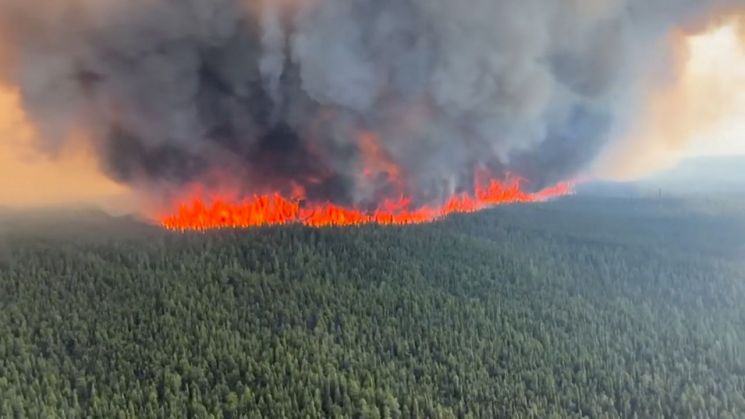 On the 8th (local time), a wildfire broke out at Tumbler Ridge in British Columbia, western Canada. [Image source=Yonhap News]
Wildfires often occur in Canada. However, local foreign media note that it is rare for a wildfire that started in the east last month to move westward and spread on such a large scale. The Canadian Interagency Forest Fire Centre (CIFC) reported that 427 fires occurred that day, with 232 of them in areas difficult for authorities to access.
The wildfire that broke out last month in Canada remains active, centered in Quebec in the east. About one-third of the ongoing wildfires are concentrated in Quebec. The wildfire has destroyed 3.8 million hectares (38,000 km²) of land, exceeding one-third of South Korea’s area (approximately 100,000 km²).
As the worst wildfire in history engulfs Canada, countries around the world have stepped up to provide support. In the United States, President Joe Biden promised assistance for firefighting efforts, and firefighters from Maine, New Hampshire, and New York were dispatched to Canada. Firefighters were also sent from European countries including France, Portugal, and Spain. South Africa, Australia, and New Zealand have also deployed personnel to help extinguish the wildfires.
The Quebec Minister of Forests said, "Hundreds of firefighters from around the world have come to Canada," adding, "We will work to extinguish the wildfires within days or weeks." He also stated, "We hope the weather will cooperate," and forecasted, "The situation will not improve in the coming days."
Meanwhile, the Canadian wildfires have severely polluted air quality in the United States. Air quality worsened significantly in several areas of the U.S. East Coast, including New York and Washington, D.C., with some regions experiencing pollution levels comparable to those of New Delhi, India. President Biden instructed the Department of Transportation to manage the impact on air traffic caused by the deteriorating air quality.
© The Asia Business Daily(www.asiae.co.kr). All rights reserved.
![Clutching a Stolen Dior Bag, Saying "I Hate Being Poor but Real"... The Grotesque Con of a "Human Knockoff" [Slate]](https://cwcontent.asiae.co.kr/asiaresize/183/2026021902243444107_1771435474.jpg)
















