Summoning the Chinese Ambassador... "Provocative Remarks, Interference in Internal Affairs"
Cooling of Korea-China Relations... Growing Concerns over Economic Retaliation
On the 9th, the Ministry of Foreign Affairs summoned Xing Haiming, the Chinese Ambassador to Korea, and the Director of the National Security Office responded by stating that "national relations are based on mutual respect," leading to a rapid cooling of Korea-China relations. This firm response from our government followed the summoning, in reaction to the aggressive criticism of the Yoon Seok-yeol administration's foreign policy made by Ambassador Xing during a dinner with Lee Jae-myung, leader of the Democratic Party of Korea.
Earlier, on the evening of the 8th, Ambassador Xing invited Lee to the Chinese Ambassador's residence and strongly criticized the Yoon Seok-yeol administration's diplomacy, which is closely aligned with the United States and Japan. In particular, he pointed out that "betting on the United States winning and China losing is a mistaken judgment," and mentioned that "those who bet on China's defeat will surely regret it later."
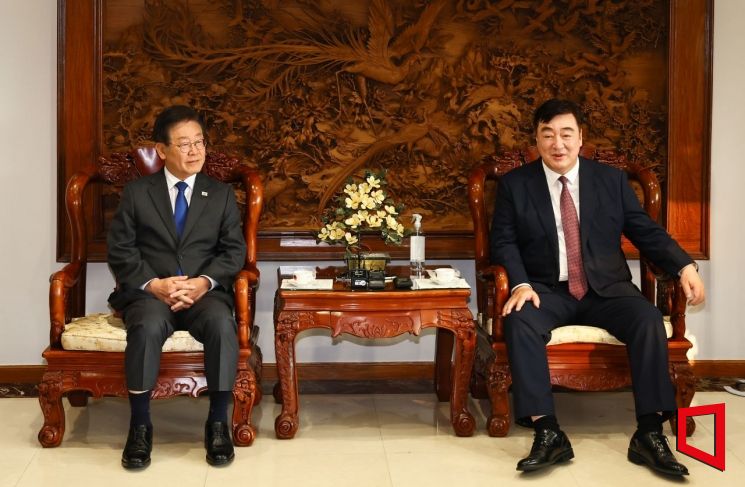 On the evening of the 8th, Xing Haiming, the Chinese Ambassador to Korea, delivered a greeting while receiving a courtesy call from Lee Jae-myung, the leader of the Democratic Party of Korea, at the Chinese Ambassador's residence in Seongbuk-gu, Seoul. Photo by the National Assembly Press Photographers Group
In response, our government summoned Ambassador Xing that afternoon. The term 'summoning' refers to the act of a country's foreign authorities calling in the ambassador, minister, or consul of a foreign country stationed in their country to their diplomatic office for diplomatic reasons concerning bilateral relations. While it is not as severe as recalling one's own ambassador, expelling the other country's ambassador, or designating a diplomatic persona non grata, it is a negative diplomatic measure.
The Ministry of Foreign Affairs summons Ambassador Xing within a day... Criticizes as "Contrary to the Spirit of Korea-China Friendship"
Jang Ho-jin, First Vice Minister of Foreign Affairs, pointed out that the ambassador's criticism of our government's policies with inaccurate content and unacceptable expressions in front of multiple media outlets violated the Vienna Convention and diplomatic customs. The Vienna Convention stipulates the mission of diplomatic agents to promote friendly relations. He also criticized it as interference in domestic affairs, which could be considered meddling in our internal politics.
Vice Minister Jang also stated that Ambassador Xing's recent words and actions seriously contradict the wishes of both governments and peoples of Korea and China, who value and seek to develop Korea-China relations based on mutual respect. He pointed out that it is irresponsible behavior that goes against the spirit of Korea-China friendship and fosters misunderstanding and distrust between the two countries. Vice Minister Jang criticized Ambassador Xing, saying he should conduct himself in accordance with the duties of a diplomatic envoy regarding his recent conduct, and that all consequences will be his responsibility.
Previously, on the 8th, Ambassador Xing invited Lee to the Chinese Ambassador's residence in Korea and stated, "In the situation where the United States is exerting full pressure on China, some are betting that the United States will win and China will lose, but this is a mistaken judgment and a failure to properly understand the flow of history."
He also said, "Currently, Korea-China relations are facing many difficulties. I am deeply concerned and heartbroken about this," but bluntly pressured the Korean government by adding, "Honestly, the responsibility does not lie with China."
Director Cho Tae-yong mentions 'Confident Diplomacy'... A Rebuke to Ambassador Xing's Provocation
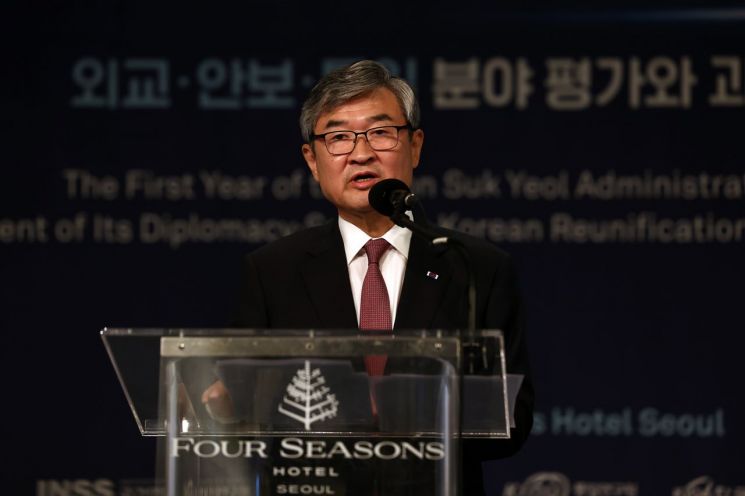
In response to Ambassador Xing's remarks, our government also responded firmly. Cho Tae-yong, Director of the National Security Office, said regarding Korea-China relations, "We will build a healthy Korea-China relationship through confident diplomacy that matches the enhanced national power of the Republic of Korea and meets the expectations of our people."
Director Cho made these remarks at a joint academic conference hosted by four national research institutions, including the National Security Strategy Institute and the Korea National Diplomatic Academy, on the topic of "Evaluation and Tasks in the Fields of Diplomacy, Security, and Unification on the First Anniversary of the Yoon Seok-yeol Government's Inauguration." The mention of terms like 'confident diplomacy' and 'mutual respect' in relation to Korea-China relations is interpreted as a response to Ambassador Xing's aggressive remarks about the Yoon administration's diplomacy closely aligned with the United States and Japan.
Director Cho emphasized, "The Yoon Seok-yeol government aims to be a global pivotal state that places national interests at the center and cooperates with the international community based on principles. There is no difference in this regard with China."
With Ambassador Xing's criticism of the Yoon government, our government's summoning, and the subsequent retaliatory remarks, Korea-China relations have rapidly entered a cooling phase. Given Korea's high dependence on exports to China, there is a high possibility of retaliatory measures at the level of industrial and supply chains between the two countries. In fact, Ambassador Xing hinted at trade retaliation in his previous remarks, saying, "China has a huge market and its doors to external openness are always open. Those who bet on China's defeat will surely regret it."
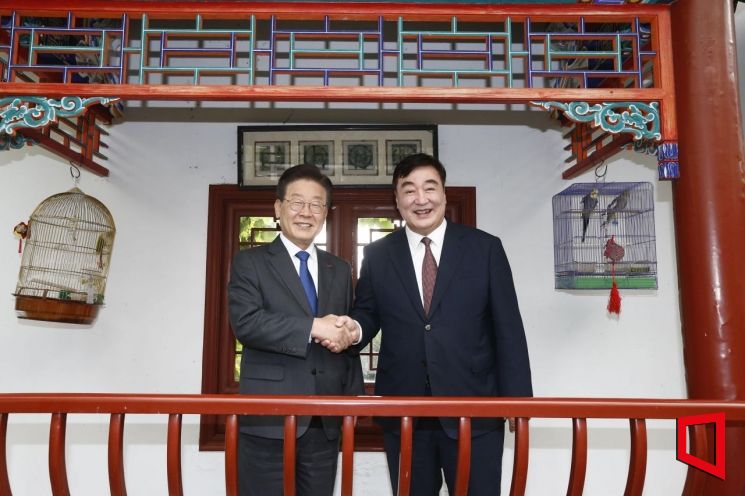 On the afternoon of the 8th, Lee Jae-myung, leader of the Democratic Party of Korea, visited the Chinese Ambassador's residence in Seongbuk-gu, Seoul, and shook hands with Xing Haiming, the Chinese Ambassador to Korea. On this day, Lee and Ambassador Xing discussed joint measures to prevent Japan's "Fukushima contaminated water marine discharge," as well as strengthening economic cooperation and public diplomacy between the two countries. Photo by the National Assembly Press Corps
Ruling Party: "Ambassador Xing's Diplomatic Conduct a Serious Breach" Opposition: "Export Slump is a Nightmare... What is the Reason for Provoking China?"
The ruling and opposition parties expressed different reactions. Kim Ki-hyun, leader of the People Power Party, said in his remarks at the party's national committee meeting that "Lee Jae-myung and Ambassador Xing held a public meeting yesterday, and both criticized our government in tandem," adding, "Ambassador Xing made remarks that seemed to shift the responsibility for the deterioration of Korea-China relations onto the Republic of Korea and openly criticized Korea, saying that Korea will surely regret it."
He further stated, "(This is) a clear interference in internal affairs and a serious diplomatic breach," and expressed "strong regret" toward Ambassador Xing.
On the other hand, the opposition criticized the Yoon government, saying, "Is provoking China while voluntarily creating uncomfortable relations with China what confident diplomacy is?" Park Sung-jun, spokesperson for the Democratic Party, said at a National Assembly briefing, "Our companies are struggling with the slump in exports to China, so what is the reason for provoking China over political issues?" He added, "The ruling party, which should be responsible for the economy, is only causing harm instead of helping the country's economy," and directly questioned, "Even the United States is seeking to improve relations with China, so is the Yoon Seok-yeol government trying to fight China alone?"
© The Asia Business Daily(www.asiae.co.kr). All rights reserved.



















