Dinner with Representative Lee Jae-myung, Political Controversy Surrounding His Remarks
Lee Jae-myung, leader of the Democratic Party of Korea, and Xing Haiming, the Chinese Ambassador to South Korea, who had dinner together, sparked controversy over a 'diplomatic faux pas' with the ambassador's remarks blaming South Korea for the deterioration of Korea-China relations and warning that if the South Korean government bets against China, it will surely regret it.
The ruling party reacted by comparing him to the Chinese warlord 'Yuan Shikai,' saying, "Does he consider Korea a tributary state?" Xing Haiming, who took office in early 2020, has been a figure of continuous 'controversy' over the past three years.
Yoon Sang-hyun, a member of the People Power Party and former chairman of the National Assembly's Foreign Affairs and Unification Committee, criticized Xing Haiming's remarks on the 9th via his social media, stating, "The threatening remarks by Ambassador Xing Haiming clearly reflect China's recent diplomatic behavior. It is regrettable to see China still considering itself the center of the world and treating Korea as a tributary state. The Republic of Korea is a sovereign and independent nation."
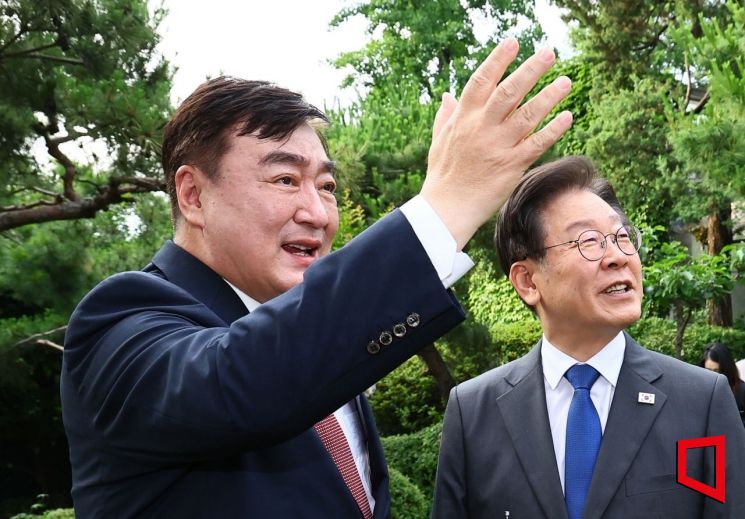 Lee Jae-myung, leader of the Democratic Party of Korea, visited Xing Haiming, Chinese Ambassador to South Korea, at the Chinese Ambassador's residence in Seongbuk-gu, Seoul, on the evening of the 8th and toured the residence. Photo by the National Assembly Press Photographers Group
Shin Won-sik, the ruling party's secretary of the National Defense Committee, also pointed out, "Ambassador Xing Haiming spewed harsh words like Yuan Shikai of the Qing Dynasty who came to Korea during the late Joseon period," and Song Eon-seok, a member of the People Power Party, expressed displeasure, calling it "a unilateral reprimand by China that ignores South Korea's diplomatic and security strategies and its independence."
Since his appointment in January 2020, Ambassador Xing Haiming has been embroiled in controversies throughout the three years. Shortly after his appointment, in February 2020, his remark "I will not highly evaluate" regarding the South Korean government's entry restrictions to prevent the spread of COVID-19 sparked controversy.
He later clarified that he meant he was "not in a position to evaluate the host country's measures," but considering that he initially insisted on following the World Health Organization (WHO), which did not recommend trade and travel restrictions, his comment was interpreted as expressing regret over the South Korean government's entry restrictions.
The controversy over his remarks continued the following year. In May 2021, Ambassador Xing appeared on MBC and responded to a question about the worsening feelings among Koreans regarding the kimchi and hanbok disputes by saying, "Our two countries, Korea and China, have lived together for thousands of years and influenced each other in the process. Now to say this is yours, that is mine, or this is not, is somewhat regrettable," adding, "Some of it seems to be misunderstandings, and some people do it very deliberately."
The interview was controversial because, despite being Chinese, he shifted the responsibility to Koreans for insisting that kimchi and hanbok belong to China.
In July of the same year, he openly contradicted an interview given by Yoon Seok-youl, then a leading presidential candidate from the ruling party, sparking controversy over 'interference in the presidential election.' At that time, President Yoon had argued in an op-ed that "China should first withdraw its long-range radar near its own borders if it wants to demand the withdrawal of the THAAD (Terminal High Altitude Area Defense) deployment," and Ambassador Xing responded in an op-ed format.
With the Chinese Foreign Ministry backing him by saying he "fulfilled his responsibilities," criticism grew louder, calling it a diplomatic faux pas and election interference.
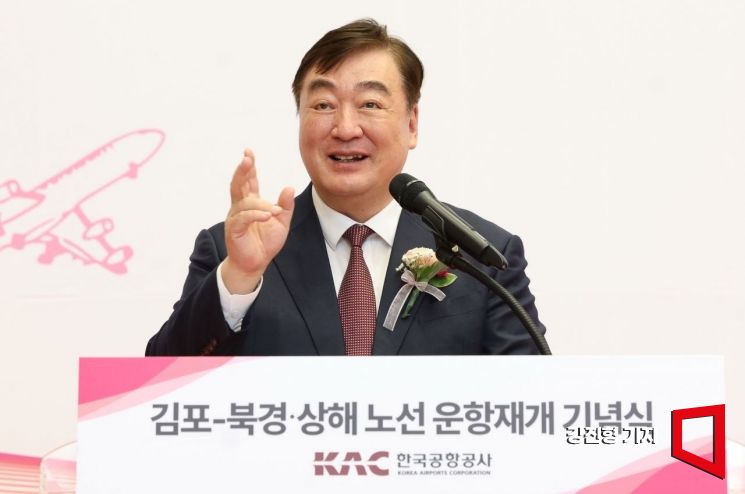 As flights on the Gimpo-China route, which were suspended due to the COVID-19 pandemic, resumed after three years, Ambassador Xing Haiming of China to Korea delivered a congratulatory speech at the "Gimpo-Beijing/Shanghai Route Resumption Ceremony" held at the international terminal of Gimpo International Airport on the 27th. Photo by Jin-Hyung Kang aymsdream@
When hanbok appeared at the opening ceremony of the Beijing Winter Olympics in February last year, and public opinion surged, the Chinese Embassy in South Korea stated that it was "the ethnic costume of the Chinese Korean minority," adding, "We are paying attention to some media's unfounded accusations and criticisms that China is engaging in 'cultural engineering' and 'cultural plundering.'" Although Ambassador Xing Haiming did not directly make this statement, it is difficult to separate it from him as it was the embassy's official position.
When anti-China sentiment intensified among Koreans due to controversies over disqualifications in Korean short track speed skating, the Chinese Embassy in South Korea further aggravated anti-China sentiment by stating via social media that "some Korean media and politicians criticized the Chinese government and the entire Beijing Olympics, even inciting anti-China sentiment, worsening the feelings between the two peoples and provoking counterattacks from Chinese netizens."
Ignoring domestic media criticism of the Chinese Embassy's 'brazen' attitude, Ambassador Xing Haiming again blamed the media at a Kwanhun Club discussion held at the Press Center in Jung-gu, Seoul, in October of the same year, saying, "I think the excessive negative reporting by some Korean media about China is a major cause of the current discord in public sentiment between the two countries."
In December of the same year, at a forum on the '30th Anniversary of Korea-China Diplomatic Relations' held at the Seoul Press Center, when asked by a reporter if it was President Xi Jinping's turn to visit South Korea according to diplomatic protocol, he replied, "What kind of order is that?" drawing criticism for being high-handed.
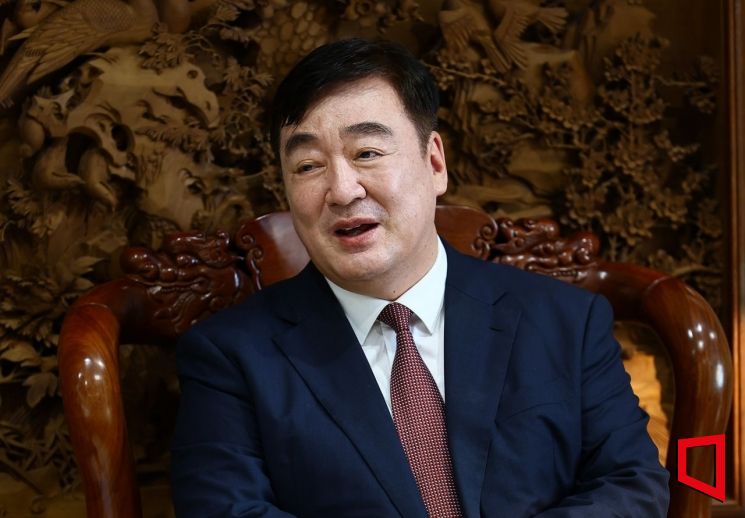 On the evening of the 8th, Xing Haiming, the Chinese Ambassador to Korea, gave a greeting while receiving a courtesy visit from Lee Jae-myung, the leader of the Democratic Party of Korea, at the Chinese Ambassador's residence in Seongbuk-gu, Seoul. Photo by the National Assembly Press Photographers Group
Ambassador Xing Haiming's remarks are unusual for a diplomat, but such attitudes are rather common among Chinese diplomats. Chinese diplomats pursuing so-called 'Wolf Warrior Diplomacy' are gaining attention for their ethnocentric and aggressive remarks.
In 2019, on the 70th anniversary of the Ministry of Foreign Affairs, Foreign Minister Wang Yi urged to "show stronger determination in representing China's interests amid international challenges," and since then, the Wolf Warrior diplomatic style has been notably strengthened.
Park Byung-kwang, a research fellow at the National Security Strategy Institute, pointed out in his recently published report, 'The Continuation and Change of Xi Jinping's Third Term Wolf Warrior Diplomacy,' that "China's Wolf Warrior diplomacy represents the Xi Jinping regime's diplomatic style to address vulnerabilities in the external environment, security anxieties, and domestic political instability," adding, "Compromise and submissive diplomacy toward China's Wolf Warrior diplomacy will give China the wrong lesson that 'Korea can be pushed around.'"
© The Asia Business Daily(www.asiae.co.kr). All rights reserved.
![Clutching a Stolen Dior Bag, Saying "I Hate Being Poor but Real"... The Grotesque Con of a "Human Knockoff" [Slate]](https://cwcontent.asiae.co.kr/asiaresize/183/2026021902243444107_1771435474.jpg)


















