Radukyeon Gate as the Cause
Time Deposits Increase from 805.8 Trillion Won to 817.6 Trillion Won
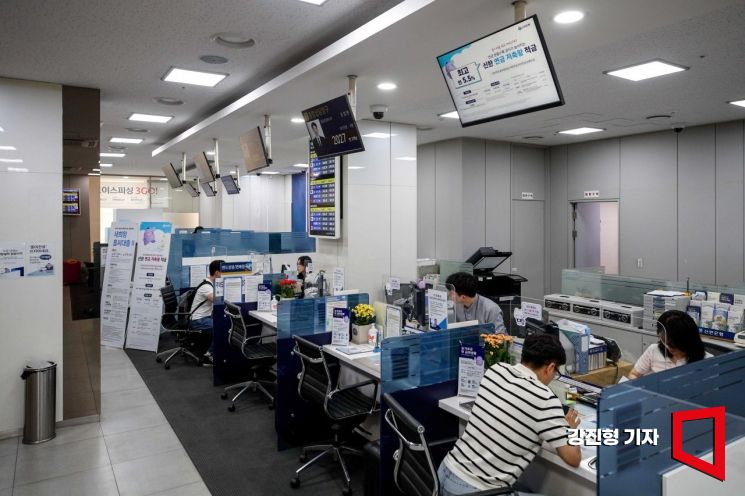 A customer is receiving consultation at a bank loan counseling desk. Photo by Kang Jin-hyung aymsdream@
A trend of 'road term deposits' has been detected in the banking sector. Funds from the market have flowed back into bank term deposits, which had withered due to falling interest rates compared to last year. This appears to be influenced by funds exiting the stock market following the La Deok-yeon Gate incident involving stock manipulation forces, shifting towards safe assets. The interest rates on term deposits have also stopped declining, leading to an increase in bank deposit balances.
According to the financial industry on the 10th, the balance of term deposits at the five major banks (KB Kookmin, Shinhan, Hana, Woori, NH Nonghyup) was about 817.6 trillion KRW as of the end of May, a sharp increase of 12 trillion KRW from the previous month (about 805.8 trillion KRW). Term installment savings also increased by 1 trillion KRW during the same period, reaching about 39 trillion KRW.
In the case of term deposits, the balance peaked at 827.3 trillion KRW in November last year when interest rates were at their highest. This was a period when market bank term deposit interest rates rose above 5%, gaining popularity. However, with the Bank of Korea freezing the base rate at the beginning of the new year and expectations that the rate hike trend had ended, the stock market revived. Consequently, interest in term deposits declined.
An official from a commercial bank said, "The trend of 'money move' was reversed by the 'La Deok-yeon Gate' that broke out at the end of April," adding, "It seems that retail investors returned to banks thinking 'safe assets are still the best'." While the balance of term deposits increased, investor deposits, which are standby funds for the stock market, decreased.
According to the Korea Financial Investment Association, investor deposits were about 48 trillion KRW in March this year, increased to 53 trillion KRW in April, and even reached 54 trillion KRW last month. However, following the aftershock of the La Deok-yeon Gate, major KOSDAQ secondary battery stocks plunged, causing investor deposits to fall to around 49 trillion KRW by mid-May.
The interest rates on term deposits at the five major banks were about 3.7% as of the 5th. For one-year products, KB Star Term Deposit offers 3.71%, Solpyeonhan Term Deposit 3.7%, Hana Term Deposit 3.7%, WON Plus Deposit 3.73%, and NH All-in-e Deposit 3.8%. Another commercial bank official stated, "The rates fell to the low 3% range in February this year, then slightly rose and have been maintained at the high 3% range since."
Although term deposits have reversed to an increasing trend, the demand deposits (checking accounts) balance, which banks need the most, continues to decline. Customers who just park their money in non-term deposits or installment savings accounts have much lower interest rates, allowing banks to procure funds at a low cost. While it is better for bank profitability to have more funds, the balance is decreasing, causing concern for banks. As of May, the demand deposit balance at the five major banks was about 585.5 trillion KRW, down 5.5 trillion KRW from the previous month (about 591 trillion KRW).
Meanwhile, with the decline in mortgage loan interest rates leading to an increase in mortgage loans, household loans at the five major commercial banks have rebounded for the first time in one year and five months. As of the end of May, the household loan balance at the five major banks was 677.6122 trillion KRW, an increase of 143.1 billion KRW from the previous month (677.4691 trillion KRW). This is the first time since December 2021 that household loans at these banks have increased compared to the previous month.
© The Asia Business Daily(www.asiae.co.kr). All rights reserved.
![Clutching a Stolen Dior Bag, Saying "I Hate Being Poor but Real"... The Grotesque Con of a "Human Knockoff" [Slate]](https://cwcontent.asiae.co.kr/asiaresize/183/2026021902243444107_1771435474.jpg)
















