"Misinterpretation of Tokyo Electric Power Official's Response"
The government has refuted reports by some media outlets claiming that Tokyo Electric Power Company (TEPCO) stated there are no discharge cutoff criteria based on radioactive material concentrations related to the release of contaminated water from Fukushima, saying these reports are inaccurate.
According to Yonhap News on the 8th, a government official stated, "TEPCO has a system in place that automatically stops the discharge if the concentration exceeds a certain threshold when releasing contaminated water treated by the Advanced Liquid Processing System (ALPS) into the sea."
The Ministry of Foreign Affairs recently reconfirmed this information through Japan's Ministry of Economy, Trade and Industry.
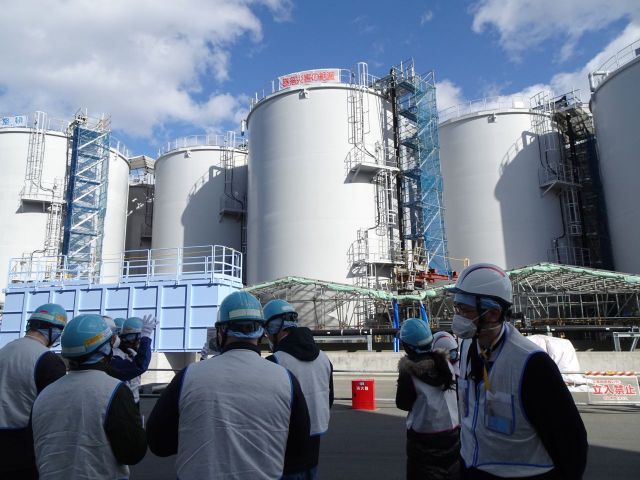 Tokyo Electric Power Company officials explained the contaminated water storage tanks to foreign journalists at the Fukushima Daiichi Nuclear Power Plant on the 2nd. Photo by Yonhap News Agency
The current discharge standard aims to dilute tritium to 1,500 Bq (becquerels) per liter, and the total sum of the concentration ratios of other radionuclides to be less than 1. A concentration ratio of 1 means the concentration level at which drinking 2 liters of the discharged water daily for 70 years results in an average dose rate of about 1 mSv (millisievert) per year.
The government’s position is that TEPCO officials’ explanations were distorted during the media reporting process. According to some earlier media reports, at a local briefing on the 6th, an expert asked TEPCO for additional clarification, questioning, "What will you do if high concentrations of radioactive materials are detected in the seawater used to dilute the contaminated water?"
In response, a TEPCO official said, "Currently, there are no conditions to decide to stop based on the concentration of radioactive materials in the seawater being taken in."
A government official explained, "The question was about how to handle radioactive materials detected in the seawater used to dilute the contaminated water treated by ALPS by a factor of 400, not the ALPS-treated contaminated water itself."
He added, "It is known that radioactivity measurements are not conducted on this seawater. However, regular monitoring is carried out near the intake where the dilution seawater is brought in to check the radioactivity concentration."
Meanwhile, TEPCO’s discharge of Fukushima contaminated water is entering the final stages. On the 5th, TEPCO began full-scale preparations for discharge, including injecting 6,000 tons of seawater into the undersea tunnel.
© The Asia Business Daily(www.asiae.co.kr). All rights reserved.

















