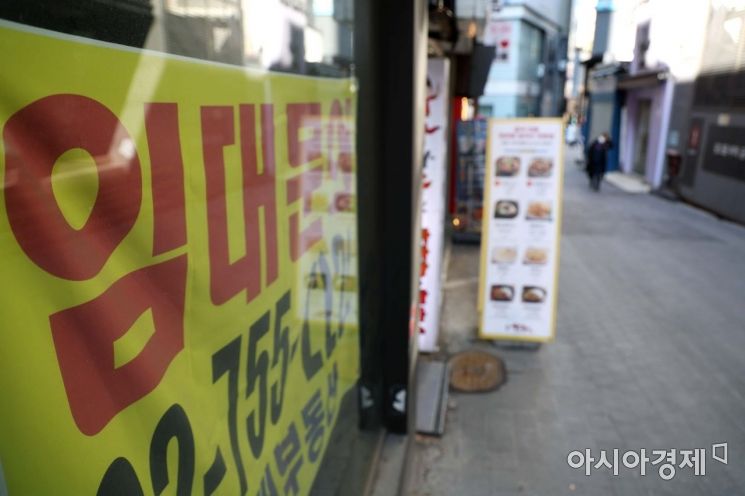
Debt among self-employed individuals is increasing. The outstanding loans for individual business owners at the five major banks?KB Kookmin, Shinhan, Hana, Woori, and NH Nonghyup?have risen by about 1 trillion KRW compared to the end of last year.
According to the financial sector on the 9th, the outstanding loans for individual business owners at the five major banks stood at 315.0753 trillion KRW as of the end of May, an increase of 439.5 billion KRW from the previous month. This is the highest level in eight months since September last year (315.2679 trillion KRW). Compared to December last year, it increased by 991.5 billion KRW, and compared to the same period last year, it rose by 5.5775 trillion KRW.
Loans to individual business owners at the five major banks have been steadily increasing this year. The trend shows continuous growth from January (313.065 trillion KRW) → February (313.5942 trillion KRW) → March (314.051 trillion KRW) → April (314.6358 trillion KRW).
The total outstanding loans for self-employed individuals across the entire financial sector have also increased. According to the Bank of Korea, the total outstanding loans for self-employed individuals stood at 1,019.8 trillion KRW at the end of last year, marking an increase of 110.6 trillion KRW over one year. According to the Federation of Korean Industries, the average loan amount for self-employed individuals was about 99.7 million KRW, with an average interest rate burden of 5.9% per annum (as of the end of last year).
The increase in loans to self-employed individuals is due to the toughening economic conditions. A representative from a commercial bank said, "We believe that the increase in operating funds, such as business expenses caused by economic slowdown and rising prices, has led to the rise in individual business owner loans."
In fact, the average income of self-employed individuals has been decreasing every year. According to data received by Representative Yang Kyung-sook of the Democratic Party from the National Tax Service, the number of self-employed individuals (those who reported business income among comprehensive income tax filers) was 6.568 million in 2021. This is an increase of 1.842 million from 4.726 million in 2017. However, their average annual income has been declining from 21.7 million KRW in 2017 to 19.52 million KRW in 2021. Representative Yang pointed out, "Due to the triple challenges of high interest rates, high prices, and high exchange rates, loans to self-employed individuals are approaching 1,000 trillion KRW, and delinquency rates are rising, putting self-employed individuals in a critical situation."
Moreover, financial authorities have announced that the repayment moratorium for loans to small and medium-sized enterprises and self-employed individuals affected by COVID-19 will end in September, raising concerns that the number of non-performing borrowers will increase. Experts advise that risk management for self-employed individuals is necessary. Professor Seo Ji-yong of Sangmyung University’s Department of Business Administration said, "Policies or private products that allow switching to long-term or low-interest loans should be expanded." However, regarding this, the Financial Services Commission drew a line on concerns about non-performing loans yesterday. According to the FSC, there are 1,100 borrowers using interest repayment deferrals who are relatively at risk of default, and the loan amount they borrowed accounts for 2% of the total, about 1.4 trillion KRW. Borrowers using repayment deferrals can negotiate with financial companies to receive a grace period and use installment repayment over up to 60 months according to a repayment plan."
© The Asia Business Daily(www.asiae.co.kr). All rights reserved.
![Clutching a Stolen Dior Bag, Saying "I Hate Being Poor but Real"... The Grotesque Con of a "Human Knockoff" [Slate]](https://cwcontent.asiae.co.kr/asiaresize/183/2026021902243444107_1771435474.jpg)
















