"The Korean Intellectual Property Office (KIPO) will not rest on its current achievements but will diligently strive until our country truly becomes one of the 'Global Intellectual Property TOP 3' nations," said Lee In-sil, Commissioner of KIPO, during a presentation on 'Intellectual Property Policy Achievements and Future Plans' held on the 8th at Daejeon ICC.
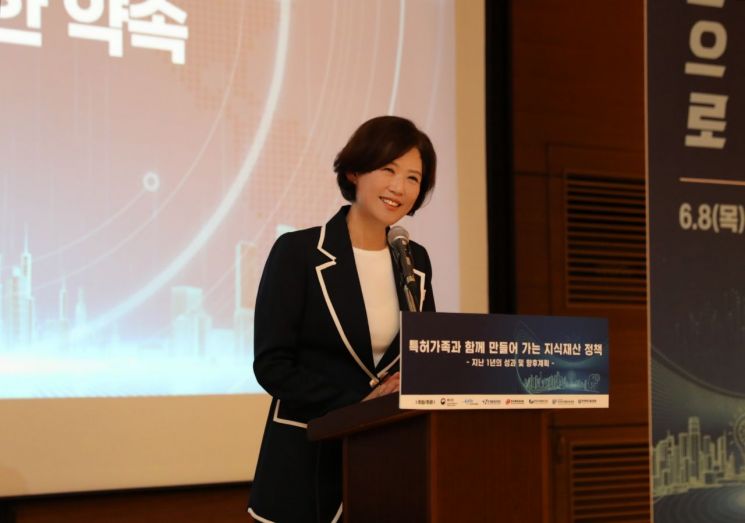 Lee In-sil, Commissioner of the Korean Intellectual Property Office, is presenting "Achievements and Future Plans of Intellectual Property Policy" at the Daejeon ICC on the 8th. Photo by the Korean Intellectual Property Office
The presentation brought together senior officials from KIPO headquarters and heads of affiliated public institutions to discuss the achievements in the patent sector over the past year since the government’s inauguration and the direction moving forward.
First, KIPO cited the establishment of a solid intellectual property administrative foundation and the internalization of intellectual property policies within the national agenda as key achievements that have strengthened its status.
Commissioner Lee proudly stated, "Last year, KIPO introduced measures such as concentrated examination time systems to create an environment where examiners and adjudicators can focus on their core duties of examination and adjudication. Through this, we emphasized providing high-quality intellectual property administrative services to patent applicants."
He particularly emphasized, "To support examinations in the semiconductor field, which has emerged as a key issue in the era of technological hegemony, we established the world's first 'Patent Examination Package Support System' encompassing organization, personnel, and systems. I firmly believe this has become a strong ally supporting the industry amid fierce competition."
Previously, in November last year, KIPO designated semiconductor patent applications as a priority examination category, shortening the examination period by more than eight months. Subsequently, in March this year, 30 retired private-sector experts were hired as specialized examiners in the semiconductor field, and in April, the 'Semiconductor Examination Promotion Team (Division)' was newly established to support the domestic semiconductor industry in swiftly securing intellectual property rights.
Another notable achievement KIPO highlights is that intellectual property policy has become a key pillar in the government's national administration.
For example, KIPO points out that following the enactment of the 'Special Act on Fostering National Strategic Technologies' in March, the use of patent analysis results will be mandated in setting directions and conducting national research and development (R&D) (effective from September this year).
Last year, KIPO also played a leading role in establishing cross-ministerial measures to protect domestic companies' technologies by utilizing the investigative capabilities of special judicial police to apprehend six suspects involved in the overseas leakage of core semiconductor technologies. Additionally, it proposed and discussed measures to protect K-brands and counter overseas patent disputes in multi-ministerial meetings.
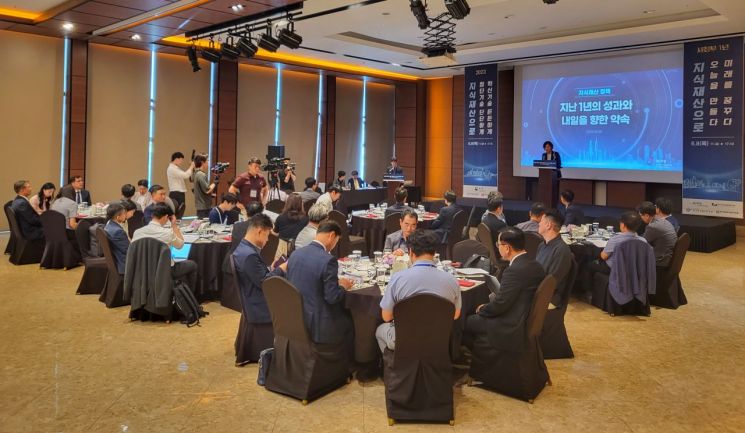 Senior officials from the Korea Intellectual Property Office headquarters and heads of affiliated public institutions gathered at Daejeon ICC on the 8th to share the achievements of intellectual property policies over the past year and discuss future policy directions. Photo by Korea Intellectual Property Office
Building on the achievements of the past year, Commissioner Lee presented the direction for intellectual property policy 'Towards Tomorrow' (five core initiatives). The key point is to expand past achievements and take on the role of an ally so that intellectual property can contribute to domestic economic growth.
To this end, KIPO plans to expand the scope of specialized examiners to strategic technology fields such as secondary batteries and bio, and to spread the patent examination package support system, including the introduction of priority examination.
Additionally, the use of patent big data will be reorganized around 12 national strategic technologies to enhance the efficiency of government-led R&D while focusing on preventing redundant research.
To establish a fair compensation system for innovation performance, KIPO will strengthen punishment standards for core technology leakage and enhance the dispute mediation system to support companies facing intellectual property disputes in resolving conflicts quickly and at low cost. This is one of the key tasks KIPO has put forward.
Furthermore, KIPO plans to establish an 'Intellectual Property Evaluation and Management Center' to ensure that technologies held by companies are properly valued, and to transfer the operation of overseas Intellectual Property Desks (IP-DESK) from KOTRA to the Intellectual Property Protection Agency, enabling export companies to receive timely and specialized dispute support locally.
Commissioner Lee said, "Over the past year, we have solidified our internal foundation while expanding the scope of intellectual property policy. In addition, KIPO will continue to steadily advance to strengthen the intellectual property capabilities of domestic companies and elevate Korea’s international standing."
© The Asia Business Daily(www.asiae.co.kr). All rights reserved.


















