Presiding over the Semiconductor National Strategy Meeting... Emphasizing Public-Private 'One Team'
Discussion on Fostering Memory and System Semiconductors and Securing SoBuJang Components
President Yoon Suk-yeol emphasized the 'one team' spirit on the 8th regarding the global semiconductor industry trends, stating, "Many citizens have confidence and high expectations for our semiconductor industry, but it is truly a war where we cannot foresee even an inch ahead," and stressed that the government and the private sector must work together. The intention is that to survive the global semiconductor hegemony war, the public and private sectors must unite to improve the industrial structure.
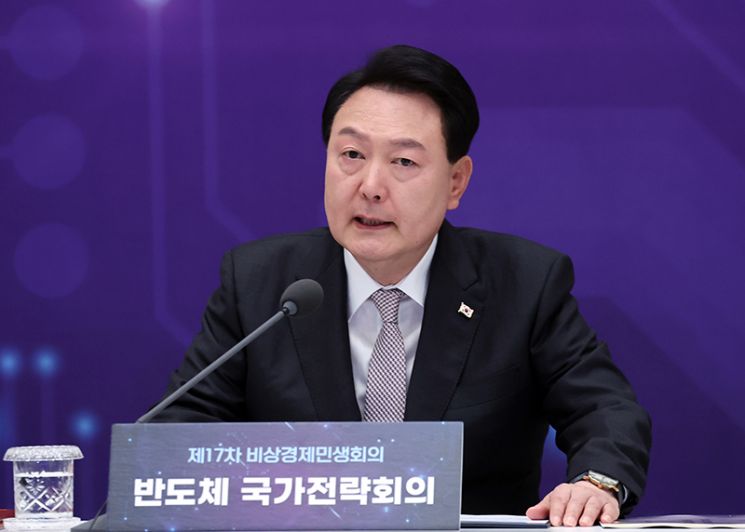
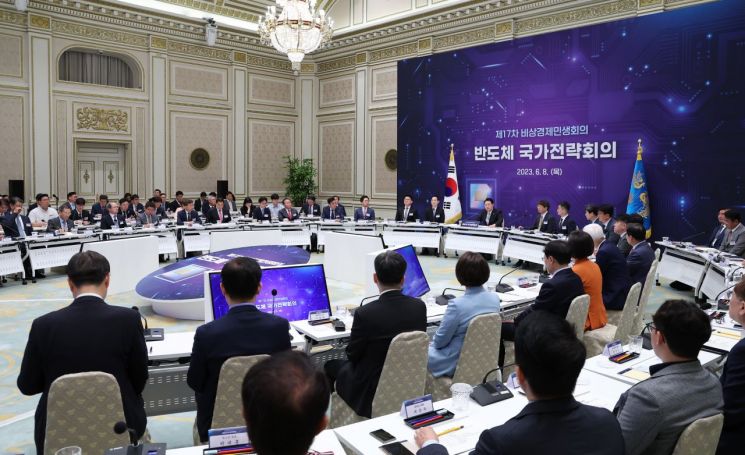
On the same day, President Yoon presided over the 17th Emergency Economic and Livelihood Meeting, the Semiconductor National Strategy Meeting, at the morning State Guest House of the Blue House, and made these remarks. This meeting is the second one following the Secondary Battery National Strategy Meeting held on April 20, and it was arranged after President Yoon instructed the preparation of national strategy meetings for secondary batteries and semiconductors at the Cabinet meeting held on April 10, ahead of his state visit to the United States.
President Yoon views that to reverse the sluggish situation of semiconductors, a core item accounting for about 20% of Korea's exports and 55% of manufacturing facility investment, and to improve the industrial structure of the semiconductor industry, strategic development measures at both the private and national levels are necessary. According to the Ministry of Trade, Industry and Energy, semiconductor exports last month recorded $7.37 billion (9.7365 trillion KRW), a sharp decline of 36.2% compared to last year, and the semiconductor export growth rate has been negative for 10 consecutive months since August last year.
In his opening remarks, President Yoon emphasized the importance by saying, "As AI is integrated into the military sector, semiconductors are truly emerging as the core of national security," and added, "The performance of semiconductors installed not only in smartphones, automobiles, and home appliances but also in satellites and strategic weapon systems is decisive, and everything that drives and implements artificial intelligence (AI) and quantum computing is also semiconductors." He continued, "To win the semiconductor war, both private sector innovation and the government's leading strategy are needed simultaneously," and added, "The government must design systems well and build infrastructure so that companies and talented investors gather."
Regarding diplomatic issues surrounding semiconductors, he also stressed, "Recently, geopolitical issues have become the biggest management risk for companies, but this is a problem that companies cannot solve alone, and the state must strengthen cooperation with allies including the United States and resolve it through close communication." President Yoon has led semiconductor-related agreements in recent summit meetings with leaders of Japan, the United States, Canada, and the European Union (EU), including the launch agreement of the Korea-US Core and Emerging Technologies Dialogue, Japan's lifting of semiconductor export restrictions, the comprehensive supply chain cooperation memorandum of understanding (MOU) on refining, trading, and recycling key semiconductor manufacturing minerals between Korea and Canada, and the development of a joint mechanism for semiconductor supply chain stability between Korea and the EU.
Following President Yoon's opening remarks, discussions were held on urgent issues such as ▲ maintaining the memory semiconductor super-gap strategy ▲ fostering the system semiconductor industry ▲ securing materials, parts, and equipment (SoBuJang) and technical manpower. Korea has maintained a global super-gap in the memory semiconductor sector for over 20 years, but geopolitical risks are intensifying due to the pursuit by competing countries and the US-China hegemony competition. In the system semiconductor sector, which accounts for about 60% of the semiconductor market, not only is Korea lagging behind foreign companies from design to manufacturing, but the industrial base is also weak. Accordingly, increasing self-reliance in semiconductor materials, parts, and equipment, securing sufficient core technologies and manpower, and preventing their leakage are also considered urgent tasks. About 60 people attended the meeting, including experts from the semiconductor industry, academia, analysts, Kim Ki-hyun, leader of the People Power Party, Yoon Jae-ok, floor leader, Park Dae-chul, chairman of the Policy Committee, and ministers from related government departments.
The government stated, "Based on the discussions at the Semiconductor National Strategy Meeting, we plan to supplement the existing semiconductor industry strategy and promote support policies with speed under close cooperation between the government and companies."
© The Asia Business Daily(www.asiae.co.kr). All rights reserved.
![Clutching a Stolen Dior Bag, Saying "I Hate Being Poor but Real"... The Grotesque Con of a "Human Knockoff" [Slate]](https://cwcontent.asiae.co.kr/asiaresize/183/2026021902243444107_1771435474.jpg)

















