Analysis of the Original Amendment Text
Mention of Establishing a Cooperation Framework with Western Countries
Emphasis on Attracting Overseas Semiconductor Companies
Using Geopolitical Tensions as an Opportunity
"The government will establish a framework for cooperation among Japan, the United States, and Europe to develop next-generation semiconductors."
This is one of the key sentences excerpted from the original text of the revised "New Capitalism" implementation plan announced by Japanese Prime Minister Fumio Kishida on the 6th. It reflects the intention to turn Japan into a semiconductor production hub by seizing the opportunity of supply chain diversification amid geopolitical crises. In particular, the revision emphasizes cooperation with Western countries to secure Japan's competitiveness.
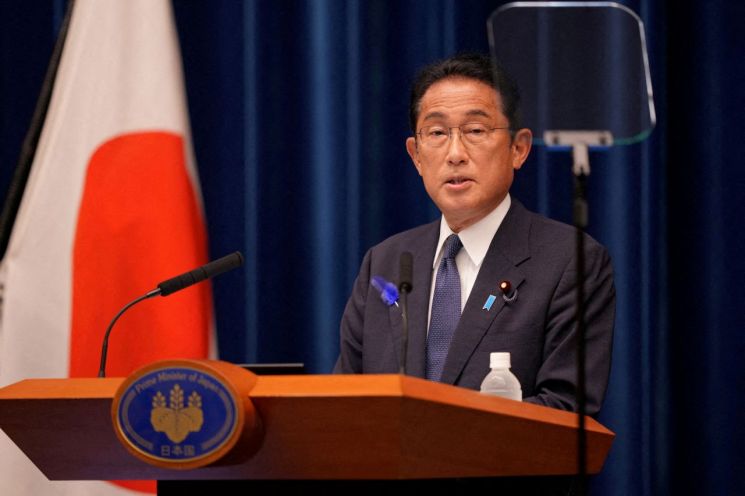
On the 6th, Japanese Prime Minister Fumio Kishida held a meeting at the Prime Minister's Office and announced the revised "New Capitalism" plan. The New Capitalism is the core economic policy of the Kishida Cabinet, focusing on fostering growth engines through growth and distribution policies. The Japanese government set five main tasks for economic growth: ▲investment in human resources and labor market reform, ▲corporate expansion and startup growth, ▲digitalization and coal phase-out, ▲increase in asset income and nurturing the middle class, and ▲systems to solve social issues.
Among these, the Kishida Cabinet placed special emphasis on fostering the semiconductor industry as part of its economic growth strategy. It declared its active commitment to attracting overseas companies through global semiconductor attraction. The revision states, "By attracting TSMC’s factory to Kumamoto Prefecture, we have achieved the effect of creating jobs in the local community," and adds, "Such cases should be widely spread throughout Japan." Previously, the Japanese government supported about 476 billion yen, approximately 40% of the 1.1 trillion yen project cost for TSMC to build the factory. TSMC also plans to construct its second semiconductor factory in Kumamoto Prefecture.
The Kishida Cabinet plans to invest a huge budget to spread such cases throughout Japan. On this day, Prime Minister Kishida stated, "We will consider support such as tax and budget at a level comparable to the world."
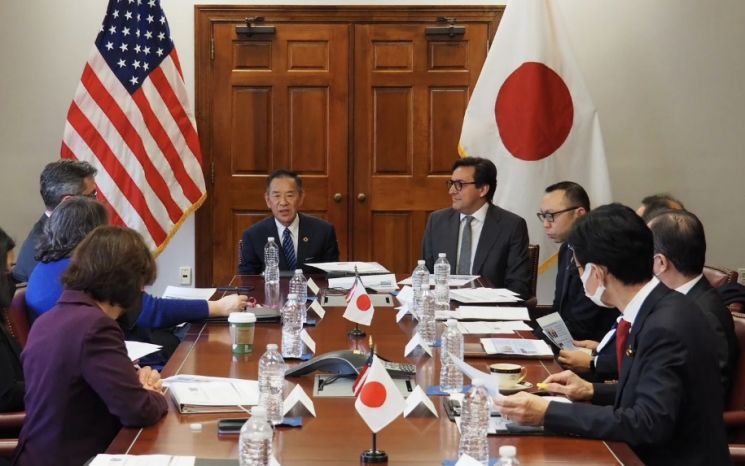 Koike Atsuyoshi, President of Rapidus, held a meeting with IBM officials and economic bureaucrats in Washington last January.
 [Image source=Official website of Rapidus Japan]
Japan is also striving to develop domestically produced semiconductors. The Japanese government plans to support 330 billion yen for the construction of the Hokkaido factory of "Rapidus," a semiconductor company jointly established by eight major Japanese corporations. Rapidus is preparing for a 2-nanometer process foundry business aiming for mass production in 2024.
Furthermore, the Japanese government emphasized that it will establish a framework for cooperation with the United States and Europe to regain competitiveness as a semiconductor manufacturing country. Through alliances with Western countries, it aims to strengthen semiconductor research and development. Currently, the United States is enhancing cooperation with Japan to produce next-generation semiconductors used in supercomputers and artificial intelligence (AI). Earlier in January, IBM, a major U.S. IT company, announced its cooperation in research and development, market development, and technician training for Rapidus, the semiconductor company jointly established by eight major Japanese corporations.
The Kishida Cabinet’s goal is to "restore the reputation of Japanese semiconductors." The Japanese government judged that this moment, when global companies are seeking new locations due to geopolitical crises such as the Russia-Ukraine war and U.S.-China conflicts, is a golden opportunity for Japan. The report self-assessed, "Uncertainty is increasing worldwide due to COVID-19 and the Ukraine war," and "Considering that policy and economic conditions are relatively stable and the semiconductor location environment is changing, Japan’s attractiveness as an investment destination will further increase."
© The Asia Business Daily(www.asiae.co.kr). All rights reserved.


















