New Town Exit Strategy Leads to Zone Deregulation in 2014
Housing Prices Surge and Residential Areas Age, Gaining Momentum Again
Plan Finalized After 1 Year and 10 Months of Rapid Integration Planning
The Sinjeong 1-5 district in Yangcheon-gu, Seoul, has been redesignated as a redevelopment maintenance zone after 9 years.
On the 7th, Seoul held a rapid integrated planning authorization subcommittee meeting of the Urban Planning Committee and announced on the 8th that it had amended and approved the review plan to designate the area around 1152 Sinjeong-dong as a housing maintenance-type redevelopment project maintenance zone.
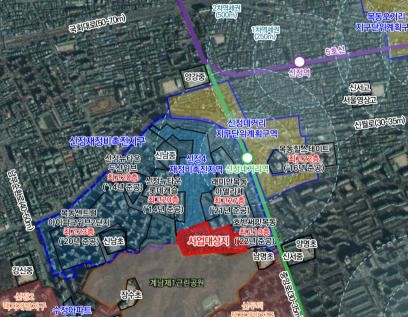
Once part of Sinjeong New Town 1-5 district, this area was removed from the maintenance zone in 2014 as part of the New Town exit strategy. This was because it was judged that the development profits would not be significant due to weak housing prices, declining sale prices, and prolonged project duration. In 2017, it was excluded from the Sinjeong Redevelopment Promotion District.
However, while the prices of new apartments within Sinjeong New Town surged, the residential areas within the target site gradually aged, and problems such as a shortage of parking spaces worsened, raising the need for redevelopment again. Accordingly, with support from Seoul’s rapid integrated planning, the maintenance plan was finalized in 1 year and 10 months.
Accordingly, the mixed-use areas consisting of Type 1 General Residential Area and Type 2 General Residential Area with a 7-story height limit (2nd type 7 floors) will be uniformly upgraded to Type 2 7 floors. Type 1 General Residential Areas allow buildings up to 4 floors, and Type 2 7 floors allow buildings up to 7 floors. With the upgrade of the use district, a residential complex of 956 households (including 251 public housing units) with a floor area ratio of up to 250% and a height of up to 75 meters, including incentives, is planned to be built in the area.
As the area was excluded from the Redevelopment Promotion District, the broken green and pedestrian axes will be reconnected to link with the nearby Gyenam Neighborhood Park and pedestrian paths. Within the complex, a 12-meter-wide public pedestrian passage connecting Jungang-ro 29ga-gil and Gyenam Neighborhood Park will be created. It will also be linked to the cultural street passing through the Sinjeong Redevelopment Promotion District. A Seoul city official said, "With this decision, we expect the residential environment maintenance in the Sinjeong-dong area, which is transforming into a large-scale apartment complex, to reach its completion stage."
Meanwhile, at the same committee meeting, the maintenance plan for the housing maintenance-type redevelopment zone in the area of 532-2 Cheonho-dong (Cheonho 3-3 district) was also amended and approved. This area, densely populated with old low-rise residences, currently has a mix of Type 2 7 floors and Type 2 General Residential Areas, but will be unified into Type 2 General Residential Area, relaxing the standard floor area ratio to 190%. If additional incentives such as public contributions are received, the floor area ratio can increase up to 230%. Accordingly, the area, which previously housed 151 households, will be transformed into an apartment complex with up to 24 floors and a total of 468 households (including 107 public housing units).
Public sports facilities will also be established in connection with Cheonho 3-1 and 3-2 districts. Additionally, a circulation plan will be developed to utilize local historical and spatial resources such as Cheonho-dong Cathedral, Gobundari Market, and Cheonho Library to create a pleasant walking environment. A Seoul city official stated, "Through the integrated plan, although these are separate complexes, by establishing unified planning principles, we aim to maximize residents’ convenience and enable coexistence with surrounding areas."
© The Asia Business Daily(www.asiae.co.kr). All rights reserved.
![Clutching a Stolen Dior Bag, Saying "I Hate Being Poor but Real"... The Grotesque Con of a "Human Knockoff" [Slate]](https://cwcontent.asiae.co.kr/asiaresize/183/2026021902243444107_1771435474.jpg)
















