The government is scheduled to announce a policy plan to promote competition in the telecommunications market by the end of this month, focusing on revitalizing MVNOs (Mobile Virtual Network Operators) and the entry of a fourth mobile carrier. Amid this, there is a claim that, to boost competition, it is better to strengthen policy support for MVNO operators rather than forcibly discovering a fourth mobile carrier.
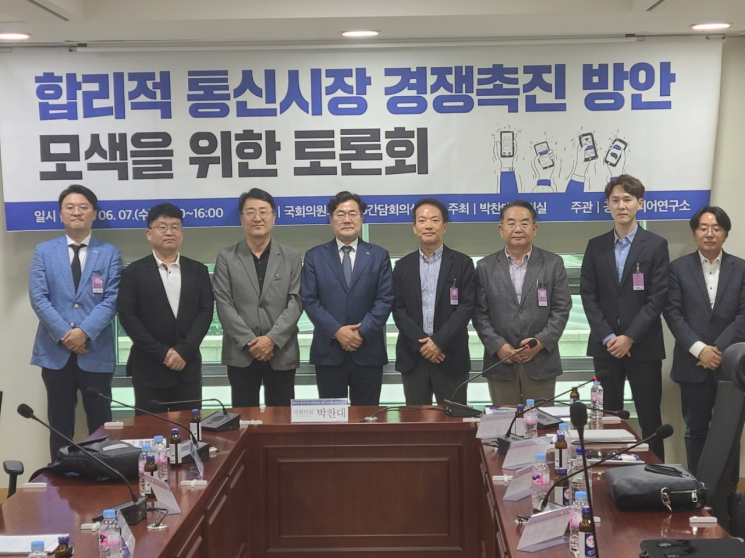
On the 7th, Park Sang-ho, director of the Public Media Research Institute, emphasized at a forum held at the National Assembly titled "Seeking Rational Measures to Promote Competition in the Telecommunications Market" that "realistically, it is not easy to introduce a fourth mobile carrier," adding, "Therefore, we need to strengthen the competitiveness of MVNOs and consider what policies are necessary for this."
Park stated, "Currently, MVNO policies have been promoted to resolve the monopoly and oligopoly in the mobile telecommunications market, activate competition, reduce household communication expenses, and promote coexistence with small and medium enterprises, but their effectiveness is being questioned," and argued, "It is necessary to first extend the mandatory wholesale provision period for MVNOs and revise the related notices on wholesale prices to enable reasonable price competition."
As a basis for policy support, Park cited the domestic situation where MVNO operators find it difficult to independently secure subscribers. He said, "In Korea, the mobile phone market was already saturated (102.7% as of 2010) when MVNOs were introduced, making direct competition with MNOs (Mobile Network Operators) inevitable," emphasizing, "Considering this situation, some institutional support is deemed necessary."
Academia also agreed that MVNOs have made a significant contribution to lowering household communication costs. Professor Yeo Jun-sang of Dongguk University’s Department of Business Administration said, "MVNOs play a considerable role in terms of market competition," and added, "The government and the National Assembly need to seek support measures to further foster MVNOs."
Professor Yoo Sung-jin of Soongsil University also supported this, stating, "For MVNOs to compete with the three major carriers, government policy consideration is needed so that not only small and medium-sized MVNOs but also large corporation-affiliated MVNOs can continue to receive reductions in radio usage fees."
There was also an opinion that MVNO operators themselves need to build competitiveness. The fundamental purpose of MVNO operators is not only price competitiveness but also the actual activation of competition in the telecommunications market, yet there is criticism that MVNO operators lack self-sustaining efforts.
Kim Yong-hee, a research fellow at Open Route, pointed out, "It is necessary to consider whether MVNOs have sustainability. Except for large corporation affiliates, it is questionable whether there are competitive operators," adding, "I am not sure what preparations small and medium operators are making other than launching services that expect consideration from the three major carriers." He further stated, "Policy support without prerequisite investment from MVNO operators is unreasonable."
In response to these opinions, Hwang Sung-wook, vice chairman of the Korea MVNO Association, expressed difficulties due to institutional limitations. Hwang said, "Currently, most MVNO operators use a simple resale method, which weakens competitiveness and leaves no operators capable of creating and selling independent products," adding, "For MVNO services to be continuously maintained and grow, it is necessary to delete Article 2 of the Supplementary Provisions of the Telecommunications Business Act, which contains the sunset clause on the mandatory wholesale provision. Also, detailed methods for calculating wholesale prices for flat-rate plans should be codified in official notices."
Regarding this, Kim Jun-mo, director of the Telecommunications Competition Policy Division at the Ministry of Science and ICT, said, "When we first implemented MVNO policies, the goal was not only to reduce household communication expenses but also to serve as a kind of 'catfish' to enable competition with the three major carriers, thus promoting competition," adding, "Although MVNOs have contributed partly to lowering communication costs through zero-won plans, they are still lacking in terms of competition activation. We will review and discuss these aspects in the telecommunications competition promotion announcement scheduled for the end of this month."
© The Asia Business Daily(www.asiae.co.kr). All rights reserved.

















