As major domestic and international institutions simultaneously downgrade their economic growth forecasts for South Korea this year, concerns are growing that the actual growth rate may fall short of the government's initial projections. This is due to the prolonged delay in the recovery of semiconductor exports, which have supported the Korean economy, exerting downward pressure on the economy. Moreover, the so-called 'three highs' phenomenon?high inflation, high interest rates, and high exchange rates?combined with sluggish exports, is dampening corporate management and could even extinguish the growth momentum of the Korean economy.
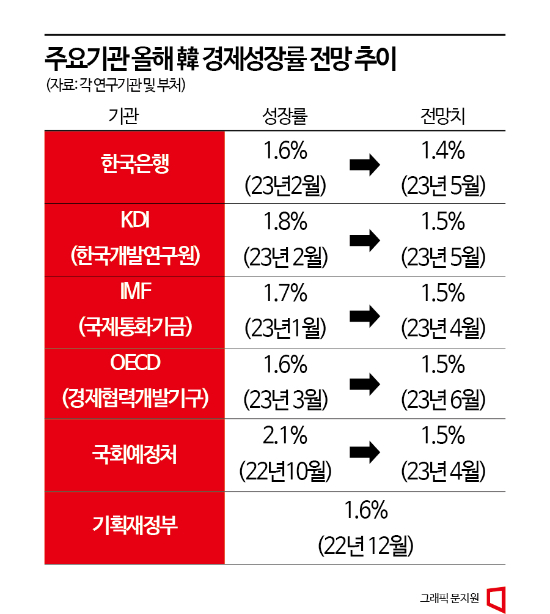
According to government ministries on the 8th, the Ministry of Economy and Finance is expected to announce a revised economic growth forecast for this year in the second half economic policy direction report as early as the end of this month. The government initially projected an economic growth rate of 1.6% for this year but is internally considering a slight downward revision. This is due to the fact that the country has not benefited at all from China's reopening effect, and with the trade deficit continuing for 15 consecutive months, there are expectations that the pace of economic recovery in the second half will be slower than anticipated.
The Organisation for Economic Co-operation and Development (OECD) also lowered South Korea's economic growth forecast for this year by 0.1 percentage points to 1.5% after three months for the same reasons. This forecast matches those of the International Monetary Fund (IMF, 1.5%) and the Korea Development Institute (KDI, 1.5%), and is 0.1 percentage points higher than that of the Bank of Korea (1.4%). The reason major institutions have collectively downgraded South Korea's growth forecast is the uncertain possibility of a short-term export recovery. The OECD assessed the current Korean economic situation by stating, "Private consumption is recovering mainly in services, but private investment is somewhat sluggish due to high interest rates."
According to the KDI, the economic growth rate refers to the increase in real GDP. This is the figure obtained by subtracting inflation from nominal GDP, which calculates all goods and services produced in a country. Real GDP growth is closely related to productivity improvements. When productivity increases, jobs naturally increase as well. Ultimately, a decline in the economic growth rate means a reduction in corporate jobs, a decrease in household income, and an increase in the impoverished population, which in the worst case can create a vicious cycle in national management, such as a decrease in tax revenue.
The problem is that signals of an economic recession in South Korea are being continuously detected. While trade with China and semiconductor export declines act as constants pulling down the current economic growth rate, upward price pressures from international oil prices, exchange rates, and international raw material prices in the second half of the year are major variables. Additionally, the planned increase in public transportation fares centered in the metropolitan area in the second half is also a source of concern. Professor Yang Jun-mo of Yonsei University's Department of Economics warned, "With the minimal effect of China's reopening and continued export stagnation in IT items such as semiconductors, oil prices are further increasing instability. We had expected the economy to gradually recover if prices such as West Texas Intermediate (WTI) crude oil fell below the $70 per barrel range, but these expectations are currently collapsing."
There is also an argument that the long-term decline in the future labor force is a bigger problem that the Korean economy must bear. The Bank of Korea has already diagnosed that the country has entered a 'long-term low-growth structure,' and the OECD has ranked responding to rapid population aging as the top policy recommendation for Korean economic growth. As the working-age population decreases due to low birth rates and aging, demand driving economic activity declines, making a drop in economic growth rate inevitable. The OECD advised, "Training for the unemployed and strengthening active labor policies, as well as expanding social safety nets, should be enhanced to facilitate smooth redistribution of the labor force."
© The Asia Business Daily(www.asiae.co.kr). All rights reserved.
![Clutching a Stolen Dior Bag, Saying "I Hate Being Poor but Real"... The Grotesque Con of a "Human Knockoff" [Slate]](https://cwcontent.asiae.co.kr/asiaresize/183/2026021902243444107_1771435474.jpg)
















