Countermeasures Against Strengthening of Korea-US-Japan Security Cooperation
China and Russia conducted a 'joint military demonstration' in the Asia-Pacific region for two consecutive days.
On the 7th, the Chinese Ministry of National Defense announced through its official WeChat channel (China's version of KakaoTalk) that "the Chinese and Russian armed forces completed the second phase of the 6th joint air strategic patrol mission over the western Pacific airspace on the 7th."
Previously, the Chinese and Russian air forces conducted a 'joint air strategic patrol' over the airspace of the East Sea and the East China Sea the day before. This joint patrol is interpreted as the 'first phase mission.'
The Republic of Korea Joint Chiefs of Staff (JCS) stated on the 6th that four Chinese military aircraft and four Russian military aircraft sequentially entered and exited the South Sea and East Sea Korean Air Defense Identification Zone (KADIZ), with no airspace violations reported.
Since the first joint air patrol in the Northeast Asia region in 2019, China and Russia have conducted the same military activity once each in 2020 and 2021, and twice last year (in May and November).
On the 7th, China's state-run media Global Times cited an anonymous military expert saying, "The ongoing U.S. maritime and air provocations in the Western Pacific region have already severely undermined peace and stability in the area," adding, "China and Russia joining hands to demonstrate their capability to safeguard regional peace and stability is a strong form of restraint against U.S. hegemonic behavior."
Furthermore, Chinese military expert Zhang Xuefeng, interviewed by Global Times, evaluated, "The fact that the two countries conducted their usual joint air patrol at a time that can be considered sensitive shows the unwavering relationship between the two militaries."
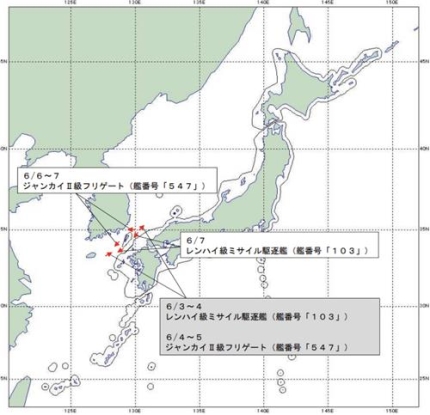
Following the joint patrol by China and Russia, it was also confirmed that Chinese naval vessels passed through the Korea Strait on the 6th and 7th.
According to Japan's equivalent of the Joint Chiefs of Staff, the Integrated Staff Office, the Chinese North Sea Fleet's destroyer Anshan (鞍山, hull number 103) was identified around 5 a.m. Korean time on the 7th, approximately 60 km east of Tsushima Island.
The Anshan is the fourth Renhai-class (Type 055) destroyer, a next-generation destroyer equipped with fixed phased array radars on all four sides.
Additionally, it was confirmed that the North Sea Fleet's Jiangkai-class (Type 054) frigate Linyi (?沂, hull number 547) also passed through the Korea Strait, continuing from the previous day. This vessel is armed with two helicopters, HQ-16 surface-to-air missiles, YJ-83 anti-ship missiles, and Yu-8 anti-submarine rockets.
© The Asia Business Daily(www.asiae.co.kr). All rights reserved.
![Clutching a Stolen Dior Bag, Saying "I Hate Being Poor but Real"... The Grotesque Con of a "Human Knockoff" [Slate]](https://cwcontent.asiae.co.kr/asiaresize/183/2026021902243444107_1771435474.jpg)
















