Goal for Practical Application in the 2050s
South Korea has begun full-scale preparations for the utilization of power generation upon successful development of fusion energy.
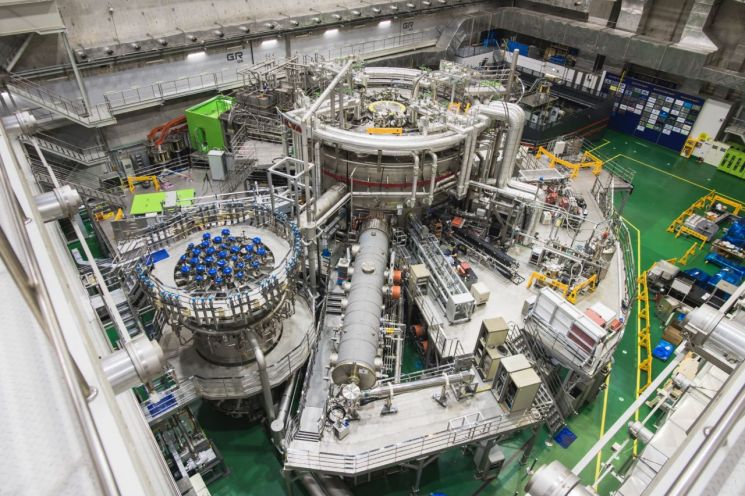
On the afternoon of the 7th, the Ministry of Science and ICT held the 'Demonstration Reactor Design Preparation Team (TF) Kick-off Ceremony' and officially started the design of the ‘Fusion Power Demonstration Reactor.’ Earlier, in February, the Ministry convened the National Fusion Committee and decided to simultaneously promote the development of core fusion demonstration technologies and the design of the demonstration reactor according to the 4th Basic Plan for Fusion Energy Development Promotion (2022?2026).
The main objectives are to prove the technical feasibility, economic viability, and social acceptance of power generation using fusion energy as the next-generation base power source. The plan is to build a demonstration reactor with a maximum electric output of over 500MW and a tritium self-sufficiency ratio of 1 or higher, to verify the inherent safety of fusion and to acquire data for economic evaluation. Specifically, a tokamak-type reactor with a major radius within 7m will be constructed, designed to achieve an operational availability of over 60%, a design life of more than 40 years, and safety standards capable of withstanding earthquakes of magnitude 7.0 or higher.
To this end, a ‘Fusion Power Demonstration Reactor Design Preparation Team (TF)’ consisting of experts from industry, academia, and research institutes has been formed, and phased design work will proceed with the goal of completing the demonstration reactor design by 2035. The process will consist of three stages: completion of the preliminary conceptual design and establishment of the licensing system by 2026; completion of the conceptual design and establishment of design standards by 2030; and completion of the engineering design and licensing promotion by 2035. A separate implementation inspection team will be formed to conduct compliance checks at each design stage and decide whether to proceed to the next phase. The team will now begin full-scale design work and aims to derive the preliminary conceptual design (draft) by 2026, the goal of the first phase.
The design preparation team includes about 20 companies, including those that participated in the Korean Superconducting Tokamak Advanced Research (KSTAR) and the International Thermonuclear Experimental Reactor (ITER) construction, as well as companies interested in participating in the demonstration phase in the future.
Chosunhak, Director of the Large Public Research Policy Division at the Ministry of Science and ICT, stated, “Challenges to accelerate the fusion demonstration timeline are continuing worldwide, including from overseas startups, and the fusion sector is increasingly showing potential for market expansion from an industrial perspective. To strengthen the competitiveness of the domestic industrial ecosystem, this design TF has focused on establishing a system where domestic industry, academia, and research jointly participate.”
Meanwhile, fusion energy is a project to reproduce the hydrogen fusion reaction occurring in the sun on Earth to produce clean and infinitely supplied energy. South Korea, the United States, Europe, and others aim to realize ‘Q (the ratio of output energy to input energy) > 1’ for the first time at ITER, scheduled for completion in the late 2020s, to demonstrate the basic principle and then proceed to full-scale energy production, targeting practical use in the 2050s.
© The Asia Business Daily(www.asiae.co.kr). All rights reserved.
![Clutching a Stolen Dior Bag, Saying "I Hate Being Poor but Real"... The Grotesque Con of a "Human Knockoff" [Slate]](https://cwcontent.asiae.co.kr/asiaresize/183/2026021902243444107_1771435474.jpg)
















