Hydrogen buses will start operating in Seoul city in two years.
On the 7th, SK E&S announced that it signed the 'Hydrogen Mobility Leading City Seoul Business Agreement' with Seoul Metropolitan Government, Ministry of Environment, Hyundai Motor Company, and T Map at Seoul City Hall.
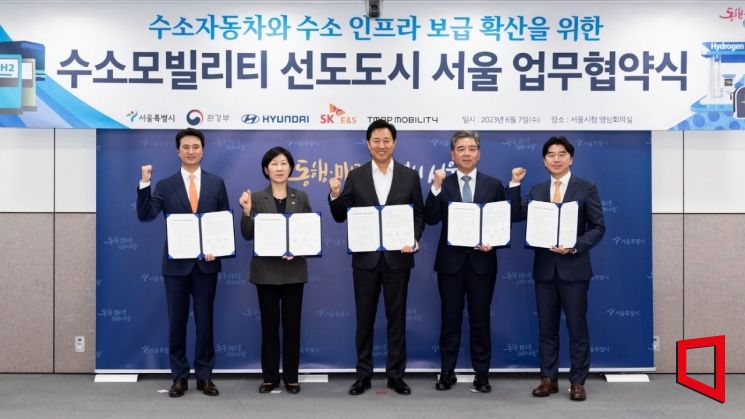 Chu Hyung-wook, CEO of SK E&S (from left), Han Hwa-jin, Minister of Environment, Oh Se-hoon, Mayor of Seoul, Jang Jae-hoon, CEO of Hyundai Motor Company, and Lee Jong-ho, CEO of T map Mobility, are posing for a commemorative photo at the hydrogen mobility leading city Seoul business agreement ceremony held on the 7th at Seoul City Hall in Jung-gu, Seoul.
According to this agreement, buses passing through Seoul city such as airport buses, city buses, and commuter buses will be converted to hydrogen buses, and hydrogen charging stations will also be established. By 2025, 700 hydrogen buses will be introduced to Seoul, increasing to about 1,300 by 2026, and five hydrogen bus charging stations will be installed within Seoul city.
In particular, about 300 buses, accounting for 70% of the buses operating between Gimpo Airport and Incheon Airport, will be converted to hydrogen buses by 2026, and all will be converted by 2030.
Large diesel buses emit 30 times more greenhouse gases and over 43 times more fine dust compared to regular passenger cars, making the transition to eco-friendly vehicles essential. Hydrogen buses have shorter refueling times than electric buses and can travel over approximately 600 km on a single charge, making them especially suitable for fixed long-distance routes such as airport buses.
SK E&S will take charge of producing and supplying liquefied hydrogen, the fuel for hydrogen buses, in a stable manner and timely establishing and operating the refueling infrastructure. Liquefied hydrogen has 12 times the transportation capacity compared to gaseous hydrogen and reduces refueling time by half, making it suitable as fuel for hydrogen commercial vehicles such as buses and trucks. SK E&S plans to produce and supply up to 30,000 tons of liquefied hydrogen annually from the Incheon liquefied hydrogen plant starting at the end of this year.
The Ministry of Environment will provide administrative and financial support for the conversion of public transportation and airport buses to hydrogen buses and the construction of charging stations. Hyundai Motor Company will cooperate in the timely production and supply of hydrogen buses, and T Map Mobility will assist in converting diesel airport buses to hydrogen buses as an airport bus operator.
Chu Hyung-wook, CEO of SK E&S, stated, "The introduction of hydrogen public transportation such as airport buses and city buses in densely populated areas like Seoul and the metropolitan area will be a meaningful first step toward achieving carbon neutrality in the transportation sector." He added, "SK E&S will contribute to opening the era of ‘eco-friendly hydrogen buses’ that citizens can experience by supplying competitive liquefied hydrogen starting at the end of this year."
© The Asia Business Daily(www.asiae.co.kr). All rights reserved.

















