Controversy Over Opposition Morality Spurs Party 'Approval' Moves
4 of 6 Cases Passed in 20th National Assembly
"Abolish Immunity from Arrest" Ruling Party Increases Pressure
The arrest consent motion for independent lawmakers Yoon Kwan-seok and Lee Sung-man, who are under prosecution investigation for the Democratic Party of Korea's 'party convention money envelope suspicion,' will be put to a vote at the National Assembly plenary session on the 12th of this month. The Democratic Party, following the rejection of the arrest consent motions for Representative Lee Jae-myung and Representative Roh Woong-rae, has been deeply troubled ahead of this vote due to moral controversies arising from the money envelope suspicion and Representative Kim Nam-guk's virtual asset speculation scandal. The People Power Party has even brought up a bill to abolish the parliamentary immunity from arrest and is increasing pressure on the Democratic Party.
A total of 70 cases in history... Parliamentary Immunity vs Arrest Consent Motions
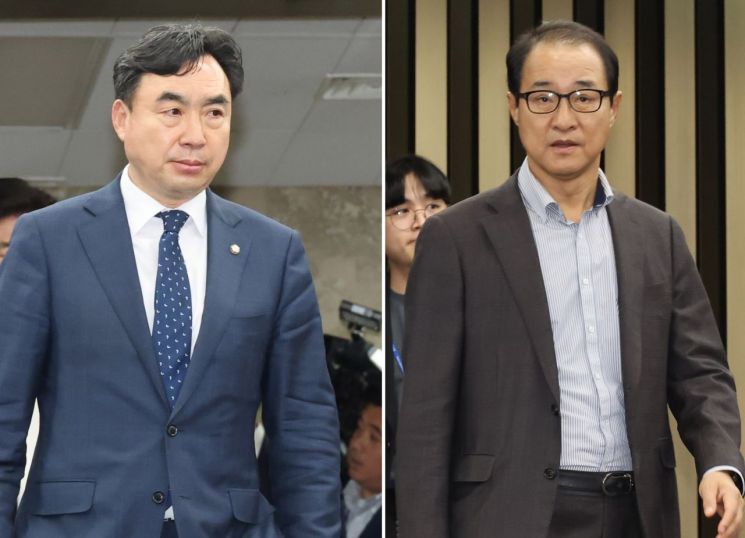
Parliamentary immunity from arrest is a constitutional right held by lawmakers, which prevents them from being arrested or detained without the consent of the National Assembly during a session, except in cases of being caught in the act. If a lawmaker is arrested before the session, they can be released upon the Assembly's request once the session begins. Therefore, investigative agencies must obtain the Assembly's consent to arrest or detain a lawmaker. The Speaker of the National Assembly, upon receiving a request for arrest consent, must report it at the first plenary session and submit it for a vote within 24 hours after the report and within 72 hours or at the next plenary session.
Since the Constituent National Assembly in 1948, there have been a total of 70 arrest consent motions submitted against lawmakers. Excluding the current motions for Representatives Yoon and Lee, 17 motions have been approved and 18 rejected. The remaining 33 were withdrawn or discarded due to term expiration.
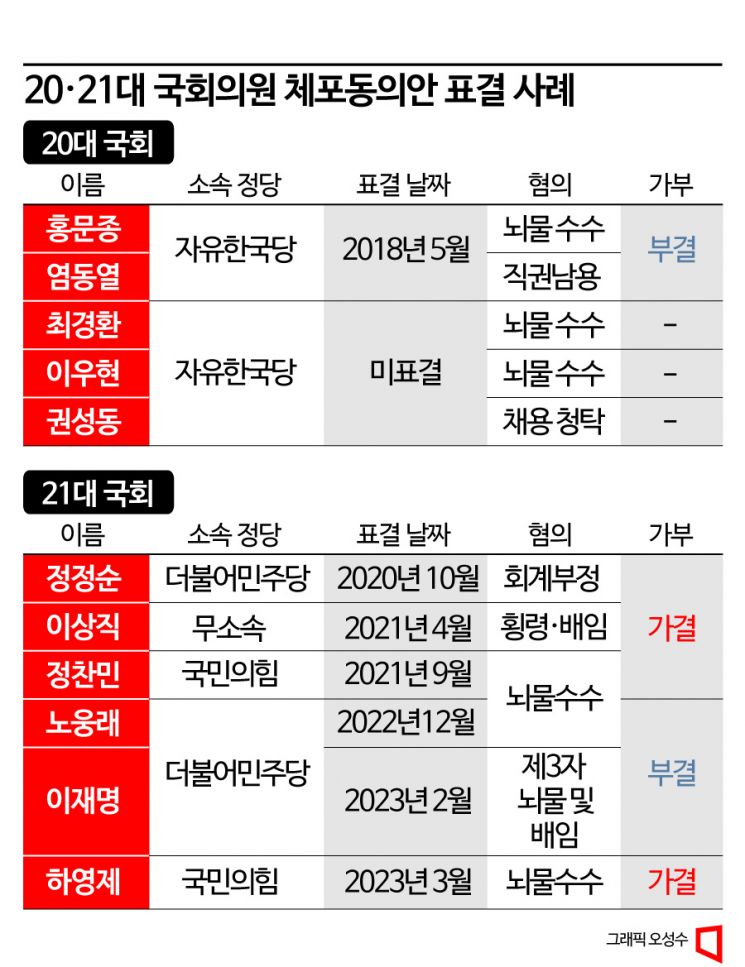
During the 20th National Assembly, a total of five arrest consent motions (Hong Moon-jong, Yeom Dong-ryeol, Choi Kyung-hwan, Lee Woo-hyun, Kwon Seong-dong) were submitted but all were either rejected or discarded. In contrast, in the 21st National Assembly, four out of six votes were approved. The arrest consent motions for Representative Jeong Jeong-soon of the Democratic Party in October 2020, Independent Representative Lee Sang-jik in April 2021, People Power Party Representative Jeong Chan-min in September 2021, and People Power Party Representative Ha Young-je in March this year were approved. The motions for Representative Roh Woong-rae of the Democratic Party in December last year and Democratic Party leader Lee Jae-myung in February this year were rejected.
Ruling and opposition parties approved Ha Young-je, what about Yoon Kwan-seok and Lee Sung-man?
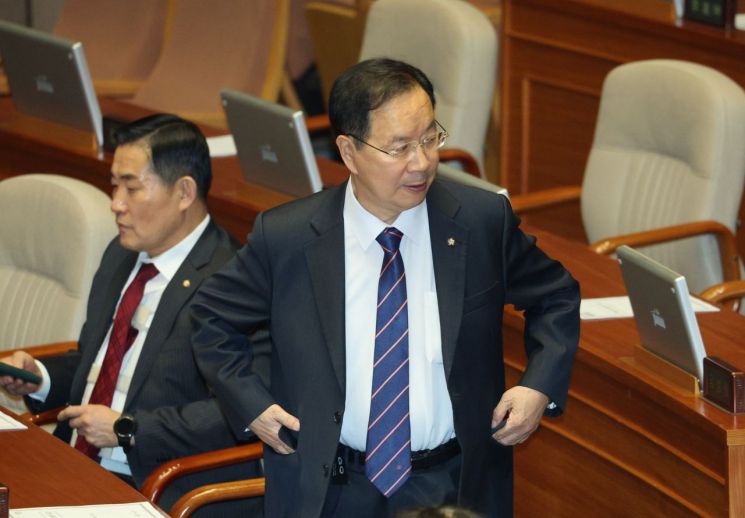
The party leadership plans to leave the decision on the arrest consent motion for Representatives Yoon and Lee to the autonomous judgment of their party members rather than making it a party stance. Unlike previous votes where the dominant voice within the party was that the prosecution was oppressing the opposition, there is now a sense that the motion should be approved. This is due to the worsening internal situation caused by successive moral suspicions. A senior lawmaker said, "Many party members have personal relationships with the two lawmakers, but apart from that, the atmosphere seems to be leaning towards approval of the arrest consent motion," adding, "The atmosphere is not good as the money envelope suspicion is compounded by the coin investment suspicion."
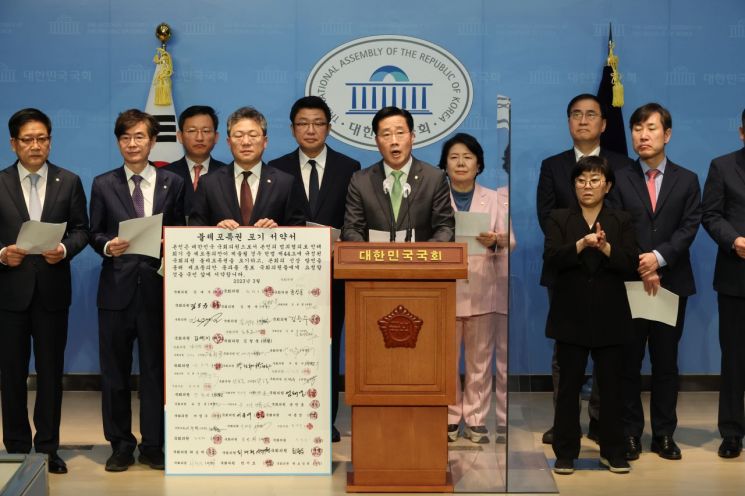
Previously, the People Power Party pressured the Democratic Party by pushing for the approval of the arrest consent motion against Representative Ha. Like Representatives Yoon and Lee, Representative Ha is also accused of violating the Political Funds Act. At that time, the People Power Party set the approval of the arrest consent motion as its party stance and had its members pledge to waive parliamentary immunity, creating an atmosphere favoring approval. Then floor leader Joo Ho-young said, "Considering the allegations revealed by the prosecution regarding bribery related to local election nominations, the reactions of party members do not seem very favorable."
Therefore, the Democratic Party cannot ignore the voting results for Representative Ha in this upcoming vote. The People Power Party criticizes the Democratic Party for consecutively rejecting the arrest consent motions for Representative Roh and leader Lee as a 'bulletproof National Assembly.' Especially since there is a possibility that leader Lee may face another arrest consent motion due to a separate investigation, this is also aimed at weakening the protective shield around him. The ruling party said, "The past Lee Jae-myung promised many times to waive parliamentary immunity, but the current Lee Jae-myung hid behind parliamentary immunity by rejecting the arrest consent motion last month," intensifying pressure on the leader.
Ruling party targets Lee Jae-myung, calls to abolish parliamentary immunity
The ruling party's offensive has expanded into a debate over the 'abolition of parliamentary immunity.' However, abolishing parliamentary immunity for lawmakers requires a constitutional amendment. Article 44 of the Constitution states, "Except in cases of being caught in the act, a lawmaker shall not be arrested or detained during a session without the consent of the National Assembly."
Therefore, ahead of the vote on the arrest consent motions for Representatives Yoon and Lee, the People Power Party is advocating for lawmakers to voluntarily waive their parliamentary immunity. Among the 113 People Power Party lawmakers, 58 have pledged to waive parliamentary immunity. The party also plans to amend the National Assembly Act within this year to effectively waive parliamentary immunity from the 22nd National Assembly onward. The Justice Party also maintains the position that lawmakers should voluntarily waive parliamentary immunity. Currently, there are four proposed amendments to the National Assembly Act related to arrest consent motions in the 21st National Assembly, which include provisions for roll-call votes or approval immediately after reporting to the plenary session.
Leader Lee also included the abolition of parliamentary immunity as one of his top 10 pledges during the last presidential election. In May last year, during a campaign speech in Chungbuk, he stated, "I fully agree with limiting parliamentary immunity." Nevertheless, the current Democratic Party leadership maintains the stance that the successive prosecution warrant requests are 'prosecution oppression.'
© The Asia Business Daily(www.asiae.co.kr). All rights reserved.
![Clutching a Stolen Dior Bag, Saying "I Hate Being Poor but Real"... The Grotesque Con of a "Human Knockoff" [Slate]](https://cwcontent.asiae.co.kr/asiaresize/183/2026021902243444107_1771435474.jpg)


















