Lump-Sum Repayment Ratio Soars from 17.5% in 2010
Vacancy Rates Rise Due to Remote Work and Economic Slowdown... Prices Fall
1,948 Trillion Won Maturing Within 3 Years... Delinquency Rate Increases
Concerns Over US Financial Crisis Trigger
Most borrowers of U.S. commercial real estate loans have taken out loans that require only interest payments without repaying the principal. Among these loans, the amount maturing within the next three years reaches $1.5 trillion (approximately 1,948 trillion won), raising concerns that borrowers may fail to extend their loans. In such a case, a large-scale default could occur, potentially becoming a 'trigger' for a crisis in the U.S. financial market.
87.9% of U.S. Commercial Real Estate Loans Require Interest-Only Payments
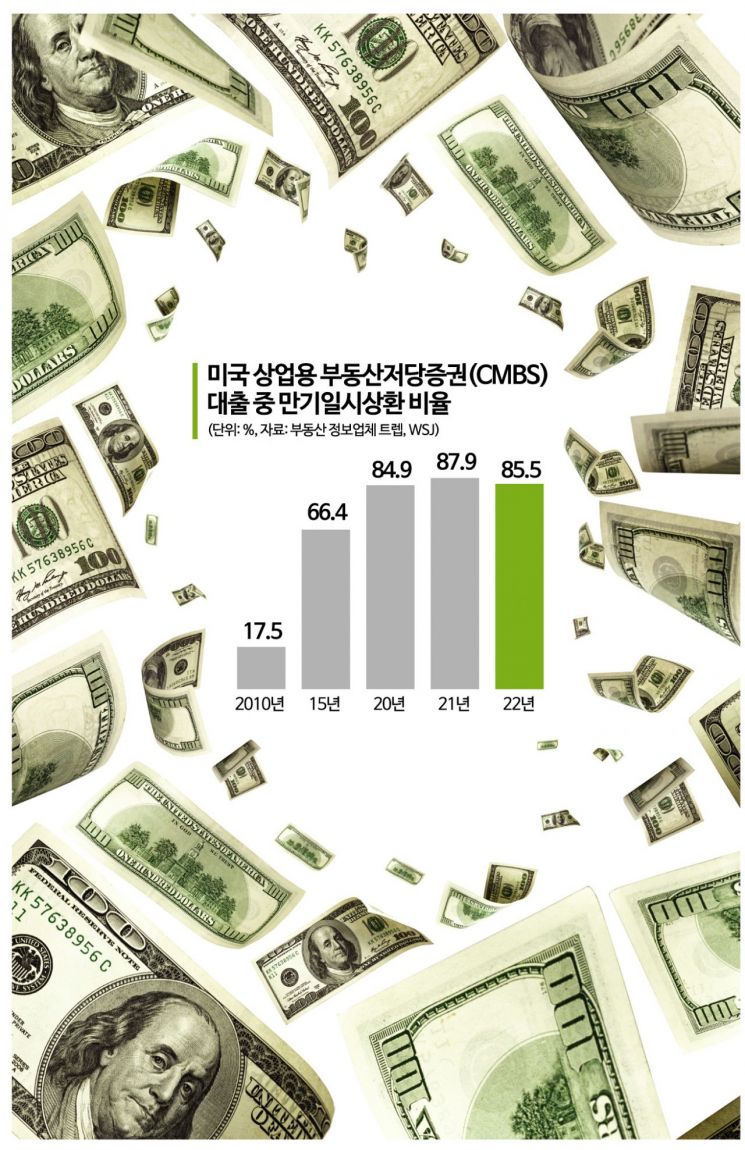
On the 6th (local time), The Wall Street Journal (WSJ), citing real estate data firm Trepp, reported that the proportion of balloon payment loans?loans repaid in full at maturity?underlying U.S. Commercial Mortgage-Backed Securities (CMBS) rose from 17.5% in 2010 and 51.1% in 2013 to 87.9% as of 2021.
The balloon payment method differs from typical mortgage loans, which repay principal and interest monthly; instead, borrowers pay only interest regularly and repay the principal in a lump sum at maturity. As low interest rates persisted, demand grew for borrowing from banks to invest and gain capital gains, leading to the spread of this loan type. While this contributed to pushing up U.S. commercial real estate prices, the current market cooling has turned it into a boomerang. Until now, borrowers have managed by paying interest only, but they now face the burden of repaying the entire principal at maturity, which is much heavier than amortized repayment. Moreover, market tightening has made loan extensions difficult.
The problem is that the U.S. commercial real estate market has turned red due to the spread of remote work caused by the COVID-19 pandemic and the effects of aggressive tightening since last year. The Federal Reserve's rate hikes have sharply increased funding costs, with some commercial real estate interest rates doubling. However, office vacancy rates have soared, and retail leasing demand has declined due to economic slowdown, causing commercial real estate prices to fall. Recently, U.S. real estate investment manager Post Brothers purchased an office building in Washington for $67 million, which is 27.6% lower than the fall 2019 market price of $92.5 million.
Trepp estimates that the volume of commercial real estate loans maturing within the next three years will reach $1.5 trillion. Generally, borrowers repay loans by extending them or selling the buildings when maturity arrives. However, if loan extensions are not possible due to declining collateral values, a massive amount of loans could become non-performing.
Banks Reluctant to Extend Loans... Could This Become a Financial Sector Trigger?
Following the bankruptcy of Silicon Valley Bank (SVB), banks have already begun reducing loans to manage risks. Commercial real estate loans, which are in a recession phase, are a major focus of caution. International credit rating agency Fitch predicts that 35% of CMBS loans maturing between April and December this year will be difficult to extend or refinance considering current interest rates, real estate rental income, and property prices. Among offices, shopping malls, and hotels, offices are the most severe. According to U.S. real estate data firm CoStar, if current interest rates persist, 83% of office loans underlying CMBS are expected to face difficulties in refinancing at maturity.
Commercial real estate loan defaults are already materializing. According to Trepp, the CMBS loan delinquency rate reached 4.02% in May this year. This is a 1.25 percentage point increase from 2.77% in April, marking the highest level since 2018. Consequently, major U.S. banks have begun 'cutting losses' on non-performing commercial real estate loans. British bank HSBC's U.S. branch recently decided to stop lending on commercial real estate, according to foreign media citing sources. Los Angeles (LA)-based regional bank PacWest Bancorp sold $2.6 billion in real estate loan assets at a loss last month, and Philadelphia regional bank Bancorp reduced its commercial real estate loan portfolio by nearly $25 million in the first quarter of this year.
WSJ reported, "When interest rates were low and real estate values kept rising, owners expected to repay existing loans by taking out new loans at maturity. At that time, the risk was low. But now, many owners find it difficult to borrow enough to repay existing loans."
There are also predictions that the commercial real estate downturn will be prolonged. A survey by British real estate consulting firm Knight Frank, targeting 350 companies employing over 10 million people worldwide, found that most companies plan to reduce office space by 10-20% within the next three years. Half of the companies even plan to relocate their headquarters within the next three years to reduce office space. Elliott Lee, a commercial real estate expert at Knight Frank, said, "Considering lease expirations and other factors, changes in the commercial real estate market will continue over a longer term of 3 to 6 years, not just 3 to 6 months."
Martin Gruenberg, chairman of the U.S. Federal Deposit Insurance Corporation (FDIC), also pointed out, "Commercial real estate is expected to face difficulties as demand weakens," adding, "This is an issue that authorities will need to continuously supervise going forward."
© The Asia Business Daily(www.asiae.co.kr). All rights reserved.
![Clutching a Stolen Dior Bag, Saying "I Hate Being Poor but Real"... The Grotesque Con of a "Human Knockoff" [Slate]](https://cwcontent.asiae.co.kr/asiaresize/183/2026021902243444107_1771435474.jpg)
















