US Takes Cautious Stance "Difficult to Conclude"
Analysis of Sinking Operation as Time-Buying Tactic Amid Ukraine Offensive
Amid the ongoing dispute between Ukraine and Russia accusing each other of war crimes over the destruction of the Kakhovka Dam in southern Kherson Oblast, Ukraine, German Chancellor Olaf Scholz has drawn attention by stating that the incident should be attributed to Russia. Western intelligence agencies and military experts are also reportedly leaning towards the view that Russia deliberately carried out the flooding operation to buy time to halt Ukraine's relentless offensive.
According to German local media ZDF on the 6th (local time), Chancellor Scholz, in a speech at the WDR Europa Forum held in Berlin that day, criticized Russia, saying, "The destruction of the dam in Ukraine aligns with the numerous war crimes committed by Russian soldiers in Ukraine," and added, "It is a new level of atrocity, but consistent with how Putin is conducting this war."
He emphasized, "Considering all circumstances, this attack should naturally be seen as an assault carried out by Russia to prevent Ukraine's offensive aimed at reclaiming its territory," and added, "There have been concerns for some time that this dam would be targeted." This marked a clear stance attributing the dam's destruction to Russia, amid mutual claims by Ukraine and Russia blaming each other for the explosion.
The U.S. government has maintained a cautious position. On the same day, John Kirby, White House National Security Council (NSC) Coordinator for Strategic Communications, stated at a briefing, "The United States is doing its best to assess who is responsible for the Russian dam explosion," and "We are cooperating with Ukraine to gather more information, but it is difficult to make definitive statements at this time." He further explained, "At the time of the explosion, the dam was illegally occupied and controlled by Russian forces," and "We have not determined whether the explosion was intentional."
However, Western intelligence agencies are reportedly leaning towards attributing the act to Russia. The Wall Street Journal (WSJ), citing Western officials, reported, "The balance of evidence points to Russian responsibility," and "Russia deliberately flooded villages along the Dnipro River to hinder Ukrainian troop movements and buy time to stop Ukraine's offensive."
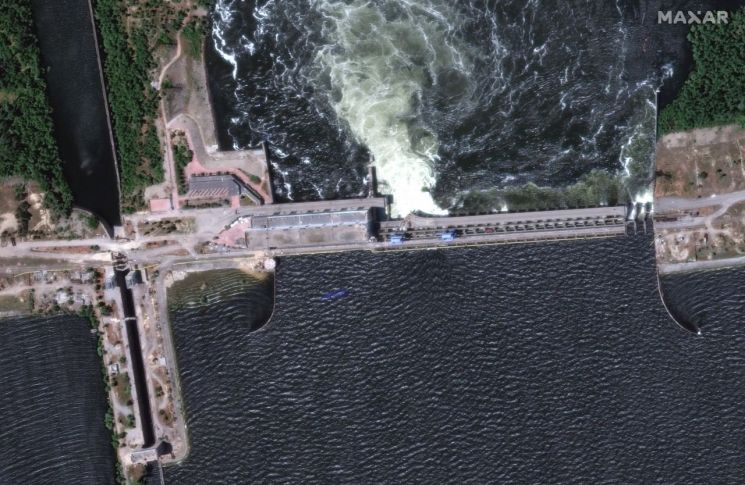
Meanwhile, earlier that day, part of the Kakhovka Dam on the Dnipro River in the Russian-occupied southern Kherson region of Ukraine was destroyed. The Kherson regional government of Ukraine issued an evacuation order to nearby residents, warning that "water levels could rise to dangerous levels within five hours." Russian state news agency RIA Novosti also reported that 22,000 residents in 14 villages in the Kherson area were at risk of flooding due to the Kakhovka Dam explosion.
Built in 1956, the Nova Kakhovka Dam is part of the Kakhovka Hydroelectric Power Plant facilities and is connected to a reservoir with a capacity of 18 cubic kilometers. It supplies water to the Zaporizhzhia Nuclear Power Plant and the Russian-occupied Crimean Peninsula. WSJ reported that the Zaporizhzhia Nuclear Power Plant has secured an alternative water source, so no immediate problems are expected.
As both Ukraine and Russia shift responsibility onto each other, a debate over accountability between the two countries is expected to arise at the United Nations Security Council.
© The Asia Business Daily(www.asiae.co.kr). All rights reserved.

















