The Kakhovka Dam on the Dnipro River in Kherson Oblast, southern Ukraine, currently occupied by Russia, was destroyed, according to major foreign media including the Associated Press on the 6th (local time). Russia and Ukraine each accuse the other of being behind the dam's destruction.
According to major foreign media, the Ukrainian Ministry of Internal Affairs announced via Telegram on the same day that "the Kakhovka Dam has been blown up," and issued an evacuation alert for residents of 10 villages on the right bank and some areas downstream in Kherson city.
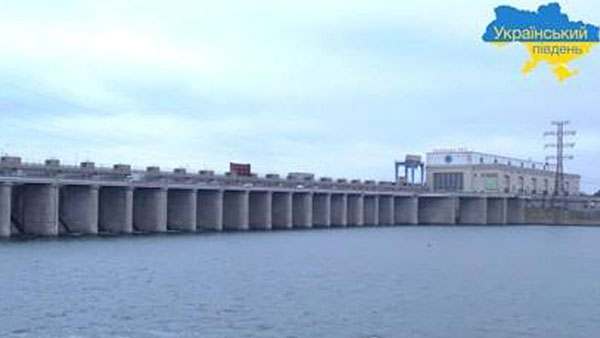
On social media (SNS) that day, videos showing the river flowing rapidly after the Kakhovka Dam explosion, along with surveillance camera footage presumed to capture flashes, explosions, and damage to the dam, were circulated.
The Southern Ukraine Military Command claimed on Facebook that "the scale of destruction, flow velocity and volume, and flood risk areas are clear," asserting that the Russian military destroyed the dam.
Immediately after news of the dam's destruction broke, Ukrainian President Volodymyr Zelensky convened an emergency meeting of the National Security and Defense Council. In a message posted on Telegram, President Zelensky labeled Russia as "terrorists," stating, "The destruction of the Kakhovka Hydroelectric Power Plant dam only confirms that they (the Russian military) must be expelled from every corner of Ukrainian land," emphasizing, "Not a single meter should be left to them. They would use even that much land for terrorism."
Andriy Yermak, head of the Ukrainian Presidential Office, condemned Russia's destruction of the Kakhovka Dam as "ecocide," accusing Russia's actions of threatening the safety of the nearby Zaporizhzhia Nuclear Power Plant.
On the other hand, Russian state media reported that the dam, controlled by Russian forces, was destroyed by shelling in a "terrorist attack." Major foreign media explained that Russia used the term "terrorist attack" to accuse Ukraine of being behind the dam's destruction.
Russia's Sputnik News quoted Vladimir Leontyev, mayor of Nova Kakhovka, reporting that the upper part of the dam was destroyed by shelling, but the reservoir itself did not collapse.
Russia's state-run RIA News Agency cited local Russian officials reporting that the explosion of the Kakhovka Dam put 22,000 residents in 14 villages in the Kherson region at risk of flooding. Ukrainian authorities stated that 16,000 people are in the "danger zone."
The Kakhovka Dam, built in 1956 during the Soviet era, is a facility 30 meters high and 3.2 kilometers long that supplies water to southern Ukraine through the North Crimean Canal and the Dnipro-Kryvyi Rih Canal. Approximately 110 kilometers north of the Kakhovka Dam on the upper Dnipro River is the Zaporizhzhia Nuclear Power Plant, the largest nuclear power plant in Europe. The Kakhovka Dam also supplies water to the Crimean Peninsula, annexed by Russia in 2014, and the Zaporizhzhia Nuclear Power Plant, currently under Russian control.
According to TASS and Sputnik News, the International Atomic Energy Agency (IAEA) stated, "We are aware of reports of damage to the Kakhovka Hydroelectric Power Plant," adding, "There is currently no immediate radiation risk."
Earlier, Ukrainian authorities warned that if the dam collapses, 18 million cubic meters of water could overflow, causing damage to more than ten areas including Kherson and affecting hundreds of thousands of people. Until now, Ukraine and Russia have each accused the other of attempting to attack the dam.
© The Asia Business Daily(www.asiae.co.kr). All rights reserved.

















