Internationally Endangered Shark Species, Illegal Export Rampant
Rooted in Asia's Culinary Culture Favoring Shark Fin
In Peru, South America, it has been revealed that fins of endangered sharks have been exported to Asian markets for several years.
On the 5th (local time), according to Mongabay Latam, a media outlet covering environmental issues in Latin America, and the environmental NGO Oceana, from April 2017 to October 2021, 153 tons of fins from endangered sharks were exported from Peru to China, Singapore, Vietnam, and other countries.
Oceana reported that there were nine companies involved in the exports, which generally appeared to have obtained legitimate export permits, but in reality, the related verifications were inadequate and poorly conducted.

The environmental group claimed, "We confirmed cases of so-called 'roulette documents,' where previously legally obtained permits were reused, or documents were prepared as if exports were possible even though the commercial requirements were not met."
According to the Convention on International Trade in Endangered Species of Wild Fauna and Flora (CITES), international regulations vary depending on which appendix an endangered species belongs to. The total number of species listed under CITES amounts to 38,692.
Species listed in Appendix I are generally prohibited from international trade except for scientific research purposes. Species in Appendix II require prior authorization from the parties involved for international trade. Species in Appendix III are those for which a party has requested regulation of international trade to prevent excessive exploitation within its jurisdiction.
For sharks listed in Appendix II, import and export require environmental authority approval and must be decided based on strict criteria such as whether the catch was bycatch (caught unintentionally along with other species).
Mongabay Latam stated, "At least 10 public officials are behind the issuance of permits that should never have been delivered to the companies," and added, "So far, related investigations have not been properly conducted."
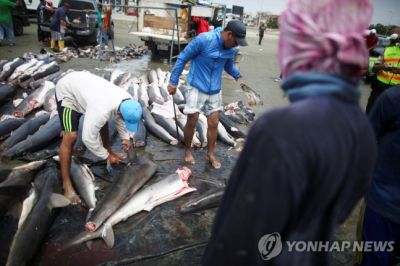
Oceana added that this is due to the culinary culture in Asian countries that regard 'shark fin' dishes as a delicacy.
Globally, about 100 million sharks are caught annually to obtain shark fin materials. As a result, shark populations are estimated to have declined by about 71% compared to 50 years ago. In some countries, sharks are often finned and then discarded back into the sea, causing extreme suffering. Moreover, since sharks cannot breathe unless they swim, if their fins are cut off, they eventually suffocate and die.
Peru is known as the world's largest exporter of shark fins. According to additional data from Oceana, Peru exported about 400 tons of shark fins in 2021, with a slight decrease to about 340 tons last year.
Earlier last year, Mongabay Latam reported that "Peru imports shark fins from neighboring Ecuador through suspicious routes and then re-exports them to Asia in significant quantities."
Meanwhile, South Korea is known as the eighth largest importer of shark fins and meat worldwide.
© The Asia Business Daily(www.asiae.co.kr). All rights reserved.
![Clutching a Stolen Dior Bag, Saying "I Hate Being Poor but Real"... The Grotesque Con of a "Human Knockoff" [Slate]](https://cwcontent.asiae.co.kr/asiaresize/183/2026021902243444107_1771435474.jpg)

















